NCHP Exam 1 Medication Administration with complete solutions
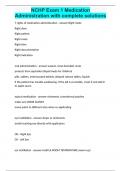
7 rights of medication administration - answer-Right meds Right dose Right patient Right route Right time Right documentation Right Indication oral administration - answer-easiest, most desirable route protects from aspiration (liquid meds for children) pills, tablets, enterocoated tablets, delayed release tables, liquids If the patient has trouble swallowing, if the pill is crushable, crush it and add it to apple sauce topical medication - answer-ointments, transdermal patches make sure WEAR GLOVES move patch to different sites when re-applicating eye instillation - answer-drops or ointments avoid touching eye directly with applicators OD - Right Eye OS - Left Eye ear instillation - answer-instill at ROOM TEMPERATURE (warm-up) never occlude ear canal comes in drop form AD - Right Ear AS - Left Ear rectal instillation - answer-thinner and bullet-shaped have patient lay in SIMS position wear gloves, lubricate finger & suppository insert 10 cm deep Enma might be required before inserting Medication by Inhalation - answer-pressurized meter-dose inhalers (PMDIS) - need hand strength and coordination - may be used with a spacer - have patient hold in for 10 seconds dry powder inhalers (DPIs) Breath-actuated meter-dose inhalers (BAIs) Medication by irrigation - answer-common is sterile water, saline, antiseptic solutions - on the ear, eye, throat, vagina or urinary tract if there is a break in skin or mucosa parenteral medication - answer-syringes: - Luer-Lok - Non-Luer-Lok - Disposable injection units storage units: - ampules - vials Insulin Syringes: - always dosed in units (U-100 syringe) - rapid, short, intermediate & long-term acting mixing insulins - answer-do not mix insulin with any other meds or diluents NEVER MIX INSULIN GLARGINE OR INSULIN DETEMIR with other types of insulin inject rapid-acting insulin mixed with NPH insulin within 15 min before a meal administering injections - answer-subcutaneous intramuscular intradermal subcutaneous injections - answer-angle needle at 45 or 90 degree angle goes into subcutaneous layer of skin very small doses, DO NOT EXCEED 0.5 mL (usually insulin, heparin) any condition that impairs blood flow is contraindication for subQ injections sites include outer posterior aspects of the upper arms, abdomen (below costal margins) and the anterior aspects of the thigh 3/8-5/8 inch sized needle insulin syringes used with pre-attached 31-25 gauge needles (can also use injection pens intramuscular injections (IM) - answer-faster absorption than subQ route 90 degree angle for administration for adults, usually 2-5 mL children, older adults, thin patients = up to 2 mL small children and older infants = up to 1 mL small infants = 0.5 mL Z-track method to minimize local skin irritation by sealing the medication in the muscle tissue use longer needles = 1-1.5 inches sites for application: ventrogluteal site vastus lateralis deltoid intradermal injections - answer-used for skin testing - TB test (PPD/Mantoux) & Allergies meds absorb slowly angle 15 degrees into dermis with TUBERCULIN NEEDLE small blob will form intravenous injections (IV) - answer-3 methods - Infusion of large volumes - infusion of bolus or small volumes - "piggyback" infusion (volume controlled Lg Volume infusions: - answer-- safest and easiest method of IV admin - 500-1000 mL fluids - if infused too rapidly, patient at risk for overdose and fluid overload Bolus/Small volume IV: - answer-- introduces concentrated dose of meds directly into SYSTEMIC CIRCULATION - adventangeous when patient is fluid restricted - most dangerous method for administration (NO ROOM FOR ERROR) - determine rate of administration by the amount of medication that can be give EACH MINUTE Volume controlled infusions - answer-3 types - volume control administration sets (150mL) - piggyback sets - syringe pumps (5-60mL) use small amounts (50-100mL) of compatible fluids advantages: - reduces the risk of rapid-dose infusion by IV push - allows for administration of meds that are stable for limited time in solution - allows control of IV fluid intake piggyback - answer-small 25-250mL IV bag or bottle connected to a short tubing line that connects to the upper Y-port of a primary infusion line or to an intermittent venous access healthcare records contains - answer-- patient identification and demographic data - existence of "living will" or "durable power of attorney for health care" documents - informed consents for treatment and procedures - admission data - nursing diagnoses or problems and the nursing or interprofessional care plan - record of nursing care treatment and evaluation - medical history - medical diagnoses - therapeutic orders, including code status (e.g., provider order for "do not resuscitate") - medical and interprofessional progress notes (including treatments administered) - physical assessment findings - diagnostic study results - patient education - summary of operative procedures - discharge of summary and plan mistakes in documentation - malpractice - answer-1. failing to record pertinent health or drug info 2. failing to record nursing actions 3. failing to record medication administration 4. failing to record drug reactions or changes in patient condition 5. incomplete or illegible records 6. failing to document discontinued medications quality nursing documentation - answer-factual accurate current organized complete PIE - answer-P: nursing problem or diagnosis I: interventions used to address problem E: nursing evaluation focus charting (DAR) - answer-D: data A: action or nursing intervention R: response of the patient SOAP note - answer-S: subjective O: objective A: assessment P: plan originates from medical recordsdfds charting by exception (CBE) - answer-all standards for normal assessment findings or for routine care activities are met unless otherwise documented "normal" body system findings - "WITHIN DEFINED LIMITS" (WDL) - "WITHIN NORMAL LIMITS" (WNL) documentation for deviations use of a shorthand method documentation of significant findings Acuity level - answer-determines hours at care and number of staff required for a give group of patients every shift or 24 hours 1-5 1 (independent, almost ready for discharge) 5 (totally dependent in all aspects of care, requiring intensive care) biotransformation - answer-occurs under the influences of enzymes that DETOXIFY, break down and remove biologically active chemicals occurs in liver therapeutic effect of medicine - answer-expected or predicted physiological response caused by a medication adverse effects of edication - answer-undesired, unintended and often unpredictable responses to medication MOST EFFECTED: very young, older adults, pregnant, patients taking multiple meds, renal or liver disease, severely overweight/underweight Idiosyncratic Reaction - answer-patient overreacts or underreacts to medication or has a reaction different than normal ex: Benadryl/Diphenhydramine - causing agitation instead of drowsiness urticaria (hives) - answer-raised, irregularly shaped skin eruptions with varying sizes and shapes; eruptions have reddened margins and pale centers rash - answer-small, raised vesicles that are usually reddened; often distributed over entire body pruritus - answer-itching of skin, accompanies most rashes rhinitis - answer-inflammation of mucous membranes lining nose; causes swelling and clear, watery discharge biological half-life - answer-time it takes for excretion process of meds to lower the serum med concentration by half to maintain therapeutic range patient needs to receive regular, fixed doses onset of medication action - answer-period of time it takes after you administer a medication for it to produce a therapeutic effect peak action - answer-time it takes for medication to reach its highest effective peak concentration trough - answer-minimum blood serum concentration of medication reached just before the next scheduled dose duration of action - answer-length of time during which a medication is present in a concentration great enough to produce a therapeutic effect plateau - answer-blood serum concentration reached and maintained after repeated, fixed doses parenteral administration - answer-intradermal (ID) subcutaneous intramuscular (IM) Intravenous (IV) Epidural - epidural space via catheter Intrathecal - in the brain (subarachnoid space) Intraosseous - directly into bone marrow Intraperitoneal - into peritoneal cavity intrapleural - into pleural space intraarterial - into arteries (patients with clots) standing order - answer-carried out until health care provider cancels it by another order or a prescribed number of days elapse ex: tetracycline 500mg PO q6h prn orders - answer-health care provider orders a med only when a ptient requires it (subjective and objective assessment (ex: pain) ex: morphine sulfate 2 mg IV q2h prn for incisional pain single (one-time) orders - answer-ex: ativan 1mg IV on call to MRI STAT orders - answer-single dose med to be given immediately and only once ex: apresoline 10mg STAT now orders - answer-more specific than a one-time order and is used when a patient needs a med quickly but not right away like STAT ex: Vancomycin 1 g IV piggyback NOW prescription - answer-health care provider writes these for patients to take outside the hospital medication errors - answer-any preventable event that may cause inappropriate med use or jeoprodize patient safety - inaccurate prescribing - administering via wrong route/time interval - administering wrong meds - administering extra doses - failing to administer meds care bundle - answer-a group of interventions related to a disease process or condition improve quality of care while preventing the most common complications associated with their conditions or diagnoses standing orders - answer-PREPRINTED DOCUMENTS that contains orders for various clinical problems provide LEGAL PROTECTION to nurses while they care for patient SIGNED BY THE LICENSED PRESCRIBING HEALTH CARE PROVIDER in charge of care at the time of implementation preparatory activities for implementation - answer-1. reassessing the patient 2. reviewing and revising the existing nursing care plan 3. organizing resources and care delivery 4. anticipating and preventing complications 5. implementing nursing intervention 3 categories of nursing intervention - answer-1. interdependent (other provider-initiated) - we are in this together 2. nurse initiated - we start it 3. health care provider-initiated - they start it - required the combined knowledge skills, and expertise of multiple health care professionals nursing intervention classification (NIC) - answer-DOMAINS: highest level of the model use broad terms to organize the more specific classes and intervention CLASSES: useful clinical categories the nurse can refer to while selecting interventions (30 classes) INTERVENTIONS: any treatment based on clinical judgment and knowledge that the nurse performs for achieving the patient outcomes PES - answer-Problem Etiology Symptoms NANDA-I diagnoses - answer-- BROAD LITERATURE BASED - REFINED BY PROFESSIONAL NURSES - classifications are considered one of the MOST COMPREHENSIVE of all nursing classification - emphasize providing ACCURATE AND PRECISE DOCUMENTATION OF HEALTH PROBLEMS to reduce errors in diagnostic statement - answer-identify a TREATABLE ETIOLOGY OR RISK FACTOR rather than a clinical sign that cannot be treated by a nursing intervention identification of the PROBLEM CAUSED BY A TREATMENT helps direct the nursing care in alleviating it identifying the PATIENT'S RESPONSE TO THE EQUIPMENTrather than the equipment NANDA-I related factors - answer-situational, maturational, treatment-related, pathophysiology NANDA-I Diagnosis - answer-risk diagnosis, problem-focused diagnosis, health promotion diagnoses related factor - answer-always within the DOMAIN OF NURSING PRACTICE in case of risk nursing diagnosis, A RISK FACTOR IS A RELATED FACTOR usually IDENTIFIED FROM THE ASSESSMENT DATA obtained from the patient problem oriented approach - answer-1. focus should be on the patient's present situation 2. ask follow-up questions to expand the understanding of patient's condition 3. physical assessment to support observations 4. analyzes the nature of the patient's problem 5. develops care plan Gordon's 11 functional health patterns - answer-1. health perception-health management pattern 2. nutritional-metabolic pattern 3. elimination pattern 4. activity-exercise pattern 5. sleep-rest pattern 6. cognitive-perceptual pattern 7. self-perception-self-concept pattern 8. role-relationship pattern 9. sexuality-reproductive pattern 10. coping-stress tolerance pattern 11. value-belief pattern precipitating factors - answer-ones that worsens the primary symptom timed "get up and go" (TGUG) - answer-1. have patient walk 10 ft as quickly as possible and turn around to sit back on chair. instruct patient to rise from a straight-backed chair without using arm support. begin counting - check for unsteadiness in person's gait. ask patient to sit on chair without using arms for support - check elasped time Nursing clinical information system (NCIS) - answer-helps organization comply with the requirements of accrediting agencies Nursing Documentation System - answer-helps in facilitating continuity of care clinical decision support system - answer-computerized programs used within the health care setting to support decision making bar-cod medication administration system - answer-document the administration of the dosage form to the patients computerized provider order entry system - answer-providing build-in reminders and alerts for medications and diagnostic tests flow sheet - answer-when REPEATED OBSERVATIONS are to be recorded in a quick and accurate manner quality of health care documentation - answer-the Joint commission National committee for quality assurance american nurses association - answer-SETS STANDARDS for providing safe, effetive, patient-centered, timely, and efficient care diagnosis-related group - answer-establish reimbursement for patient care Deep intramuscular injection - answer-1. position the patient in supine or lateral position 2. place the palm of your hand over the greater trochanter of patient's hip while keeping your wrist perpendicular to the femur 3. position the thumb toward the patient's groin and the index finder toward the anterior superior iliac spine 4. your middle finger should be extended back along the iliac crest toward the buttock 5. V-shaped triangle is formed with the index finger, middle finger, and the iliac crest enoxaparin angle - answer-45 defgrees liniment - answer-a semisolid preparation containing alcohol, oil, or soapy emollient that is applied to skin elixir - answer-clear fluid containing water and/or alcohol - oral nasogastric tube - answer-dissolve the different medications separately flush the tube before and after administration of the med contact the health care provider if the patient resists the administration
Written for
- Institution
- NCHP
- Course
- NCHP
Document information
- Uploaded on
- May 21, 2024
- Number of pages
- 18
- Written in
- 2023/2024
- Type
- Exam (elaborations)
- Contains
- Questions & answers
Subjects
-
nchp exam 1 medication administration

Also available in package deal