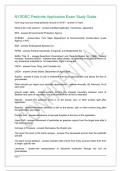
NYSDEC Pesticide Applicators Exam Study Guide
How long must you keep pesticide records in NYS? - answer-3 Years What is the 3 tier system? - answer-Certified Applicator, Technician, Apprentice EPA - answer-Environmental Protection Agency NYSDEC - answer-New York State Department of Environmental Conservation (Lead Agency in NY) ESA - answer-Endangered Species Act FIFRA - answer-Federal Insecticide, Fungicide, and Rodenticide Act SARA Title III - answer-Superfund Amendment and Reauthorization Act (1986). Federal mandate. Requires MSDS - material data safety sheets. All business must provide these for any hazardous materials for 1st responders. Right to know act FDCA - answer-Food, Drug, and Cosmetic Act USDA - answer-United States Department of Agriculture Aquifer - answer-A body of rock or sediment that stores groundwater and allows the flow of groundwater. When should you report your pesticide applications? - answer-Annually. By February 1st of each year. ground water table - answer-surface forming the irregular boundary between zone of aeration and zone of saturation; the level below which all soil is saturated Deposit - answer-The pesticide which is on the leaves, skin, or other surface right after appli-cation Residue - answer-Whatever pesticide is left on the leaves, skin or other surface long after the application was made Particle Drift - answer-Movement of sprayed droplets at the time of the application Vapor Drift - answer-Movement of pesticides as gaseous vapors from the target area after it has been sprayed Increase in Pressure - answer-Decreases the droplet size The lower the level of the bomb sprayer - answer-The decreased amount that the pesticide will drift non-point source pollution - answer-pollution that comes from many sources rather than from a single, specific site Leaching - answer-the transportation of dissolved molecules through the soil via groundwater Runoff - answer-Part of the water cycle where an excess of water runs down and does not sink into the soil and eventually makes it to the rivers, lakes, and oceans. Evaporation - answer-The change of a substance from a liquid to a gas Accumulative Pesticides - answer-Pesticides that build up in the bodies of animals Non-accumulative pesticides - answer-The pesticides that do not build up in the body of ani-mals or in the food chain Photodegradation - answer-Breakdown of chemicals by the action of sunlight. microbial degradation - answer-Breakdown of a chemical by microorganisms. Chemical degradation - answer-the breakdown of chemicals that do not involve living organ-isms, usually by a chemical reaction with water Back flow prevention device - answer-needed for all water from a center's water treatment systems it stops the water from a water treatment system from flowing back into the feed water air gap - answer-an air space that separates a water supply outlet from a potentially contami-nated source P100 Respirator - answer-Filters out 99.97% of solid particles in the air P99 Respirator - answer-filters at least 99% of airborne particles and is strongly resistant to oil N-Respirator - answer-No oil is present in the air P-Respirator - answer-Oil is present, but follow the manufacturer's time use limitations if you want to re-use these R-Respirator - answer-Oil is present, but only for a single shift or 8 hours of continuous or in-termittent use. Re-use beyond a single shift or 8 hours is not recommended. How long should you flush your eyes if pesticides get in them? - answer-Usually you will be instructed to flush out the eye with warm water. If no label is available, flush the eye with wa-ter for about 15 minutes. Then seek medical help immediately. Gradual/incomplete metamorphosis - answer-Has no distinct larva stages - egg hatches into nymph gradual/complete metamorphosis - answer-egg, nymph, larvae annuals, biennials, perennials - answer-What Are Three Major Life Cycle Of Plants annuals - answer-A flowering plant that completes its entire life cycle in a single year or grow-ing season. Biennials - answer-A flowering plant that completes its life cycle in two years. Perenials - answer-life cycle of flower continues for many years Chitin synthesis inhibitors - answer-Chitin synthesis inhibitors work by preventing the for-mation of chitin, a carbohydrate needed to form the insect's exoskeleton. With these inhibi-tors, an insect grows normally until it molts. The inhibitors prevent the new exoskeleton from forming properly, causing the insect to die. Insect growth regulators - answer-disrupt the molting, maturing from pupal stage to adult, or other life processes of insects. broad-spectrum pesticide - answer-a pesticide that kills many different types of pests narrow-spectrum pesticide - answer-pesticide that kills only the organism for which it was in-tended and not harm any other species Special Local Need (SLN) Registration - answer-FIFRA section 24 (c) authorizes state lead agencies to register additional uses of federally registered pesticides (also called Special Lo-cal Needs ( SLN ) registrations or SLNs). The SLN permits distribution and use only in the registering state. Emergency Exemption Registration - answer-Registration that allows the sale and use of a certain pesticide product for a specific non-registered purpose during a specified period of
Written for
- Institution
- NYSDEC Pesticide Applicator
- Module
- NYSDEC Pesticide Applicator
Document information
- Uploaded on
- May 21, 2024
- Number of pages
- 4
- Written in
- 2023/2024
- Type
- Exam (elaborations)
- Contains
- Questions & answers
Subjects
-
nysdec pesticide applicators exam study guide

Also available in package deal