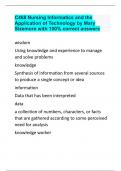
C468 Nursing Informatics and the Application of Technology by Mary Sizemore
wisdom Using knowledge and experience to manage and solve problems knowledge Synthesis of information from several sources to produce a single concept or idea information Data that has been interpreted data a collection of numbers, characters, or facts that are gathered according to some perceived need for analysis knowledge worker Individual with a high degree of expertise, education, or experience who creates, distributes, and applies knowledge information literacy Ability to recognize when information is needed as well as the skills to find, evaluate, and use needed information effectively Information System A computer system that uses hardware and software to process data into information in order to solve a problem informatics innovator Expected to be educationally prepared to conduct informatics research and generate informatics theory and have advanced understanding and skills in information management and computer technology Informatics Specialist A nurse with advanced skills specific to health information management and computer technology with expertise in systems development life cycles Standardized Terminologies Structured, controlled languages developed according to terminology guidelines and approved by an authoritative body data warehouse Provides a powerful method of managing and analyzing data CDSS (Clinical Decision Support System) Supports healthcare practitioners in making patient-care decisions by integrating patient data with current clinical knowledge CPOE (Computerized Provider (or Practitioner) Order Entry) The prescribers' decisions to enter orders and immediately share the orders with appropriate health professionals who execute the orders and the departments that need to dispense, schedule, or immediately deliver services to patients EHR (electronic health record) A database of an individual's healthcare data during healthcare encounters. Is comprised of any patient data stored in electronic form EMR (electronic medical record) Legal record created in hospitals and ambulatory settings of a single encounter or visit that is the source of data for the electronic health record. Brings together diagnostic and treatment information for an individual in a specific healthcare setting. PHR (Personal Health Record) Lifelong tool for managing health information, such as conditions, allergies, medications, past surgeries, and other relevant information Physical Security The protection of physical items, objects, or areas from unauthorized access and misuse. Measures include the placement of computers, file servers, routers, switches, and computers in restricted areas. Other examples include physical locks on devices Logical Security Non-tangible protocols used for identification, authentication, authorization, and accountability. Example includes automatic sign-off after a period of no activity. Health Information Exchange (HIE) Electronic sharing of patient information between healthcare providers according to nationally recognized standards. HITECH Act The Health Information Technology for Economic & Clinical Health Act was enacted as part of the American Recovery and Reinvestment Act of 2009, promotes the adoption and meaningful use of health information technology HIPAA (Health Insurance Portability and Accountability Act) Also known as the Kennedy-Kassebaum Bill, it is the first federal legislation to protect automatic client records and to mandate that all electronic transactions include only HIPAA compliant codes Ergonomics Scientific study of work and space, including details that impact productivity and health Data mining Technique that looks for hidden patterns and relationships in large groups of data using software ICD-10 (International Classification of Diseases-10th Revision) Is the international standard diagnostic classification for health-management purposes, and clinical use. The ICD diagnoses are used to classify mortality and morbidity data from inpatient and outpatient records. Also used for reimbursement. Store-and-Forward Applications Consists of asynchronous connected-health applications that can transmit recorded health information (ex. Photos) through a secure communication network to a provider Telehealth Delivery of information to healthcare providers and consumers and the delivery of services to clients at remote sites through the use of telecommunication and computer technology (CCD) Continuity of Care Record Technical informatics standard that provides a snapshot of a person's current health and healthcare to a provider who does not have access to that person's electronic health record Mission Purpose or reason for an organization's existence, representing the fundamental and unique aspirations that differentiate it from others Vision Future-oriented, high-level view of what an organization would like to become that provides direction for planning purposes Usability Specific issues of human performance in achieving specific goals during computer interactions within a particular context User Interface Allows humans and computers to cooperatively
Written for
- Institution
- C468
- Course
- C468
Document information
- Uploaded on
- May 20, 2024
- Number of pages
- 17
- Written in
- 2023/2024
- Type
- Exam (elaborations)
- Contains
- Questions & answers
Subjects
-
c468 nursing informatics and the application

Document also available in package deal