Weberian theories of inequality
Weber’s views on power
- Weber was concerned with same social issues as Marx but came to different
conclusions as to causes of inequality in society
- Agreed with Marx that inequality was caused by the organisation of the economy
but suggested there was more to inequality than economic relationships
- Criticised Marxist analysis of inequality for being too simplistic
- Weber viewed control of social power as significant in how society is organised and
believed power to consist of the ability to control social resources such as wealth,
knowledge and property
- Social resources are those things that a culture considers desirable and which are
limited in the sense that only some people can have these things
- Weber defined power as the ability to impose one’s will over other regardless of
their views /feelings
- Society organised in a system of hierarchy with some people being more powerful
and others less able to dominate
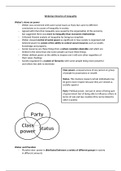
Class power- unequal access of any person or group
of people to possessions or wealth
Status- This involves respect-certain individuals may
be given more respect because they are viewed as
socially superior
Party- Political power, not just in sense of being part
of government but of being able to influence others in
terms of rule and law creation (this can be linked to
other 2 points)
Party
Class
Status
power
Weber and Pluralism
- Pluralist view- power is distributed between a variety of different groups in society
in different amounts
Weber’s views on power
- Weber was concerned with same social issues as Marx but came to different
conclusions as to causes of inequality in society
- Agreed with Marx that inequality was caused by the organisation of the economy
but suggested there was more to inequality than economic relationships
- Criticised Marxist analysis of inequality for being too simplistic
- Weber viewed control of social power as significant in how society is organised and
believed power to consist of the ability to control social resources such as wealth,
knowledge and property
- Social resources are those things that a culture considers desirable and which are
limited in the sense that only some people can have these things
- Weber defined power as the ability to impose one’s will over other regardless of
their views /feelings
- Society organised in a system of hierarchy with some people being more powerful
and others less able to dominate
Class power- unequal access of any person or group
of people to possessions or wealth
Status- This involves respect-certain individuals may
be given more respect because they are viewed as
socially superior
Party- Political power, not just in sense of being part
of government but of being able to influence others in
terms of rule and law creation (this can be linked to
other 2 points)
Party
Class
Status
power
Weber and Pluralism
- Pluralist view- power is distributed between a variety of different groups in society
in different amounts