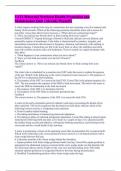
VATI Maternal Newborn Health Promotion and Maintenance Quiz (Already Passed!)
A client reports awaking from sleep by contractions that are occurring every five minutes and lasting 30-40 seconds. Which of the following questions should the nurse ask to assess for true labor versus false labor?correct answers a. "When did your contractions begin?" b. "Have you noticed any bloody show or fluid coming from your vagina?" CorrectCORRECT. Vaginal discharge of blood or fluid may indicate cervical dilation, and potentially rupture of membranes. False labor is characterized by painless, irregular, and intermittent contractions that decrease in frequency, duration, and intensity with walking or position changes. Contractions are felt in the lower back or above the umbilicus and often stop with comfort measures (like oral hydration). There is usually no vaginal discharge with false labor. c. "What happens to your contractions when you move about?" d. "Have you felt fetal movement over the last 24 hours?" Feedback The correct answer is: "Have you noticed any bloody show or fluid coming from your vagina?" The client who is scheduled for a nonstress test (NST) asks the nurse to explain the purpose of the test. Which of the following is the correct response?correct answers a. The purpose of the NST is to determine fetal breathing. b. The purpose of the NST is to assess the fetal CNS. CorrectThis is the primary purpose of a NST. The test monitors the response of the FHR to fetal movement. This allows the nurse to assess the FHR in relationship to the fetal movement c. The purpose of the NST is to determine fetal lie. d. The purpose of the NST helps to determine gestational age. Feedback The correct answer is: The purpose of the NST is to assess the fetal CNS. A client in the early postpartum period is talkative and enjoys recounting the details of her labor and birth. The nurse recognizes that the behaviors must likely indicate which of the following?correct answers a. Postpartum role transition. b. Positive mother-infant bonding. c. The taking-hold phase of maternal psychosocial adaptation. d. The taking-in phase of maternal postpartum adjustment. CorrectThe taking-in phase begins immediately following birth and lasts a few hours to a couple of days. It is characterized by the mother being excited and talkative, reliving her birthing experience, and focusing on her own needs and the overall health of her newborn. A nurse is positioning a client on the operating room table in preparation for a cesarean birth. Which of the following is the correct position?correct answers a. Left lateral position with a foam wedge between the legs. b. Lithotomy position with a foam wedge behind the shoulders. c. Supine position with foam wedge positioned under one hip. CorrectThe supine position is appropriate for abdominal surgery (cesarean birth), and a wedge under one hip laterally tilts the client and reduces uterine weight on the vena cava and descending aorta. This helps maintain optimal perfusion of oxygenated blood to the fetus during the procedure. d. Modified Trendelenburg position with a foam wedge under the legs.
École, étude et sujet
- Établissement
- Maternal newborn
- Cours
- Maternal newborn
Infos sur le Document
- Publié le
- 16 mai 2024
- Nombre de pages
- 6
- Écrit en
- 2023/2024
- Type
- Examen
- Contient
- Questions et réponses
Sujets
-
a client reports awaking from sleep by contraction

Document également disponible en groupe