Entertainment Communication Exam
Week 1
Entertainment → action of providing or being provided with amusement or enjoyment; any
mediated product created with the purpose of engaging an audience
● Not necessarily positive
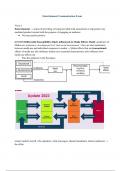
(DSMM) Differential Susceptibility (likely influenced) to Media Effects Model -predictors of
Media use: preference, development level, and social environment + they are also moderators
between media use and individual responses to media → Media effects that are transactional:
effects of media use also influence media use (+personal characteristics also influence how
media use affects us)
- Puts the audience in the first place
Linear model Laswell: who (speaker), what (message), channel (medium), whom (audience) →
the effect
,Entertainment Industry → incorporates all subindustries devoted to entertainment (film
industry) + forms of financing (marketing, distribution, exhibition of ent.products); control of
distribution and production
Vertical integration, Horizontal integration, and Concentric integration(companies stick
with the same resource activity (production) but change the medium(different types of products)
Users of entertainment:
1. By demographics
2. Social (status)
3. Trait and state (psychological traits)
4. Experience and knowledge
Production:
1. Creativity → discovering novel connections between elements in order to create
something interesting
2. Innovation → process of turning creative ideas into something that is actually
marketable; ent.products that are more innovative are more arousing and distinctive →
more successful → need domain-specific expertise
3. Familiarity → perceived connection with an ent. product, its elements
● Selective exposure theory → tendency to favor information that reinforces
pre-existing views (for movie sequels)
4. Franchise → related ent.products from the same brand or intellectual property; every
new product ads up to the image of franchise; prejudice financial risk due to predictable
revenues
5. Exploitation vs Exploration → Products need to be similar in order to feel familiar and
innovative to arouse an intrigue
Distribution → process of selecting the most suitable method and channel for making an ent.
product available to an audience:
1. Marketing → effective management of the flow of information about a product; people
perceive successful products as better products→ initial success can turn into future
success
2. Windowing → maximize profits by making a product available in different formats in
successions
- Financial progress decreases as installment progress (making second part of
hunger games)
3. Cumulative advantage → established by systematically providing news outlets with
inflated opening-weekend revenue estimates for their movies
,Identifiers of entertainment product labels:
1. Medium
2. Title: phonetics, orthography, morphology, semantics
3. Genre
4. Brand
Natural Monopoly → products that are successful are being selected by light users, heavy users
select both top and niche products
Media entertainment:
Experience goods → attribute of the experience dominate our quality judgment for ent. products
Postman form of entertainment product → particular medium can only sustain a limited set of
ideas
Genres → guide users' expectations and help them make a quick decision
● Entertainment brands → evoke cognitive associations with a product
Design → consists of combination of numerous interrelated structural and technological
elements whose combination form the language of ent.
● Multitudes of design elements are essential determinants of ent. experience
Narrative design → hero’s journey
Entertainment experience describes the interaction of the consumer with the design → not
possible without willing suspension of disbelief → allows us to enjoy entertainment media by
pretending that what we see is real (suspend the knowledge that what we see might not be real)
1. Immersion → extent to which an ent. product is capable of delivering an inclusive,
extensive, vivid illusion of depicted reality (VR is more immersive than TV)
2. Presence→ subjective perception of being in a mediated environment, perceiving
immersive events as really happening
3. Social presence → subjective experience of being in the presence of a real person and
having access to his/her emotions
Narrative transportation → being immersed in a story
Flow→state of energized focus, full involvement
User responses to ent. → emotional, cognitive, physiological factors that mediate the relation
between experience and its effects
, 1. Cognitive responses – the extent to which users comprehend ent. content and its
messages
● Verisimilitude → Events, characters, and settings should be internally consistent
and plausible (seem similar or true to real life), not all fiction is equally believable
● Processing fluency → ease and efficiency with which users can process content
that is consistent with our preferences; familiarity enhances appreciation for the
product
- Positive responses - more superficial cognitive processing
- Negative responses - more systematic processing
2. Physiological responses - physical arousal and excitement (happen when we are under
stress)
- Arousing content boosts attention
3. Emotional responses: enjoyment (come from eudemonic experience), eudemonia
(appreciation), hedonism
- elicited by the evaluation of events on cognitive dimensions
Media effects → structural changes in user’s knowledge, attitudes, beliefs, behavior resulting
from media use
Entertainment effects → Small to moderate media effects in large and heterogeneous groups
Mediated entertainment → effective due to users’ motivated persistent involvement with its
characters, which reduces counter-arguing and facilitates persuasion
● Effects are conditional on user characteristics, not universal
● Effects can be transactional (reciprocal)
Segmentation → target groups with common feelings, thoughts, and tendencies related to their
ent. preferences based on observable differences (demographics, personality)
Users → seek sense of individuality but also to fit within groups
Target groups → users with common characteristics
Popular culture →
Cultural congruence → similarities between ent. product and audience influences whether they
will appreciate it
Cancel culture → mass media withdrawal of support to celebrities who have acted in a way to
be unacceptable
- Spiral of silence → People influence each other's willingness to express opinions
through social interaction (unpopular opinions not stated)
Cultural influences and previous ent. experiences influence attitude, opinion…
Week 1
Entertainment → action of providing or being provided with amusement or enjoyment; any
mediated product created with the purpose of engaging an audience
● Not necessarily positive
(DSMM) Differential Susceptibility (likely influenced) to Media Effects Model -predictors of
Media use: preference, development level, and social environment + they are also moderators
between media use and individual responses to media → Media effects that are transactional:
effects of media use also influence media use (+personal characteristics also influence how
media use affects us)
- Puts the audience in the first place
Linear model Laswell: who (speaker), what (message), channel (medium), whom (audience) →
the effect
,Entertainment Industry → incorporates all subindustries devoted to entertainment (film
industry) + forms of financing (marketing, distribution, exhibition of ent.products); control of
distribution and production
Vertical integration, Horizontal integration, and Concentric integration(companies stick
with the same resource activity (production) but change the medium(different types of products)
Users of entertainment:
1. By demographics
2. Social (status)
3. Trait and state (psychological traits)
4. Experience and knowledge
Production:
1. Creativity → discovering novel connections between elements in order to create
something interesting
2. Innovation → process of turning creative ideas into something that is actually
marketable; ent.products that are more innovative are more arousing and distinctive →
more successful → need domain-specific expertise
3. Familiarity → perceived connection with an ent. product, its elements
● Selective exposure theory → tendency to favor information that reinforces
pre-existing views (for movie sequels)
4. Franchise → related ent.products from the same brand or intellectual property; every
new product ads up to the image of franchise; prejudice financial risk due to predictable
revenues
5. Exploitation vs Exploration → Products need to be similar in order to feel familiar and
innovative to arouse an intrigue
Distribution → process of selecting the most suitable method and channel for making an ent.
product available to an audience:
1. Marketing → effective management of the flow of information about a product; people
perceive successful products as better products→ initial success can turn into future
success
2. Windowing → maximize profits by making a product available in different formats in
successions
- Financial progress decreases as installment progress (making second part of
hunger games)
3. Cumulative advantage → established by systematically providing news outlets with
inflated opening-weekend revenue estimates for their movies
,Identifiers of entertainment product labels:
1. Medium
2. Title: phonetics, orthography, morphology, semantics
3. Genre
4. Brand
Natural Monopoly → products that are successful are being selected by light users, heavy users
select both top and niche products
Media entertainment:
Experience goods → attribute of the experience dominate our quality judgment for ent. products
Postman form of entertainment product → particular medium can only sustain a limited set of
ideas
Genres → guide users' expectations and help them make a quick decision
● Entertainment brands → evoke cognitive associations with a product
Design → consists of combination of numerous interrelated structural and technological
elements whose combination form the language of ent.
● Multitudes of design elements are essential determinants of ent. experience
Narrative design → hero’s journey
Entertainment experience describes the interaction of the consumer with the design → not
possible without willing suspension of disbelief → allows us to enjoy entertainment media by
pretending that what we see is real (suspend the knowledge that what we see might not be real)
1. Immersion → extent to which an ent. product is capable of delivering an inclusive,
extensive, vivid illusion of depicted reality (VR is more immersive than TV)
2. Presence→ subjective perception of being in a mediated environment, perceiving
immersive events as really happening
3. Social presence → subjective experience of being in the presence of a real person and
having access to his/her emotions
Narrative transportation → being immersed in a story
Flow→state of energized focus, full involvement
User responses to ent. → emotional, cognitive, physiological factors that mediate the relation
between experience and its effects
, 1. Cognitive responses – the extent to which users comprehend ent. content and its
messages
● Verisimilitude → Events, characters, and settings should be internally consistent
and plausible (seem similar or true to real life), not all fiction is equally believable
● Processing fluency → ease and efficiency with which users can process content
that is consistent with our preferences; familiarity enhances appreciation for the
product
- Positive responses - more superficial cognitive processing
- Negative responses - more systematic processing
2. Physiological responses - physical arousal and excitement (happen when we are under
stress)
- Arousing content boosts attention
3. Emotional responses: enjoyment (come from eudemonic experience), eudemonia
(appreciation), hedonism
- elicited by the evaluation of events on cognitive dimensions
Media effects → structural changes in user’s knowledge, attitudes, beliefs, behavior resulting
from media use
Entertainment effects → Small to moderate media effects in large and heterogeneous groups
Mediated entertainment → effective due to users’ motivated persistent involvement with its
characters, which reduces counter-arguing and facilitates persuasion
● Effects are conditional on user characteristics, not universal
● Effects can be transactional (reciprocal)
Segmentation → target groups with common feelings, thoughts, and tendencies related to their
ent. preferences based on observable differences (demographics, personality)
Users → seek sense of individuality but also to fit within groups
Target groups → users with common characteristics
Popular culture →
Cultural congruence → similarities between ent. product and audience influences whether they
will appreciate it
Cancel culture → mass media withdrawal of support to celebrities who have acted in a way to
be unacceptable
- Spiral of silence → People influence each other's willingness to express opinions
through social interaction (unpopular opinions not stated)
Cultural influences and previous ent. experiences influence attitude, opinion…