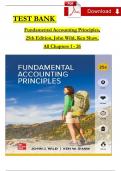
TEST BANK
Fundamental Accounting Principles,
25th Edition, John Wild, Ken Shaw,
All Chapters 1 - 26
,TABLE OF CONTENTS
Chapter 1: Accounting in Business
Chapter 2: Analyzing and Recording Transactions
Chapter 3: Adjusting Accounts for Financial Statements
Chapter 4: Completing the Accounting Cycle
Chapter 5: Accounting for Merchandising Operations
Chapter 6: Inventories and Cost of Sales
Chapter 7: Accounting Information Systems
Chapter 8: Cash, Fraud, and Internal Control
Chapter 9: Accounting for Receivables
Chapter 10: Plant Assets, Natural Resources, and Intangibles
Chapter 11: Current Liabilities and Payroll Accounting
Chapter 12: Accounting for Partnerships
Chapter 13: Accounting for Corporations
Chapter 14: Long-Term Liabilities
Chapter 15: Investments
Chapter 16: Reporting the Statement of Cash Flows
Chapter 17: Analysis of Financial Statements
Chapter 18: Managerial Accounting Concepts and Principles
Chapter 19: Job Order Costing
,Chapter 20: Process Costing
Chapter 21: Cost Behavior and Cost-Volume-Profit Analysis
Chapter 22: Master Budgets and Planning
Chapter 23: Flexible Budgets and Standard Costs
Chapter 24: Performance Measurement and Responsibility Accounting
Chapter 25: Relevant Costs for Managerial Decisions
Chapter 26: Capital Budgeting and Investment Analysis
,Chapter 1: Accounting in Business
Answers at the End of Each Chapter
Student name:
1) Which of the following is not accomplished by accounting?
A) Identifies business activities.
B) Records business activities.
C) Communicates business activities.
D) Eliminates the need for interpreting financial data.
E) Helps people make better decisions.
2) Which of the following is an external user of accounting information?
A) Purchasing manager.
B) Human resource manager.
C) Lender.
D) Chief executive officer (CEO).
E) Marketing manager.
3) The primary objective of financial accounting is to:
A) Serve the decision-making needs of internal users.
B) Provide accounting information that serves external users.
C) Monitor consumer needs, tastes, and price concerns.
D) Provide information on both the costs and benefits of looking after products
and services.
E) Know what, when, and how much product to produce.
,4) The area of accounting aimed at serving the decision-making needs of internal users
is:
A) Financial accounting.
B) Managerial accounting.
C) External auditing.
D) SEC reporting.
E) Bookkeeping.
5) Which of the following is not an external user of accounting information?
A) Shareholders.
B) Customers.
C) Purchasing managers.
D) Government regulators.
E) Creditors.
6) Which of the following is not true regarding a Certified Public Accountant?
A) Must meet education requirements.
B) Must pass an examination.
C) Must exhibit ethical character.
D) Must meet experience requirements.
E) Cannot hold any certificate other than a CPA.
7) Which of the following factors is not a component of the fraud triangle?
, A) Opportunity
B) Pressure
C) Rationalization
D) All of the above are components of the fraud triangle.
8) Which of the following is not true regarding ethics:
A) Ethics are beliefs that separate right from wrong.
B) Good ethics are good business.
C) Ethics do not affect the operations or outcome of a company.
D) Accountants face ethical choices as they prepare financial reports.
E) Ethics are accepted standards of good and bad behavior.
9) A corporation is:
A) A business legally separate from its owners.
B) Controlled by the FASB.
C) Not responsible for its own acts and own debts.
D) The same as a limited liability partnership.
E) Not subject to double taxation.
10) The group that sets international preferred accounting practices is called the:
A) AICPA.
B) IASB.
C) CAP.
D) SEC.
E) FASB.
,11) The Securities and Exchange Commission (SEC) has given the task of setting
GAAP to the:
A) APB.
B) FASB.
C) AAA.
D) AICPA.
E) IASB.
12) The accounting concept that requires every business to be accounted for separately
from other business entities, including its owner or owners is known as the:
A) Time-period assumption.
B) Business entity assumption.
C) Going-concern assumption.
D) Revenue recognition principle.
E) Measurement (Cost) principle.
13) The rule that requires financial statements to assume that the business will
continue operating instead of being closed or sold is the:
A) Going-concern assumption.
B) Business entity assumption.
C) Objectivity principle.
D) Measurement (Cost) principle.
E) Monetary unit assumption.
14) If a company is considering the purchase of a parcel of land that was originally
acquired by the seller for $100,000, is currently offered for sale at $180,000, is considered
by the purchaser as easily being worth $170,000, and is finally purchased for $167,000, the
land should be recorded in the purchaser’s books at:
, A) $110,000.
B) $167,000.
C) $168,500.
D) $170,000.
E) $180,000.
15) If a company is considering the purchase of a parcel of land that was originally
acquired by the seller for $85,000, is currently offered for sale at $150,000, is considered by
the purchaser as easily being worth $140,000, and is finally purchased for $137,000, the
land should be recorded in the purchaser’s books at:
A) $95,000.
B) $137,000.
C) $138,500.
D) $140,000.
E) $150,000.
16) To include the personal assets and transactions of a business's owner in the records
and reports of the business would be in conflict with the:
A) Objectivity principle.
B) Monetary unit assumption.
C) Business entity assumption.
D) Going-concern assumption.
E) Revenue recognition principle.
17) The accounting principle that requires accounting information to be based on actual
cost and requires assets and services to be recorded initially at the cash or cash-equivalent
amount given in exchange, is the:
, A) Accounting equation.
B) Measurement (Cost) principle.
C) Going-concern assumption.
D) Cost-benefit constraint.
E) Business entity assumption.
18) The rule that requires revenue to be recognized when (1) goods or services are
provided to customers and (2) at the amount expected to be received from the customer is
called the:
A) Going-concern assumption.
B) Measurement (Cost) principle.
C) Revenue recognition principle.
D) Objectivity principle.
E) Business entity assumption.
19) The question of when revenue should be recognized on the income statement
according to GAAP is addressed by the:
A) Revenue recognition principle.
B) Going-concern assumption.
C) Objectivity principle.
D) Business entity assumption.
E) Measurement (Cost) principle.
20) The Superior Company acquired a building for $500,000. The building was appraised
at a value of $575,000. The seller had paid $300,000 for the building 6 years ago. Which
accounting principle would require Superior to record the building on its records at
$500,000?
, A) Monetary unit assumption.
B) Going-concern assumption.
C) Measurement (Cost) principle.
D) Business entity assumption.
E) Revenue recognition principle.
21) On December 15 of the current year, Conrad Accounting Services received $40,000
from a client to provide bookkeeping services for the client in the following year. Which
accounting principle would require Conrad Accounting Services to record the bookkeeping
revenue in the following year and not in the year the cash was received?
A) Monetary unit assumption.
B) Going-concern assumption.
C) Measurement (Cost) principle.
D) Business entity assumption.
E) Revenue recognition principle.
22) Marsha Bogswell is the owner of Bogswell Legal Services. Which accounting
principle requires Marsha to keep her personal financial information separate from the
financial information of Bogswell Legal Services?
A) Monetary unit assumption.
B) Going-concern assumption.
C) Measurement (Cost) principle.
D) Business entity assumption.
E) Expense recognition (Matching) principle.
23) A limited liability company (LLC):
Fundamental Accounting Principles,
25th Edition, John Wild, Ken Shaw,
All Chapters 1 - 26
,TABLE OF CONTENTS
Chapter 1: Accounting in Business
Chapter 2: Analyzing and Recording Transactions
Chapter 3: Adjusting Accounts for Financial Statements
Chapter 4: Completing the Accounting Cycle
Chapter 5: Accounting for Merchandising Operations
Chapter 6: Inventories and Cost of Sales
Chapter 7: Accounting Information Systems
Chapter 8: Cash, Fraud, and Internal Control
Chapter 9: Accounting for Receivables
Chapter 10: Plant Assets, Natural Resources, and Intangibles
Chapter 11: Current Liabilities and Payroll Accounting
Chapter 12: Accounting for Partnerships
Chapter 13: Accounting for Corporations
Chapter 14: Long-Term Liabilities
Chapter 15: Investments
Chapter 16: Reporting the Statement of Cash Flows
Chapter 17: Analysis of Financial Statements
Chapter 18: Managerial Accounting Concepts and Principles
Chapter 19: Job Order Costing
,Chapter 20: Process Costing
Chapter 21: Cost Behavior and Cost-Volume-Profit Analysis
Chapter 22: Master Budgets and Planning
Chapter 23: Flexible Budgets and Standard Costs
Chapter 24: Performance Measurement and Responsibility Accounting
Chapter 25: Relevant Costs for Managerial Decisions
Chapter 26: Capital Budgeting and Investment Analysis
,Chapter 1: Accounting in Business
Answers at the End of Each Chapter
Student name:
1) Which of the following is not accomplished by accounting?
A) Identifies business activities.
B) Records business activities.
C) Communicates business activities.
D) Eliminates the need for interpreting financial data.
E) Helps people make better decisions.
2) Which of the following is an external user of accounting information?
A) Purchasing manager.
B) Human resource manager.
C) Lender.
D) Chief executive officer (CEO).
E) Marketing manager.
3) The primary objective of financial accounting is to:
A) Serve the decision-making needs of internal users.
B) Provide accounting information that serves external users.
C) Monitor consumer needs, tastes, and price concerns.
D) Provide information on both the costs and benefits of looking after products
and services.
E) Know what, when, and how much product to produce.
,4) The area of accounting aimed at serving the decision-making needs of internal users
is:
A) Financial accounting.
B) Managerial accounting.
C) External auditing.
D) SEC reporting.
E) Bookkeeping.
5) Which of the following is not an external user of accounting information?
A) Shareholders.
B) Customers.
C) Purchasing managers.
D) Government regulators.
E) Creditors.
6) Which of the following is not true regarding a Certified Public Accountant?
A) Must meet education requirements.
B) Must pass an examination.
C) Must exhibit ethical character.
D) Must meet experience requirements.
E) Cannot hold any certificate other than a CPA.
7) Which of the following factors is not a component of the fraud triangle?
, A) Opportunity
B) Pressure
C) Rationalization
D) All of the above are components of the fraud triangle.
8) Which of the following is not true regarding ethics:
A) Ethics are beliefs that separate right from wrong.
B) Good ethics are good business.
C) Ethics do not affect the operations or outcome of a company.
D) Accountants face ethical choices as they prepare financial reports.
E) Ethics are accepted standards of good and bad behavior.
9) A corporation is:
A) A business legally separate from its owners.
B) Controlled by the FASB.
C) Not responsible for its own acts and own debts.
D) The same as a limited liability partnership.
E) Not subject to double taxation.
10) The group that sets international preferred accounting practices is called the:
A) AICPA.
B) IASB.
C) CAP.
D) SEC.
E) FASB.
,11) The Securities and Exchange Commission (SEC) has given the task of setting
GAAP to the:
A) APB.
B) FASB.
C) AAA.
D) AICPA.
E) IASB.
12) The accounting concept that requires every business to be accounted for separately
from other business entities, including its owner or owners is known as the:
A) Time-period assumption.
B) Business entity assumption.
C) Going-concern assumption.
D) Revenue recognition principle.
E) Measurement (Cost) principle.
13) The rule that requires financial statements to assume that the business will
continue operating instead of being closed or sold is the:
A) Going-concern assumption.
B) Business entity assumption.
C) Objectivity principle.
D) Measurement (Cost) principle.
E) Monetary unit assumption.
14) If a company is considering the purchase of a parcel of land that was originally
acquired by the seller for $100,000, is currently offered for sale at $180,000, is considered
by the purchaser as easily being worth $170,000, and is finally purchased for $167,000, the
land should be recorded in the purchaser’s books at:
, A) $110,000.
B) $167,000.
C) $168,500.
D) $170,000.
E) $180,000.
15) If a company is considering the purchase of a parcel of land that was originally
acquired by the seller for $85,000, is currently offered for sale at $150,000, is considered by
the purchaser as easily being worth $140,000, and is finally purchased for $137,000, the
land should be recorded in the purchaser’s books at:
A) $95,000.
B) $137,000.
C) $138,500.
D) $140,000.
E) $150,000.
16) To include the personal assets and transactions of a business's owner in the records
and reports of the business would be in conflict with the:
A) Objectivity principle.
B) Monetary unit assumption.
C) Business entity assumption.
D) Going-concern assumption.
E) Revenue recognition principle.
17) The accounting principle that requires accounting information to be based on actual
cost and requires assets and services to be recorded initially at the cash or cash-equivalent
amount given in exchange, is the:
, A) Accounting equation.
B) Measurement (Cost) principle.
C) Going-concern assumption.
D) Cost-benefit constraint.
E) Business entity assumption.
18) The rule that requires revenue to be recognized when (1) goods or services are
provided to customers and (2) at the amount expected to be received from the customer is
called the:
A) Going-concern assumption.
B) Measurement (Cost) principle.
C) Revenue recognition principle.
D) Objectivity principle.
E) Business entity assumption.
19) The question of when revenue should be recognized on the income statement
according to GAAP is addressed by the:
A) Revenue recognition principle.
B) Going-concern assumption.
C) Objectivity principle.
D) Business entity assumption.
E) Measurement (Cost) principle.
20) The Superior Company acquired a building for $500,000. The building was appraised
at a value of $575,000. The seller had paid $300,000 for the building 6 years ago. Which
accounting principle would require Superior to record the building on its records at
$500,000?
, A) Monetary unit assumption.
B) Going-concern assumption.
C) Measurement (Cost) principle.
D) Business entity assumption.
E) Revenue recognition principle.
21) On December 15 of the current year, Conrad Accounting Services received $40,000
from a client to provide bookkeeping services for the client in the following year. Which
accounting principle would require Conrad Accounting Services to record the bookkeeping
revenue in the following year and not in the year the cash was received?
A) Monetary unit assumption.
B) Going-concern assumption.
C) Measurement (Cost) principle.
D) Business entity assumption.
E) Revenue recognition principle.
22) Marsha Bogswell is the owner of Bogswell Legal Services. Which accounting
principle requires Marsha to keep her personal financial information separate from the
financial information of Bogswell Legal Services?
A) Monetary unit assumption.
B) Going-concern assumption.
C) Measurement (Cost) principle.
D) Business entity assumption.
E) Expense recognition (Matching) principle.
23) A limited liability company (LLC):