

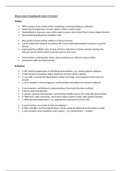
Discuss ways of studying the brain. (16 marks)
Outline:
fMRI, measure brain activity whilst completing a task/responding to a stimulus
Detect blood oxygenation of brain regions, relative activity levels
Haemodynamic response, more active regions require more blood flow to meet oxygen demand
Neural activity displayed on activation map
EEGs general neural activity, patterns of firing neurones
Can be statistically analysed to produce ERP, shows electrophysiological response to specific
stimuli
Superimposing multiple scans of same stimulus, extraneous activity removed, leaving only
relevant neural activity (which would be same in each scan)
Post-mortems, studying after death, observed behaviours linked to abnormalities
Comparison with neurotypical brain
Evaluation:
P: EEG practical applications in identifying abnormalities, e.g. random patterns epilepsy
E: high temporal resolution, better diagnostic tool than other methods
A: e.g. fMRI 5-second time lag between activity and image, miss responses faster than one
second
L: EEGs valuable in clinical diagnosis, health problems identified so treatment explored
P: post-mortem, contributes to understanding of how brain functions localised
E: Broca, speech production
C: passive, questionable precision, confounding variables means not universally generalisable
A: fMRI more valid conclusions, which brain regions active in tasks, high spatial resolution
L: allows practical applications, e.g. cingulotomy treatment for severe OCD
P: post-mortem, areas deep in brain investigated
E: EEGs and ERPs, electrical signals deep in brain cannot be detected by electrodes on scalp
L: post-mortems more beneficial, more regions – e.g. hypothalamus – studied
Outline:
fMRI, measure brain activity whilst completing a task/responding to a stimulus
Detect blood oxygenation of brain regions, relative activity levels
Haemodynamic response, more active regions require more blood flow to meet oxygen demand
Neural activity displayed on activation map
EEGs general neural activity, patterns of firing neurones
Can be statistically analysed to produce ERP, shows electrophysiological response to specific
stimuli
Superimposing multiple scans of same stimulus, extraneous activity removed, leaving only
relevant neural activity (which would be same in each scan)
Post-mortems, studying after death, observed behaviours linked to abnormalities
Comparison with neurotypical brain
Evaluation:
P: EEG practical applications in identifying abnormalities, e.g. random patterns epilepsy
E: high temporal resolution, better diagnostic tool than other methods
A: e.g. fMRI 5-second time lag between activity and image, miss responses faster than one
second
L: EEGs valuable in clinical diagnosis, health problems identified so treatment explored
P: post-mortem, contributes to understanding of how brain functions localised
E: Broca, speech production
C: passive, questionable precision, confounding variables means not universally generalisable
A: fMRI more valid conclusions, which brain regions active in tasks, high spatial resolution
L: allows practical applications, e.g. cingulotomy treatment for severe OCD
P: post-mortem, areas deep in brain investigated
E: EEGs and ERPs, electrical signals deep in brain cannot be detected by electrodes on scalp
L: post-mortems more beneficial, more regions – e.g. hypothalamus – studied


