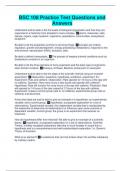
BSC 108 Practice Test Questions and Answers
Understand and be able to list the levels of biological organization and how they are organized in a hierarchy from simplest to more complex. atoms, molecules, cells, tissues, organs, organ systems, organisms, populations, communities, ecosystems, biosphere Be able to list the properties common to all living things. Complex yet orderly, regulation, growth and development, energy processing (metabolism), response to the environment, reproduction (DNA), evolution, cells. Be able to define homeostasis. The process of keeping internal conditions such as temperature constant in an organism. Be able to list the three domains of living organisms and the basic type of organisms each domain contains. Eukarya, Archaea, Bacteria; prokaryotic or eukaryotic Understand and be able to list the steps of the scientific method using an example experiment. Observation, questions, hypothesis, prediction, experiment. Ex. Experiment: Rats and caffeine. Observation: Rats operate for 12 hours of the day with no caffeine. Question: How many hours a day would rats operate with caffeine? Hypothesis: Rats will function for more hours of the day with caffeine. Prediction: Rats will operate for 14 hours of the day instead of 12 hours of the day with caffeine. Experiment: Create a control group (rats w/ no caffeine), experimental group (rats w/ caffeine) and document. Know what data are and be able to give an example of a hypothesis, an experimental variable, and a control group. Hypothesis: a proposed explanation for a set of observations. Experimental variable: the independent variable that is manipulated by the researcher to determine its relationship to or influence upon some outcome or dependent variable. Control group: the group in an experiment that receives no treatment. How do hypotheses differ from theories? Be able to give an example of a scientific theory. Hypothesis: a proposed explanation for a set of observations. Scientific Theory: a widely accepted explanatory idea that is much broader in scope than a hypothesis and is a comprehensive and well-substantiated explanation. I.e. Darwin's Theory of Evolution What is an element? A substance that can't be broken down into another substance by ordinary means.
Geschreven voor
- Instelling
- BSC 108
- Vak
- BSC 108
Documentinformatie
- Geüpload op
- 11 mei 2024
- Aantal pagina's
- 8
- Geschreven in
- 2023/2024
- Type
- Tentamen (uitwerkingen)
- Bevat
- Onbekend
Onderwerpen
-
bsc 108 practice test questions and answers
-
understand and be able to list the levels of biol
-
be able to list the properties common to all livin

Ook beschikbaar in voordeelbundel