
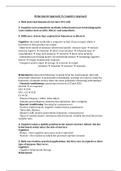
Behaviourist Approach Vs. Cognitive Approach
1: Both state that humans do not have free will.
2: Cognitive uses nomothetic methods; behaviourist uses both idiographic
(case studies such as Little Albert) and nomothetic.
3: Difference in how they explain how behaviour is affected:
Cognitive: the mind works like a computer in that it has an input, which it
processes to then produce an output:
- Multi-store model of memory (theoretical model): sensory input sensory
memory register attention short-term memory rehearsal loop
consolidation long-term memory retrieval short-term memory.
- Information processing model: environmental stimuli mediating cognitive
factors output/behavioural response.
- Computer model: input storage retrieval output
stimulus attention memory response
Behaviourist: states that behaviour is learnt from the environment, that only
observable behaviour is measurable scientifically, and that it is valid to study the
behaviour of animals as they share the same principles of learning with humans:
- Classical conditioning (association between a CS and UCR):
Neutral no response
UCS UCR
UCS + CS UCR
CS CR
- Watson & Rayner (1920): Little Albert
- Stimulus generalisation; stimulus discrimination; time contiguity.
- Operant conditioning (learning by consequences):
- Positive reinforcement; negative reinforcement; punishment.
- Thorndike; Skinner.
- Skinner’s ABC model (antecedents; behaviour; consequences).
- Types of reinforcement: continuous; fixed interval; variable interval; fixed ratio;
variable ratio.
4: Cognitive takes a middle position in the nature/nurture debate, but the
behavioural solely takes the side of nurture:
Cognitive:
- Nature = how cognitive processes work is inherited.
- Nurture = the content on which the processes operate is learnt.
5: Both can result in practical applications, but they vary in regards to what
type of purpose they serve:
Cognitive:
- Cognitive behavioural therapy.
Behavioural:
1: Both state that humans do not have free will.
2: Cognitive uses nomothetic methods; behaviourist uses both idiographic
(case studies such as Little Albert) and nomothetic.
3: Difference in how they explain how behaviour is affected:
Cognitive: the mind works like a computer in that it has an input, which it
processes to then produce an output:
- Multi-store model of memory (theoretical model): sensory input sensory
memory register attention short-term memory rehearsal loop
consolidation long-term memory retrieval short-term memory.
- Information processing model: environmental stimuli mediating cognitive
factors output/behavioural response.
- Computer model: input storage retrieval output
stimulus attention memory response
Behaviourist: states that behaviour is learnt from the environment, that only
observable behaviour is measurable scientifically, and that it is valid to study the
behaviour of animals as they share the same principles of learning with humans:
- Classical conditioning (association between a CS and UCR):
Neutral no response
UCS UCR
UCS + CS UCR
CS CR
- Watson & Rayner (1920): Little Albert
- Stimulus generalisation; stimulus discrimination; time contiguity.
- Operant conditioning (learning by consequences):
- Positive reinforcement; negative reinforcement; punishment.
- Thorndike; Skinner.
- Skinner’s ABC model (antecedents; behaviour; consequences).
- Types of reinforcement: continuous; fixed interval; variable interval; fixed ratio;
variable ratio.
4: Cognitive takes a middle position in the nature/nurture debate, but the
behavioural solely takes the side of nurture:
Cognitive:
- Nature = how cognitive processes work is inherited.
- Nurture = the content on which the processes operate is learnt.
5: Both can result in practical applications, but they vary in regards to what
type of purpose they serve:
Cognitive:
- Cognitive behavioural therapy.
Behavioural:


