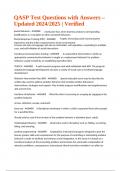
QASP-S Test Questions with Answers – Updated 2024/2025 | Verified
QASP-S Test Questions with Answers – Updated 2024/2025 | Verified. pivotal behavior - ANSWER A behavior that, when learned, produces corresponding modifications or covariation in other untrained behaviors. Pivotal Response Training (PRT) - ANSWER Targets increasing social-communicative repertoires and the child's responsiveness to the environment. Focuses not only on language, but also on motivation, self-regulation, responding to multiple cues, and self-initiation of social interactions functional communication training - ANSWER An antecedent intervention in which an appropriate communicative behavior is taught as a replacement behavior for problem behavior usually evoked by an establishing operation (EO). TEACCH - ANSWER A well research program used with individuals with ASD. The program emphasizes language development and uses a variety of visual cues to facilitate language development. Behavior Intervention Plan (BIP) - ANSWER Special education term used to describe the written plan used to address problem behavior that includes positive behavioral interventions, strategies and support. May include program modifications and supplementary aids and services. functions of behavior - ANSWER What the client is accessing or escaping by engaging in the problem behavior Access, attention, escape, automatic time-out - ANSWER A disciplinary technique in which a child is separated from other people for a specified time. Should only be used if the function of the problem behavior is attention (peer, adult). Challenging behaviors - ANSWER Destructive and/or disruptive such as: hitting, screaming, biting, and swearing. positive programming - ANSWER longitudinal, instructional program designed to give the learner greater skills and competencies for the purpose of controlling or eliminating problem behavior in order to facilitate and enhance social integration. In this sense it is based on a functional analysis of the preventing problem and involves the systematic manipulation of stimulus conditions, consequences, instructional stimuli and other variables in an effort to QASP Test Questions with Answers – Updated 2024/2025 | Verified establish the new, more adaptive behavioral repertoire. positive behavior support plan - ANSWER Typical plans involve an objective for the intervention, prevention strategies, replacement behaviors, reinforcers, attention to what should not be reinforced, and ways to monitor children's progress delivering consequences - ANSWER immediacy operational definition - ANSWER a statement of the procedures used to define research variables. The procedures included in definitions should be repeatable by anyone or at least by peers. onset and offset behavior - ANSWER Behavior must have a defined beginning and end added to the definition. Doing so increases the strength of your intervention by increasing the likelihood of accurate measurement frequency/rate - ANSWER Ratio of count per observation time baseline data - ANSWER information gathered by scientists to be used as a starting point to compare changes after the implementation of the independent variable topography - ANSWER what a behavior looks like generallization - ANSWER intervention can only be deemed a success if change can be shown in different environments and with multiple people evidence based - ANSWER description of medical techniques or practices that are supported by scientific evidence of their safety and efficacy, rather than merely on supposition and tradition. advocacy - ANSWER Quality advocacy services are person-centered and developed using a co-production approach that aims to maximize the participation of people who use services and their carers person centered planning - ANSWER a method of planning for people with disabilities that places the person and his family at the center of the planning process seeks to build a support network, increase independence and connect to the community Circle of support - ANSWER meeting of extended family, friends, service providers, etc. to ensure well-being of a child about to age out of cps care essential lifestyle plans - ANSWER ELP is a guided process for learning how someone wants to live and for developing a plan to help make it happen. It's also: A snapshot of how someone wants to live today, serving as a blueprint for how to support someone tomorrow; A way of organizing and communicating what is important to an individual; A flexible process that can be used in combination with other person centered techniques; A way of making sure that the person is heard, regardless of the severity of disability. QASP will demonstrate - ANSWER trustworthiness, honesty, fairness and sincerity Autism Spectrum Disorder (ASD) - ANSWER A disorder characterized by deficits in social relatedness and communication skills that are often accompanied by repetitive, ritualistic behavior. ASD deficits - ANSWER Social interaction, communication, repetitive/restricitive beahviors Triad of Impairments - ANSWER Deficits in reciprocal social interaction Deficits in communication Restricted, repetitive behaviors, interests or activities. joint attention - ANSWER Joint Attention and Social Referencing. Joint attention occurs when two people share interest in an object or event and there is understanding between the two people that they are both interested in the same object or event.Less likely to use gestures or eye contact as a means of sharing interest and directing interactional partners' attention to object of interest •Instrumental use less likely to be impaired Autism (word) History - ANSWER The word "autism" comes from the Greek word "autos," which means "self." It describes conditions in which a person is removed from social interaction. In other words, he becomes an "isolated self." IDEA- First recognized ASD - ANSWER 1990 Least Restrictive Environment (LRE) - ANSWER when the Individualized Education Program (IEP) is written, a determination is made regarding the amount of time each student with disabilities will spend with nondisabled peers both in classroom and all other school activities. Antecedent - ANSWER An environmental condition or stimulus change existing or occurring prior to a behavior of interest. Consequence - ANSWER A stimulus change that follows a behavior of interest. ABA- Defined - ANSWER The science in which tactics derived from the principles of behavior are applied to improve socially significant behavior and experimentation is used to identify the variables responsible for the improvement in behavior. A-B-C contingency - ANSWER antecedent, behavior, consequence Motivating Operation (MO) - ANSWER An environmental variable that (a) alters (increases or decreases) the reinforcing effectiveness of some stimulus, object, or event; and (b) alters (increases or decreases) the current frequency of all behavior that have been reinforced by that stimulus, object, or event. Positive Reinforcement - ANSWER Increasing behaviors by presenting a stimuli, such as food. A positive reinforcer is any stimulus that, when presented after a response, increases the future likelihoss of that same response. Positive Punishment - ANSWER the administration of a stimulus to decrease the probability of a behavior's recurring Conditioned Reinforcement - ANSWER occurs when a stimulus reinforces set behaviors through its association with a primary reinforcer Unconditioned Reinforcement - ANSWER a reinforcement that is inherent, such as food Schedules of reinforcement - ANSWER Intermittent Schedules- ratio/interval schedules. Not all responses of the same response class can be reinforced. Compound Schedules operant conditioning - ANSWER a type of learning in which behavior is strengthened if followed by a reinforcer or diminished if followed by a punisher- behavior that is selected by its consequences Primary reinforcers - ANSWER stimuli, such as food or warmth, that have reinforcement value without learning target behavior - ANSWER the response class selected for intervention; can be defined either functionally or topographically goal - ANSWER A result that a person aims for and works hard to reach objective - ANSWER Factual, related to reality or physical objects; not influenced by emotions, unbiased errorless learning - ANSWER ensures success, early immediate prompts, prompts faded over time, decreases frustration/increases motivation Strategies for generalization and maintenance - ANSWER Teach loosely, use multiple exemplars, vary instructional methods, select target behaviors that will get naturally reinforced, prompt fading strategies - ANSWER most-to-least prompts, graduated guidance, least-to-most prompts, time delay. Fading out stimulus prompts gradually to transfer stimulus control inter-trial interval - ANSWER The time interval between presentation of the consequence for one trial and the presentation of the SD for the next trial. When to use mass trials in DTT - ANSWER To promote discrimination. Repeatedly presenting the target with decreasing prompt levels will transfer stimulus control of the prompt to the SD. concurrent schedule - ANSWER schedule of reinforcement in which 2 or more contingencies of reinforcement operates independently and simultaneously for 2 or more behaviors multiple schedule - ANSWER Consists of two or more alternating schedules, each associated with a different stimulus. chained schedule - ANSWER A conditioned reinforcer is produced by completion of the response requirements for that component schedule in the chain. Mixed schedule - ANSWER compound schedule of reinforcement consisting of 2 or more basic schedules of reinforcement that occur in an alternating, usually random sequence Satiation - ANSWER A decrease in the frequency of operant behavior presumed to be the result of continued contact with or consumption of a reinforcer that has followed the behavior. deprivation - ANSWER the state of lacking or doing without something; loss Extinction - ANSWER A term that typically describes a species that no longer has any known living individuals. extinction burst - ANSWER an increase in the frequency of responding when an extinction procedure is initially implemented. behavior modification - ANSWER the use of operant conditioning techniques to bring about desired changes in behavior visual supports for ASD - ANSWER Pictures, models, video, graphics, realia, body language, and so on makes content-area concepts easier to understand. PECS - ANSWER Picture Exchange Communication System- begins with teaching a student to exchange a picture of a desired item with a teacher/communicative partner, who immediately honors the request. After the student learns to spontaneously request for a desired item, the system goes on to teach discrimination among symbols and then how to construct a simple sentence. In the most advanced phases, individuals are taught to respond to questions and to comment. Additionally, descriptive language concepts such as size, shape, color, number, etc. are also taught so the student can make their message more specific. For example, I want big yellow ball. ASD characteristics - ANSWER Communication- Delay or lack of development of language, diffiulty holding conversations, unusual or repetitive language, play that is not appropriate for developmental level. Social interaction- Difficutly using nonverbal behaviors to regulate social interaction, failure to develop age appropriate peer relationships, little sharing of pleasure, achievements or interests with others, lack of social or emotional reciprocity. Restrictied/Repetitive activities- Interests are narrow in focus, overly intense and/or unusual, unreasonalbe insistence on sameness and folowing familiar routines, repetitive motor mannerisms, preoccupation with parts of objects. Hyper/hyposensitive sensory input - ANSWER Sometimes the senses of autistic children are in 'hypo', so that they do not really see, hear or feel anything. To stimulate their senses they might wave their hands around or rock forth and back or make strange noises. Hypersensitive is the exact opposite, some may get too much sensory input from any of the senses. Historical definitions of autism - ANSWER 1908- word autism is used to describe schizophrenic patients who were also withdrawn and self-absorbed. Kanner (1943) described children who were highly intelligent but "displayed a powerful desire for aloneness" and rigidity/insistence on sameness Hans Asperger (1944) difficulty with social interaction 1967- refrigerator mothers were the cause of autism 1980-infantile autism listed in the DSM 1987-autism disorder in DSM 1991-federal government makes autism a sped category 1990- IDEA recognized ASD 1994-Asperger's syndrome added to DSM 2013- DSM-5 folds all subcategories of autism ASD with two categories 1) impaired social communication and/or interaction. 2) restricted and/or repetitive beahviors Co-Morbid conditions associated with autism - ANSWER Mental retardation, learning difficulties, ADD/ADHD, Depression, Anxiety, CD, Nonverbal learnning disabilities Asperger's Syndrome Definition - ANSWER Developmentally appropriate language, but differences (pragmatics, sentence structure, pronunciation, vocabulary) Social deficits, Literal interperatation of langauge Asperger's Syndrome (HFA) common characteristics - ANSWER He's just as smart as other folks, but he has more trouble with social skills. He also tends to have an obsessive focus on one topic or perform the same behaviors again and again. Evidence based treatments for ASD - ANSWER applied behavior analysis-DTT, FCT, PRT, Antecedent based interventions Early intervention, social skills training, cognitive behavioral therapy, medication AAC, PECS, Video modeling, visual supports, computer aided instruction, parent implemented intervention IDEA - ANSWER ndividuals with Disabilities Education Act-is a law that makes available a free appropriate public education to eligible children with disabilities throughout the nation and ensures special education and related services to those children The IDEA governs how states and public agencies provide early intervention, special education, and related services to more than 6.5 million eligible infants, toddlers, children, and youth with disabilities. Infants and toddlers, birth through age 2, with disabilities and their families receive early intervention services under IDEA Part C. Children and youth ages 3 through 21 receive special education and related services under IDEA Part B. IEP - ANSWER individualized education plan, a written statement for each child with a disability, must include: statement of child's present levels of functional performance measurable annual goals
Written for
- Institution
- QASP-S
- Module
- QASP-S
Document information
- Uploaded on
- May 9, 2024
- Number of pages
- 26
- Written in
- 2023/2024
- Type
- Exam (elaborations)
- Contains
- Questions & answers
Subjects
- qasp
- qasp s
- latest updated 2024
- graded
- verified answers
-
qasp s test questions with answers

Also available in package deal