ATI: Vital Signs Question and Answers 100% Pass
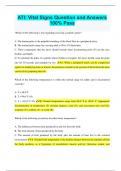
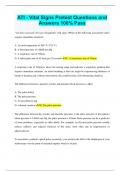
Which of the following is true regarding assessing a patient's pulse? A. The human pulse is the palpable bounding of the blood flow in a peripheral artery. B. The normal pulse range for a resting adult is 50 to 110 beats/min. C. Three components that the nurse should include when documenting pulse (P) are the rate, rhythm, and depth. D. To calculate the pulse of a patient whose rhythm is irregular, the nurse should count the pulse rate for 30 seconds and multiply by two. A. When a peripheral artery can be compressed against an underlying bone or muscle, the pulsation created by the ejection of blood from the heart can be felt by palpating that site. Which of the following temperatures is within the normal range for adults and is documented correctly? A. T = 98.6º F B. T = 99.6º F (O) C. T = 101.0º F (O) B. Normal temperatures range from 96.8° F to 100.4° F. Appropriate documentation of temperature (T) includes degrees, scale (F), and assessment site: oral (O), tympanic (T), axillary (A), or rectal (R). Which of the following accurately describes body temperature? A. The difference between heat produced by and lost from the body B. The total amount of heat produced by the body C. The amount of heat produced by the body plus the amount of heat lost to the external environment A. Normal body temperature is the healthy balance between the amounts of heat the body produces as a byproduct of metabolism, muscle activity, thyroxine output, andsympathetic stimulation and the heat lost as a result of radiation, conduction, convection, and evaporation. The primary reason for assessing this patient's vital signs is to A. establish a baseline when the patient reports no specific health-related problem. B. determine the presence of any acute or chronic illness or disease process. C. initiate the nursing process. A. Vital signs are assessed for various reasons that include determining the patient's response to medical and nursing therapy as well as identifying clinical problems. However, the primary reason for such assessment at an initial visit of an apparently well patient is to document baseline data. This information will be useful for comparison with vitalsign data obtained at subsequent visits. Will your assessment of respiration provide information about your patient's ability to intake carbon dioxide and to expel oxygen? A. Yes B. No B. Respiration is the mechanism a person uses to introduce oxygen into the body while expelling carbon dioxide into the atmosphere. Which of the following is true regarding assessing a patient's respiration? A. It is best to inform the patient that you are assessing her respiration. B. "R = 14/min, normal, regular" is an appropriate documentation of a patient's respiration. C. Occurrence or periods of apnea in an older adult is a normal respiratory finding. D. Anxiety and acute pain are two factors that should not affect a patient's respiratory rate. B. Appropriate documentation of respiration includes rate, rhythm (regular, irregular), and depth (deep, normal, shallow). Which of the following describes systolic pressure? Which of the following is true regarding assessing a patient's pulse? A. The human pulse is the palpable bounding of the blood flow in a peripheral artery. B. The normal pulse range for a resting adult is 50 to 110 beats/min. C. Three components that the nurse should include when documenting pulse (P) are the rate, rhythm, and depth. D. To calculate the pulse of a patient whose rhythm is irregular, the nurse should count the pulse rate for 30 seconds and multiply by two. A. When a peripheral artery can be compressed against an underlying bone or muscle, the pulsation created by the ejection of blood from the heart can be felt by palpating that site. Which of the following temperatures is within the normal range for adults and is documented correctly? A. T = 98.6º F B. T = 99.6º F (O) C. T = 101.0º F (O) B. Normal temperatures range from 96.8° F to 100.4° F. Appropriate documentation of temperature (T) includes degrees, scale (F), and assessment site: oral (O), tympanic (T), axillary (A), or rectal (R). Which of the following accurately describes body temperature? A. The difference between heat produced by and lost from the body B. The total amount of heat produced by the body C. The amount of heat produced by the body plus the amount of heat lost to the external environment A. Normal body temperature is the healthy balance between the amounts of heat the body produces as a byproduct of metabolism, muscle activity, thyroxine output, andsympathetic stimulation and the heat lost as a result of radiation, conduction, convection, and evaporation. The primary reason for assessing this patient's vital signs is to A. establish a baseline when the patient reports no specific health-related problem. B. determine the presence of any acute or chronic illness or disease process. C. initiate the nursing process. A. Vital signs are assessed for various reasons that include determining the patient's response to medical and nursing therapy as well as identifying clinical problems. However, the primary reason for such assessment at an initial visit of an apparently well patient is to document baseline data. This information will be useful for comparison with vitalsign data obtained at subsequent visits. Will your assessment of respiration provide information about your patient's ability to intake carbon dioxide and to expel oxygen? A. Yes B. No B. Respiration is the mechanism a person uses to introduce oxygen into the body while expelling carbon dioxide into the atmosphere. Which of the following is true regarding assessing a patient's respiration? A. It is best to inform the patient that you are assessing her respiration. B. "R = 14/min, normal, regular" is an appropriate documentation of a patient's respiration. C. Occurrence or periods of apnea in an older adult is a normal respiratory finding. D. Anxiety and acute pain are two factors that should not affect a patient's respiratory rate. B. Appropriate documentation of respiration includes rate, rhythm (regular, irregular), and depth (deep, normal, shallow). Which of the following describes systolic pressure?
Written for
- Institution
- ATI: Vital Signs Qu
- Course
- ATI: Vital Signs Qu
Document information
- Uploaded on
- May 8, 2024
- Number of pages
- 16
- Written in
- 2023/2024
- Type
- Exam (elaborations)
- Contains
- Questions & answers
Subjects
-
ati vital signs question and answers 100 pass

Also available in package deal