14. Olfaction
Parts concerning mainly anatomy are mainly composed of definitions, as it is the case in
the textbook.
o = olfaction/olfactory; envt = environment, dvpt = development; btwn = between; = =
is/are; n = nose/nasal; b = bulb(s); od = odour(s); xpce = experience; ° = tion
Olfactory physiology
Olfaction = the sense of smell.
Gustation = the sense of taste.
Orthonasal olfaction = sniffing in and perceiving odours through our nostrils, which occurs when we are
smelling something that is outside of us.
Retronasal olfaction = perceiving odours through your mouth while breathing and chewing. This occurs
when we are smelling something that is inside our mouth and is what gives us the experience of flavour.
Odours and odorants
Odour = translation of a chemical stimulus into a smell sensation. “The cake has a chocolate odour”.
Odorant = molecule that is defined by its physicochemical characteristics, which is capable of being
translated by the nervous system into the perception of a smell. For example, “you were given the
odorant methyl salicylate to smell, which has the odour of winter-green mint”.
The human olfactory apparatus
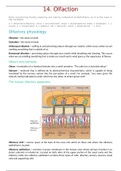
Olfactory cleft = narrow space at the back of the nose into which air flows and where the olfactory
epithelium is located.
Olfactory epithelium = secretory mucous membrane in the human nose whose primary function is to
detect odorants in inhaled air. Located on both sides of the upper portion of the nasal cavity and the
olfactory clefts, the olfactory epithelium contains three types of cells: olfactory sensory neurons, basal
cells and supporting cells.
, Nasal dominance= the asymmetry characterizing the intake of air by the two nostrils, which
corresponds to differing sensitivity to odorants between the two nostrils. Nasal dominance alternates
nostrils throughout the day, but there is no predictability about when the nostrils alternate.
Supporting cell = provide metabolic and physical support for the olfactory sensory neurons.
Basal cell = precursor cells to olfactory sensory neurons.
Olfactory sensory neuron (OSN) = the main cell type in the olfactory epithelium. Small neurons located
beneath a mucous layer in the epithelium. The cilia on the OSN dendrites contain the receptor sites for
odorant molecules.
Cilium = hairlike protrusion on the dendrites of olfactory sensory neurons. Cilia are the first structures
involved in olfactory signal transduction.
Odorant receptor (OR) = region on the cilia of olfactory sensory neurons where odorant molecules bind.
Cribriform plate = bony structure riddled with tiny holes, at the level of the eyebrows, which separates
the nose from the brain. The axons from the olfactory sensory neurons pass through the tiny holes of
the cribriform plate to enter the brain.
Anosmia = total inability to smell (sinus illness or head trauma).
Neurophysiology of olfaction
Olfactory (I) nerves = first pair of cranial nerves. The axons of the OSNs bundle together after passing
through the cribriform plate to form the olfactory nerve, which conducts impulses from the olfactory
epithelia in the nose to the olfactory bulb.
Olfactory bulb = blueberry-sized extension of the brain just above the nose, where olfactory information
is first processed. There are two olfactory bulbs, one in each brain hemisphere, corresponding to the
right and left nostrils.
Glomerulus = spherical conglomerate containing the incoming axons of the olfactory sensory neurons.
Each OSN converges onto two glomeruli.
Juxtaglomerular neurons = first layer of cells surrounding the glomeruli. They are a mixture of excitatory
and inhibitory cells and respond to a wide range of odorants. The selectivity of neurons to specific
odorant increases in a gradient from the surface of the olfactory bulb to the deeper layers.
Tufted cells = the next layer of cells after the jg neurons. They respond to fewer odorants than the jg
cells, but more than neurons at the deepest layer of cells.
Mitral cell = the deepest layer of neurons in the ob. Each mitral cell responds only to a few specific
odorants.
Granule cells = like mitral cells, are at the deepest level of the ob. They comprise an extensive network
of inhibitory neurons, integrate input from all the earlier projections and are thought to be the basis of
specific odorant identification.
Olfactory tract = bundle of axons of the mitral and tufted cells within the olfactory bulb that sends
odour information to the primary olfactory cortex.
Primary o cortex or piriform cortex = neural area where o information is first processed. It comprises
the amygdala, parahippocampal gyrus and interconnected areas. It interacts closely with the entorhinal
cortex.
Amygdala-hippocampal cortex = conjoined regions of the amygdala and hippocampus, which are key
structures in the limbic system. This complex = critically involved in the unique emotional and
associative properties of olfactory cognition.
Entorhinal cortex = cortical region that provides the major sensory association input into the
hippocampus. It also receives direct projections from olfactory regions.
Parts concerning mainly anatomy are mainly composed of definitions, as it is the case in
the textbook.
o = olfaction/olfactory; envt = environment, dvpt = development; btwn = between; = =
is/are; n = nose/nasal; b = bulb(s); od = odour(s); xpce = experience; ° = tion
Olfactory physiology
Olfaction = the sense of smell.
Gustation = the sense of taste.
Orthonasal olfaction = sniffing in and perceiving odours through our nostrils, which occurs when we are
smelling something that is outside of us.
Retronasal olfaction = perceiving odours through your mouth while breathing and chewing. This occurs
when we are smelling something that is inside our mouth and is what gives us the experience of flavour.
Odours and odorants
Odour = translation of a chemical stimulus into a smell sensation. “The cake has a chocolate odour”.
Odorant = molecule that is defined by its physicochemical characteristics, which is capable of being
translated by the nervous system into the perception of a smell. For example, “you were given the
odorant methyl salicylate to smell, which has the odour of winter-green mint”.
The human olfactory apparatus
Olfactory cleft = narrow space at the back of the nose into which air flows and where the olfactory
epithelium is located.
Olfactory epithelium = secretory mucous membrane in the human nose whose primary function is to
detect odorants in inhaled air. Located on both sides of the upper portion of the nasal cavity and the
olfactory clefts, the olfactory epithelium contains three types of cells: olfactory sensory neurons, basal
cells and supporting cells.
, Nasal dominance= the asymmetry characterizing the intake of air by the two nostrils, which
corresponds to differing sensitivity to odorants between the two nostrils. Nasal dominance alternates
nostrils throughout the day, but there is no predictability about when the nostrils alternate.
Supporting cell = provide metabolic and physical support for the olfactory sensory neurons.
Basal cell = precursor cells to olfactory sensory neurons.
Olfactory sensory neuron (OSN) = the main cell type in the olfactory epithelium. Small neurons located
beneath a mucous layer in the epithelium. The cilia on the OSN dendrites contain the receptor sites for
odorant molecules.
Cilium = hairlike protrusion on the dendrites of olfactory sensory neurons. Cilia are the first structures
involved in olfactory signal transduction.
Odorant receptor (OR) = region on the cilia of olfactory sensory neurons where odorant molecules bind.
Cribriform plate = bony structure riddled with tiny holes, at the level of the eyebrows, which separates
the nose from the brain. The axons from the olfactory sensory neurons pass through the tiny holes of
the cribriform plate to enter the brain.
Anosmia = total inability to smell (sinus illness or head trauma).
Neurophysiology of olfaction
Olfactory (I) nerves = first pair of cranial nerves. The axons of the OSNs bundle together after passing
through the cribriform plate to form the olfactory nerve, which conducts impulses from the olfactory
epithelia in the nose to the olfactory bulb.
Olfactory bulb = blueberry-sized extension of the brain just above the nose, where olfactory information
is first processed. There are two olfactory bulbs, one in each brain hemisphere, corresponding to the
right and left nostrils.
Glomerulus = spherical conglomerate containing the incoming axons of the olfactory sensory neurons.
Each OSN converges onto two glomeruli.
Juxtaglomerular neurons = first layer of cells surrounding the glomeruli. They are a mixture of excitatory
and inhibitory cells and respond to a wide range of odorants. The selectivity of neurons to specific
odorant increases in a gradient from the surface of the olfactory bulb to the deeper layers.
Tufted cells = the next layer of cells after the jg neurons. They respond to fewer odorants than the jg
cells, but more than neurons at the deepest layer of cells.
Mitral cell = the deepest layer of neurons in the ob. Each mitral cell responds only to a few specific
odorants.
Granule cells = like mitral cells, are at the deepest level of the ob. They comprise an extensive network
of inhibitory neurons, integrate input from all the earlier projections and are thought to be the basis of
specific odorant identification.
Olfactory tract = bundle of axons of the mitral and tufted cells within the olfactory bulb that sends
odour information to the primary olfactory cortex.
Primary o cortex or piriform cortex = neural area where o information is first processed. It comprises
the amygdala, parahippocampal gyrus and interconnected areas. It interacts closely with the entorhinal
cortex.
Amygdala-hippocampal cortex = conjoined regions of the amygdala and hippocampus, which are key
structures in the limbic system. This complex = critically involved in the unique emotional and
associative properties of olfactory cognition.
Entorhinal cortex = cortical region that provides the major sensory association input into the
hippocampus. It also receives direct projections from olfactory regions.