NFPA 10 Standard for Portable Fire Extinguishers Questions Perfectly Answered
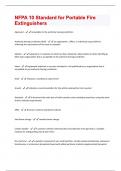
Approved - Acceptable to the authority having jurisdiction Authority Having Jurisdiction (AHJ) - an organization , Office, or individual responsible for enforcing the requirement of the code or standard labeled - equipment or materials to which has been attached a label symbol or other identifying Mark open organization that is acceptable to the authority having jurisdiction listed - equipment materials or services included in a list published by an organization that is acceptable to you authority having jurisdiction Shall - Indicates a mandatory requirement should - Indicates a recommendation for the witches advised but not required Standard - A document the main text of which contains only mandatory provisions using the word shall to indicate requirements ANSI - American national standards institute Anti-freeze charge - Loaded stream charge Carbon dioxide - A colorless odorless electronically nonconductive inert gas that is a suitable medium for extinguishing class B and C fires Dry chemical - a powder composed of very small particles, Usually sodium bicarbonate, potassium bicarbonate, or ammonium phosphate based with added particular material supplemented by specialtreatment to provide resistance to packing, resistance to moisture absorption, in the proper flow capabilities wet chemical - normally an aqueous solution of organic or inorganic salts or combustion thereof that forms and extinguishing agent clean agent - electronically non-conducting, volatile, or gaseous fire extinguishant that does not leave a residue upon evaporation dry chemical closed recovery system - A system that is constructed in a manner that does not introduce foreign material into the agent being recovered and has a means of visually inspecting the recovered agent for contaminants Halogenated closed recovery system - A system that provides for the transfer of halogenated agents between fire extinguishers, supply containers, and recharge and recovery containers so that none of the halogenated agent escapes into the atmosphere High pressure cylinder - cylinders and cartridges containing nitrogen, compressed air, carbon dioxide, or other gases at a pressure higher than 500 psi at 70°F low-pressure cylinder - cylinders containing fire extinguishing agent, nitrogen, compressed air, or other compressed gases at a service pressure of 500 psi or lower at 70°F DOT - US department of transportation Dry powder - solid materials in a powder or granular form designed to extinguish class D combustible metal fires by crusting, smothering, or heat transferring means Electronic monitoring - A method of electronic communication between an in-place fire extinguisher and an electronic monitoring device/systemextinguisher bracket - extinguisher retention device to designed to mount and secure a specific extinguisher model onto various surfaces by incorporating releasable straps or bands to secure the fire extinguisher Extinguisher cabinet - an identifiable and readily accessible fire extinguisher housing device designed to store and protect fire equipment extinguisher hanger - extinguisher mounting device designed for mounting a specific extinguisher model on to stationary vertical surfaces extinguisher inspection - A quick check that a fire extinguisher is in its designated place, that it has not been actuated or tampered with, and that there is no obvious physical damage or condition to prevent its operation Extinguisher maintenance - a thorough examination of the fire extinguisher that is intended to give maximum assurance that a fire extinguisher will operate effectively and safely and to determine if physical damage or condition will prevent its operation Film-forming foam agents - aqueous film-forming foam(AFFF) and film-forming fluoroprotein foam(FFFP) flammable liquids of appreciable depth - flammable liquids of appreciable depth are those with a depth greater than 1/4 inch Halogenated agents - halocarbons or halons Hydrostatic testing - pressure testing of the extinguisher to verify its strength against unwanted rupture Loaded stream charge - A water-based extinguishing agent that uses an alkali metal salt as a freezing point depressantMild steel shell - all steel shells other than stainless steel shells used for high-pressure cylinders Extinguisher service pressure - The normal operating pressure as indicated on the nameplate or cylinder of a fire extinguisher Factory test pressure - The pressure shown on the name plate at which a shell was tested at time of manufacture Pressurized flammable liquid fires - fires resulting from liquids that are forced, pumped, or sprayed recharging - The replacement of the extinguishing agent servicing - performing maintenance, recharging, or hydrostatic testing on a fire extinguisher TC - Transport Canada Travel distance - The actual walking distance from any point to the nearest fire extinguisher fulfilling hazard requirements Wetting agent - A concentrate which, when added to water reduces the surface tension and increases its ability to penetrate and spread
Written for
- Institution
- NFPA 10 Standard for Portable Fire Extinguishers
- Course
- NFPA 10 Standard for Portable Fire Extinguishers
Document information
- Uploaded on
- May 5, 2024
- Number of pages
- 6
- Written in
- 2023/2024
- Type
- Exam (elaborations)
- Contains
- Questions & answers
Subjects
-
nfpa 10 standard for portable fire extinguishers

Also available in package deal