8. Visual motion perception
v = vision/visual; m = motion; e= eye(s); mvt = movement; ° = tion; RF = receptive field(s); = = is/are;
w/ = with; envt = environment, xpce = experience
Motion aftereffect (MAE) = illusion of motion of a stationary object that occurs after prolonged
exposure to a moving object.
Computation of visual motion
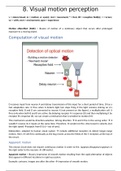
D receives input from neuron A and delays transmission of this input for a short period of time. D has a
fast adaptation rate. It fires when A detects light but stops firing if the light remains shining on A’s
receptive field. B and D are connected to neuron X (not present on the figure), a multiplication cell. X
fires only when both B and D are active. By delaying receptor A’s response (D) and then multiplying it by
receptor B’s response (X), we can create a mechanism that is sensitive to motion (M).
This mechanism would be direction-selective. Wrong direction B and D fire in the wrong order X
wouldn’t receive its 2 inputs at the same time. Therefore, M would not fire. Also tuned in velocity (not
the right speed outputs from B & d = out of sync).
Elaboration, adapted to human visual system include additional receptors to detect longer-range
motion. Here, M cell fires continually as the bug moves across the fields of the 5 receptors at the top of
the circuit.
Apparent motion
This neural circuit does not require continuous motion in order to fire. (appears/disappears/appears in
the right order to the neurons still works).
Apparent motion = illusory impression of smooth motion resulting from the rapid alternation of objects
that appear in different locations in rapid succession.
Example: cartoons. Images one after the other impression of smooth motion.
v = vision/visual; m = motion; e= eye(s); mvt = movement; ° = tion; RF = receptive field(s); = = is/are;
w/ = with; envt = environment, xpce = experience
Motion aftereffect (MAE) = illusion of motion of a stationary object that occurs after prolonged
exposure to a moving object.
Computation of visual motion
D receives input from neuron A and delays transmission of this input for a short period of time. D has a
fast adaptation rate. It fires when A detects light but stops firing if the light remains shining on A’s
receptive field. B and D are connected to neuron X (not present on the figure), a multiplication cell. X
fires only when both B and D are active. By delaying receptor A’s response (D) and then multiplying it by
receptor B’s response (X), we can create a mechanism that is sensitive to motion (M).
This mechanism would be direction-selective. Wrong direction B and D fire in the wrong order X
wouldn’t receive its 2 inputs at the same time. Therefore, M would not fire. Also tuned in velocity (not
the right speed outputs from B & d = out of sync).
Elaboration, adapted to human visual system include additional receptors to detect longer-range
motion. Here, M cell fires continually as the bug moves across the fields of the 5 receptors at the top of
the circuit.
Apparent motion
This neural circuit does not require continuous motion in order to fire. (appears/disappears/appears in
the right order to the neurons still works).
Apparent motion = illusory impression of smooth motion resulting from the rapid alternation of objects
that appear in different locations in rapid succession.
Example: cartoons. Images one after the other impression of smooth motion.