

Need for gluconeogenesis.
When glucose runs out, it is synthesised from non-carbohydrates precursors. Common
sources are lactate, alanine and glycerol = these are used to make pyruvate which is turned
into glucose.
Occurs in the kidneys and liver.
The irreversible steps in glycolysis is what we need to overcome to achieve gluconeogenesis.
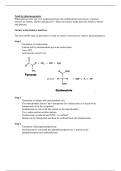
Step 1
- Formation of oxaloacetate.
- Carried out by mitochondrial pyruvate carboxylase.
- Uses ATP
- Activated by acetyl CoA
.
Step 2
- Formation of malate and mitochondrial exit.
- The mitochondria doesn’t have transporter for oxaloacetate as it needs to be
transported out in the cytoplasm.
- Oxaloacetate is converted into malate in the mitochondria.
- It is a redox and reversible reaction.
- Oxaloacetate is reduced and NAD+ is oxidised.
- Malate can be transported and then its oxidised back into Oxaloacetate.
Step 3
- Formation of phosphoenolpyruvate.
- Oxaloacetate is converted into phosphoenolpyruvate. Carried out by
phosphoenolpyruvate carboxykinase.
, - Used GTP
Step 4
- Generation of fructose 6-phosphate from fructose 1,6-bisphosphate.
- Carried out by phosphoenolpyruvate carboxykinase.
Step 5
- Formation of glucose
- Glucose 6-phosphate is converted into glucose.
- Carried out by glucose 6-phosphatases which is located inside the ER.
When glucose runs out, it is synthesised from non-carbohydrates precursors. Common
sources are lactate, alanine and glycerol = these are used to make pyruvate which is turned
into glucose.
Occurs in the kidneys and liver.
The irreversible steps in glycolysis is what we need to overcome to achieve gluconeogenesis.
Step 1
- Formation of oxaloacetate.
- Carried out by mitochondrial pyruvate carboxylase.
- Uses ATP
- Activated by acetyl CoA
.
Step 2
- Formation of malate and mitochondrial exit.
- The mitochondria doesn’t have transporter for oxaloacetate as it needs to be
transported out in the cytoplasm.
- Oxaloacetate is converted into malate in the mitochondria.
- It is a redox and reversible reaction.
- Oxaloacetate is reduced and NAD+ is oxidised.
- Malate can be transported and then its oxidised back into Oxaloacetate.
Step 3
- Formation of phosphoenolpyruvate.
- Oxaloacetate is converted into phosphoenolpyruvate. Carried out by
phosphoenolpyruvate carboxykinase.
, - Used GTP
Step 4
- Generation of fructose 6-phosphate from fructose 1,6-bisphosphate.
- Carried out by phosphoenolpyruvate carboxykinase.
Step 5
- Formation of glucose
- Glucose 6-phosphate is converted into glucose.
- Carried out by glucose 6-phosphatases which is located inside the ER.


