

The first steps in vision: from light to
neural signals
Light physics
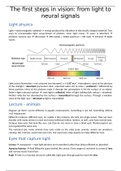
Light = electromagnetic radiation (= energy produced by vibrations of electrically charged material). Two
ways to conceptualize light: wave/stream of photons. Here: light moves wave. Is absorbed
particles. Gamma rays Ultraviolet 400 (violet) | Visible spectrum | 700 (red) Infrared Radio
waves.
Light waves themselves = not coloured (we interpret). c = 3.108 m.s-1. Atmosphere: some of the photons
of the starlight = absorbed (encounters dust, vaporized water etc) & some = scattered (= diffracted) by
these particles. Most of the photons make it through the atmosphere & hit the surface of an object.
Strike a light-coloured surface most light is reflected. Most of light striking dark surface = absorbed.
Neither reflected nor absorbed by the surface = transmitted through the surface. Through a window:
some of the light rays = refracted as light is transmitted.
Lecture - animals
Diagram up there: can be different in aquatic environments. Something is not red. Something reflects
‘red’ frequencies.
Different creatures, different eyes, ex: copilia, a tiny creature, ahs only one single sensor. Flies can have
facettes with many sensors in each and many individual retinas. Spiders, as well, cane have several eyes.
Octopus have eyes that look like ours, but they do not seem to have a blind spot. Photoreceptors are
not organized the same way.
The vertebral eye: many animals have eyes really on the sides (pray animals: wanna see predators
coming). We, humans, need more eye mvts. Our eyes have a big capacity to make different mvts.
Eyes that capture light
Cornea transparent = most light photons are transmitted rather than being reflected or absorbed.
Aqueous humour fluid filling the space behind the cornea. Gives oxygen & nutrients to cornea & lens
and remove waste from them.
Pupil hole in a muscular structure called iris. Light goes through pupil to reach the lens.
, Iris gives the eye its distinctive colour. Controls the size of the pupil & thus the amount of light that
reaches the retina (pupillary light reflex). Automatically expands or contracts depending on the amount
of light.
Lens shape is controlled by the ciliary muscle.
Vitreous humour fills the vitreous chamber. After passing through the lens, light enters this space
between the lens and the retina and is refracted for the final time by the vitreous humour.
Retina some of the light is brought into focus at the retina. Much of it have been lost in space,
atmosphere (absorption, scattering), in the eyeball (half of the light that reaches the cornea does reach
the retina). Retina = where seeing really beings. Image on the retina = reversed right to left & is upside
down. “Hole” because of optic nerve = optic disc. Here, absence of photoreceptors blind spot.
Focusing light onto the retina
To focus on the retina, perfect match between the refractive power of the eye components and the
length of the eyeball is necessary. This perfect match = emmetropia. Refractive errors: eyeball = too
long or too short relative to the power of the optic components. Too long = image focused in front of
retina myopia. Too short for the optics = image focused behind retina hyperopia.
Cornea not spherical astigmatism. Vertical lines = focused in front of the retina & horizontal are
focused behind or vice versa some lines = blurred and others are sharp.
Refraction (= light bending) = necessary to focus light rays. Refraction: cornea, aqueous & vitreous
humours (cornea > humours).
Bring close objects to focus lens (alter the refracting power by changing its shape = accommodation).
Accommodation = contraction of the ciliary muscle. Lens: flat distant objects; ciliary muscle contracts,
lens is bulged (= gonflé) close objects. The fatter the lens is, the more power it has. Presbyopia =
can’t accommodate properly.
Cataracts = loss of transparency of the lens. Interfere w/ vision (they absorb & scatter more light than
the normal lens does).
The retina
Taking a picture = record the image and that’s all; human visual system: purpose = interpreting the
image. Process of seeing begins w/ retina. In the retina, light energy = transduced into neural energy
that can be interpreted by the brain. Transduce = convert from one form of energy to another (ex: light
to neural electrical energy, mechanical movement to neural electrical energy).
neural signals
Light physics
Light = electromagnetic radiation (= energy produced by vibrations of electrically charged material). Two
ways to conceptualize light: wave/stream of photons. Here: light moves wave. Is absorbed
particles. Gamma rays Ultraviolet 400 (violet) | Visible spectrum | 700 (red) Infrared Radio
waves.
Light waves themselves = not coloured (we interpret). c = 3.108 m.s-1. Atmosphere: some of the photons
of the starlight = absorbed (encounters dust, vaporized water etc) & some = scattered (= diffracted) by
these particles. Most of the photons make it through the atmosphere & hit the surface of an object.
Strike a light-coloured surface most light is reflected. Most of light striking dark surface = absorbed.
Neither reflected nor absorbed by the surface = transmitted through the surface. Through a window:
some of the light rays = refracted as light is transmitted.
Lecture - animals
Diagram up there: can be different in aquatic environments. Something is not red. Something reflects
‘red’ frequencies.
Different creatures, different eyes, ex: copilia, a tiny creature, ahs only one single sensor. Flies can have
facettes with many sensors in each and many individual retinas. Spiders, as well, cane have several eyes.
Octopus have eyes that look like ours, but they do not seem to have a blind spot. Photoreceptors are
not organized the same way.
The vertebral eye: many animals have eyes really on the sides (pray animals: wanna see predators
coming). We, humans, need more eye mvts. Our eyes have a big capacity to make different mvts.
Eyes that capture light
Cornea transparent = most light photons are transmitted rather than being reflected or absorbed.
Aqueous humour fluid filling the space behind the cornea. Gives oxygen & nutrients to cornea & lens
and remove waste from them.
Pupil hole in a muscular structure called iris. Light goes through pupil to reach the lens.
, Iris gives the eye its distinctive colour. Controls the size of the pupil & thus the amount of light that
reaches the retina (pupillary light reflex). Automatically expands or contracts depending on the amount
of light.
Lens shape is controlled by the ciliary muscle.
Vitreous humour fills the vitreous chamber. After passing through the lens, light enters this space
between the lens and the retina and is refracted for the final time by the vitreous humour.
Retina some of the light is brought into focus at the retina. Much of it have been lost in space,
atmosphere (absorption, scattering), in the eyeball (half of the light that reaches the cornea does reach
the retina). Retina = where seeing really beings. Image on the retina = reversed right to left & is upside
down. “Hole” because of optic nerve = optic disc. Here, absence of photoreceptors blind spot.
Focusing light onto the retina
To focus on the retina, perfect match between the refractive power of the eye components and the
length of the eyeball is necessary. This perfect match = emmetropia. Refractive errors: eyeball = too
long or too short relative to the power of the optic components. Too long = image focused in front of
retina myopia. Too short for the optics = image focused behind retina hyperopia.
Cornea not spherical astigmatism. Vertical lines = focused in front of the retina & horizontal are
focused behind or vice versa some lines = blurred and others are sharp.
Refraction (= light bending) = necessary to focus light rays. Refraction: cornea, aqueous & vitreous
humours (cornea > humours).
Bring close objects to focus lens (alter the refracting power by changing its shape = accommodation).
Accommodation = contraction of the ciliary muscle. Lens: flat distant objects; ciliary muscle contracts,
lens is bulged (= gonflé) close objects. The fatter the lens is, the more power it has. Presbyopia =
can’t accommodate properly.
Cataracts = loss of transparency of the lens. Interfere w/ vision (they absorb & scatter more light than
the normal lens does).
The retina
Taking a picture = record the image and that’s all; human visual system: purpose = interpreting the
image. Process of seeing begins w/ retina. In the retina, light energy = transduced into neural energy
that can be interpreted by the brain. Transduce = convert from one form of energy to another (ex: light
to neural electrical energy, mechanical movement to neural electrical energy).




