

3. Spatial vision: from spots to
stripes
Image with blue & white circles (ON/OFF etc) if surround is illuminated: inhibition for an ON-centre,
but when the surround’s illumination is removed, then the centre is more illuminated compared to the
surround than it was before later, you have a response. That’s why you have a response although the
OFF part is illuminated and not the centre.
If we only had ON-centre: dark edge, little response. ON = makes the diff btwn bright é very bright but
not btwn dark & very dark. Only ON: dark edges less detectable. Centre-surround organization
emphasises edges. Both ON and OFF systems emphasise even further. Only ON centre: only bright
edges, OFF: only dark ones, both: you can see clearer all the details.
Go from fovea to periph receptive fields become bigger less precise/accurate view.
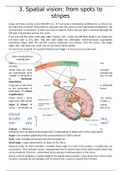
Basic visual pathway -
Lateralization
Superior colliculus eye
saccades.
Things that are more eccentric
are represented more towards the
‘middle’ of the brain in the V1 due
to retinotopic
organization.
A big part of the brain is dedicated
to the processing of foveal
info/inputs ( cortical
magnification).
Striate cortex = there are stripes.
Input from LGN arrives in layer 4.
Hubel & Wiesel tuning
curves / orientation of bars (cat).
Visual
acuity: oh say,
can you see?
Contrast = difference in
luminance btwn an object & the background, or btwn lighter & darker parts of the same object.
Acuity = the smallest spatial detail that can be resolved at 100% contrast.
Cycle = pair consisting of one dark bar and one bright bar.
Visual angle = angle subtended by an object at the retina.
Measure acuity vision scientists = smallest visual angle of a cycle of the grating (= la grille) that we
can perceive. This resolution acuity = fundamental limit of spatial vision (finest high-contrast detail that
can be resolved). This limit = determined by the spacing of photoreceptors in the retina.
Rods & cones in periphery = packed together less tightly (rods in periph = more dense than cones); many
receptors converge on each ganglion cell visual acuity = poorer in periph than in fovea.
, Types of visual acuity
Finest stripes that can be resolved = minimum resolvable acuity; smallest letter that can be recognized =
minimum recognizable acuity. Visual acuity is used to specify a spatial limit.
Minimum visible acuity
Minimum visible acuity = smallest object that one can detect. It is so small for two reasons. First, the
optics of the eye spread the image of the thin line, making it much wider on the retina. Second, the
fuzzy retinal image of the line casts a shadow that reduces the light on a row of cones to a level that is
just detectably less than the light on the row of cones on either side. although we specify the
minimum visible acuity in terms of the angular size of the target at the retina, it is actually limited by our
ability to discriminate the intensity of the target relative to its background. Thus, the minimum visible
acuity is a limit in the ability to discern small changes in contrast, rather than a spatial limit per se.
Minimum resolvable acuity
Minimum resolvable acuity = smallest angular separation btwn neighbouring objects that one can
resolve. Fundamental limit of spatial vision finest high-contrast detail that can be resolved. Foveal
vision: limit is determined by the spacing of photoreceptors in the retina.
Minimum recognizable acuity
Minimum recognizable acuity = angular size of the smallest feature that one can recognize or identify.
Minimum discriminable acuity
Minimum discriminable acuity = angular size of the smallest change in a feature that one can
discriminate (size, position, orientation). This acuity is extremely high in humans.
Acuity for low-contrast stripes
Spatial frequency = number of grating cycles (dark & bright stripes) in a given unit of space.
Cycles per degree = number of grating cycles per degree of visual angle.
Contrast sensitivity function (CSF) = a function describing how the sensitivity to contrast depends on
the spatial frequency (size) of the stimulus. Describes the entire system’s sensitivity to contrast (how
much contrast do we need to see?). CSF depends on age.
Contrast threshold = smallest amount of contrast required to detect a pattern.
CSF is influenced by the adaptation level of the eye (scotopic/photopic) temporal modulation and age.
Orientation = axis of the grating’s bars.
Spatial phase = a grating’s position relative to some landmark.
Why sine wave gratings?
‘Pure’ sine wave gratings = rare in the real world; patterns of stripes w/ fuzzy boundaries = common.
+ edge of any object produces a single stripe, often blurred by a shadow, in the retinal image.
Visual system breaks down real-world images into a vast number of components (sine wave
grating with a particular spatial frequency (analogous auditory system).
Retinal ganglion cells and stripes
Ganglion cells respond vigorously to spots of light each ganglion cell also responds well to certain
types of stripes or gratings.
Spatial frequency/grating = too low responds weakly (bright bar of the grating lands in the
inhibitory surround; damped response)
Spatial frequency = too high responds weakly (both dark & bright stripes fall within the
receptive field centre; washed out response)
stripes
Image with blue & white circles (ON/OFF etc) if surround is illuminated: inhibition for an ON-centre,
but when the surround’s illumination is removed, then the centre is more illuminated compared to the
surround than it was before later, you have a response. That’s why you have a response although the
OFF part is illuminated and not the centre.
If we only had ON-centre: dark edge, little response. ON = makes the diff btwn bright é very bright but
not btwn dark & very dark. Only ON: dark edges less detectable. Centre-surround organization
emphasises edges. Both ON and OFF systems emphasise even further. Only ON centre: only bright
edges, OFF: only dark ones, both: you can see clearer all the details.
Go from fovea to periph receptive fields become bigger less precise/accurate view.
Basic visual pathway -
Lateralization
Superior colliculus eye
saccades.
Things that are more eccentric
are represented more towards the
‘middle’ of the brain in the V1 due
to retinotopic
organization.
A big part of the brain is dedicated
to the processing of foveal
info/inputs ( cortical
magnification).
Striate cortex = there are stripes.
Input from LGN arrives in layer 4.
Hubel & Wiesel tuning
curves / orientation of bars (cat).
Visual
acuity: oh say,
can you see?
Contrast = difference in
luminance btwn an object & the background, or btwn lighter & darker parts of the same object.
Acuity = the smallest spatial detail that can be resolved at 100% contrast.
Cycle = pair consisting of one dark bar and one bright bar.
Visual angle = angle subtended by an object at the retina.
Measure acuity vision scientists = smallest visual angle of a cycle of the grating (= la grille) that we
can perceive. This resolution acuity = fundamental limit of spatial vision (finest high-contrast detail that
can be resolved). This limit = determined by the spacing of photoreceptors in the retina.
Rods & cones in periphery = packed together less tightly (rods in periph = more dense than cones); many
receptors converge on each ganglion cell visual acuity = poorer in periph than in fovea.
, Types of visual acuity
Finest stripes that can be resolved = minimum resolvable acuity; smallest letter that can be recognized =
minimum recognizable acuity. Visual acuity is used to specify a spatial limit.
Minimum visible acuity
Minimum visible acuity = smallest object that one can detect. It is so small for two reasons. First, the
optics of the eye spread the image of the thin line, making it much wider on the retina. Second, the
fuzzy retinal image of the line casts a shadow that reduces the light on a row of cones to a level that is
just detectably less than the light on the row of cones on either side. although we specify the
minimum visible acuity in terms of the angular size of the target at the retina, it is actually limited by our
ability to discriminate the intensity of the target relative to its background. Thus, the minimum visible
acuity is a limit in the ability to discern small changes in contrast, rather than a spatial limit per se.
Minimum resolvable acuity
Minimum resolvable acuity = smallest angular separation btwn neighbouring objects that one can
resolve. Fundamental limit of spatial vision finest high-contrast detail that can be resolved. Foveal
vision: limit is determined by the spacing of photoreceptors in the retina.
Minimum recognizable acuity
Minimum recognizable acuity = angular size of the smallest feature that one can recognize or identify.
Minimum discriminable acuity
Minimum discriminable acuity = angular size of the smallest change in a feature that one can
discriminate (size, position, orientation). This acuity is extremely high in humans.
Acuity for low-contrast stripes
Spatial frequency = number of grating cycles (dark & bright stripes) in a given unit of space.
Cycles per degree = number of grating cycles per degree of visual angle.
Contrast sensitivity function (CSF) = a function describing how the sensitivity to contrast depends on
the spatial frequency (size) of the stimulus. Describes the entire system’s sensitivity to contrast (how
much contrast do we need to see?). CSF depends on age.
Contrast threshold = smallest amount of contrast required to detect a pattern.
CSF is influenced by the adaptation level of the eye (scotopic/photopic) temporal modulation and age.
Orientation = axis of the grating’s bars.
Spatial phase = a grating’s position relative to some landmark.
Why sine wave gratings?
‘Pure’ sine wave gratings = rare in the real world; patterns of stripes w/ fuzzy boundaries = common.
+ edge of any object produces a single stripe, often blurred by a shadow, in the retinal image.
Visual system breaks down real-world images into a vast number of components (sine wave
grating with a particular spatial frequency (analogous auditory system).
Retinal ganglion cells and stripes
Ganglion cells respond vigorously to spots of light each ganglion cell also responds well to certain
types of stripes or gratings.
Spatial frequency/grating = too low responds weakly (bright bar of the grating lands in the
inhibitory surround; damped response)
Spatial frequency = too high responds weakly (both dark & bright stripes fall within the
receptive field centre; washed out response)




