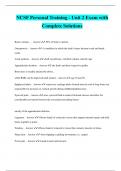
NCSF Personal Training - Unit 2 Exam with Complete Solutions
NCSF Personal Training - Unit 2 Exam with Complete Solutions Bones contain... - Answer ️️ -98% of body's calcium Osteoporosis - Answer ️️ -A condition in which the body's bones become weak and break easily. Axial skeleton - Answer ️️ -skull, hyoid bone, vertebral column, and rib cage Appendicular skeleton - Answer ️️ -the limbs and their respective girdles Bone mass is usually attained by about... while BMD can be improved until around - Answer ️️ -age 18 and 30 Epiphyseal plate - Answer ️️ -transverse cartilage plates located near the end of long bones are responsible for increases in vertical growth during childhood/adolescence Synovial joint - Answer ️️ -uses synovial fluid to reduce frictional stresses and allow for considerable movement between the associated articulating bones mostly of the appendicular skeleton Ligament - Answer ️️ -fibrous bands of connective tissue that support internal organs and hold bones together at joints Tendons - Answer ️️ -fibrous band of connective tissue that connects muscles to bones Plane joint - Answer ️️ -short slipping or gliding movements; i.e. carpals Pivot joint - Answer ️️ -found in neck and forearm Hinge joint - Answer ️️ -found in knees, elbows, fingers, and toes Condyloid joint - Answer ️️ -found in the wrist Saddle joint - Answer ️️ -Only in the thumb Ball-and-Socket joint - Answer ️️ -found in shoulders and hips Skeletal Muscle, Cardiac Muscle, Smooth Muscle - Answer ️️ -3 types of muscle tissue Muscle Fascia - Answer ️️ -fibrous connective tissue that encapsulates full muscles as well as bundles of fibers; provides the muscle's shape and regulates tension/transfer of force across joints Asynchronous firing - Answer ️️ -employed during endurance activities involving slow-twitch fibers which conserve motor unit potential, allowing prolonged work Synchronized firing - Answer ️️ -employed during high-output demands involving fast-twitch fibers and warranting significant fiber recruitment Agonist-antagonist relationships - Answer ️️ -help facilitate smooth force production; one muscle contracts while the muscle on the opposite side of the joint relaxes (neural regulation) Agonist - Answer ️️ -muscle that contracts/shortens during a given exercise (e.g., biceps during a curl) Antagonist - Answer ️️ -muscle that relaxes and lengthens during a given exercise to accommodate contraction of the agonist (e.g., triceps during a biceps curl) Isotonic - Answer ️️ -tension remains constant while joint angles change; seen during most exercises that include an acceleration and deceleration component Concentric - Answer ️️ -occurs during the acceleration phase of a lift as the muscle shortens Eccentric - Answer ️️ -occurs during the deceleration phase of a lift as the muscle lengthens Isometric - Answer ️️ -tension is created but no joint angle changes; common in stabilizers Isokinetic - Answer ️️ -involves a constant speed of movement; requires specialized rehab equipment Type 1 - Answer ️️ -slow-twitch oxidative fibers possess the lowest powe
Written for
- Institution
- Ncsf
- Course
- Ncsf
Document information
- Uploaded on
- May 3, 2024
- Number of pages
- 13
- Written in
- 2023/2024
- Type
- Exam (elaborations)
- Contains
- Questions & answers
Subjects
-
ncsf personal training unit 2 exam with complete

Also available in package deal