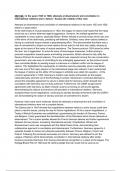
2023 Q4: ‘in the years 1923 to 1928, attempts at disarmament and conciliation in
international relations were a failure.’ Assess the validity of this view
Attempts at disarmament and conciliation in international relations in the years 1923 and 1928
failed to a large extent.
At the draft treaty of mutual assistance in 1923, the league of nations had hoped that the treaty
would act as a severe deterrent against aggression. However, the drafted agreement was
unpalatable to many nations, especially Britain. Britain refused to provide troops which was one
of the terms of the draft treaty, prioritizing self-defense. Similarly, many other nations balked at
having to contribute troops towards a peacekeeping effort. This demonstrated that there was a
lack of commitment to disarm as most nations did not want to risk their own safety, refusing to
agree to the terms of the treaty of mutual assistance. The Geneva protocol 1924 aimed to refine
the term ‘act of aggression’ to solve the issue of slow league responses, further aiming to
promote cooperation towards peace and limiting armaments. Britain refused to fully ratify the
Geneva Protocol for several reasons. The protocol was unpopular among the new conservative
government, who was wary of committing to any entangling agreements, as the protocol would
have committed Britain to sending troops to intervene in a distant conflict via the league of
nations. This highlighted the unpopularity of collective security especially since it was Britain
who was one of the major players on the international stage who refused. It also undermined
the league of nations as the ability of the league to arbitrate was called into question. At the
Locarno agreements in 1925, Germany’s reaction was hardly enthusiastic as the largest
nationalist party stormed out of the Reichstag in protest. Stresemann continued attempts to
amend the Versailles agreement to secure a better deal for Germany which showed how
conciliation with Germany was not fully achieved. Furthermore, the USSR sought secret
agreements with Germany, as Stalin viewed Locarno as having an anti-soviet agenda,
demonstrating the distrust and tensions still prevalent in international relations. Germany
accepted these secret negotiations, continuing to secretly develop armaments with the USSR’s
aid, demonstrating the nature of secrecy and lack of commitment to disarm.
However, there were some instances where the attempts at disarmament and conciliation in
international relations were not a complete failure.
The Dawes plan in 1924 showed that negotiations between nations to solve issues could take
place to resolve issues, paving the way for future negotiations. At the Locarno negotiations, a
Treaty of Mutual Guarantee was established, guaranteeing the borders of Germany, France,
and Belgium. It also guaranteed the demilitarization of the Rhineland which shows attempts at
disarmament. The Locarno treaties allowed for Franco-German détente and further agreements
between the two powers, increasing international security; Chamberlain, Briand and
Stressenman’s work was recognised with the Nobel Peace Prize, demonstrating their
collaborative approach to conciliation and disarmament. Furthermore, Germany agreed to 4
separate treaties to resolve any disputes peacefully between France, Belgium, Czech and
Poland. Following the perceived successes at Locarno, Germany was allowed to join the
League of Nations which demonstrates conciliation in international relations after earlier
tensions prevented Germany from having international recognition or a place at the league. The
Kellogg-Briand Pact of 1928 saw 62 nations pledge that war would not be used as an
international relations were a failure.’ Assess the validity of this view
Attempts at disarmament and conciliation in international relations in the years 1923 and 1928
failed to a large extent.
At the draft treaty of mutual assistance in 1923, the league of nations had hoped that the treaty
would act as a severe deterrent against aggression. However, the drafted agreement was
unpalatable to many nations, especially Britain. Britain refused to provide troops which was one
of the terms of the draft treaty, prioritizing self-defense. Similarly, many other nations balked at
having to contribute troops towards a peacekeeping effort. This demonstrated that there was a
lack of commitment to disarm as most nations did not want to risk their own safety, refusing to
agree to the terms of the treaty of mutual assistance. The Geneva protocol 1924 aimed to refine
the term ‘act of aggression’ to solve the issue of slow league responses, further aiming to
promote cooperation towards peace and limiting armaments. Britain refused to fully ratify the
Geneva Protocol for several reasons. The protocol was unpopular among the new conservative
government, who was wary of committing to any entangling agreements, as the protocol would
have committed Britain to sending troops to intervene in a distant conflict via the league of
nations. This highlighted the unpopularity of collective security especially since it was Britain
who was one of the major players on the international stage who refused. It also undermined
the league of nations as the ability of the league to arbitrate was called into question. At the
Locarno agreements in 1925, Germany’s reaction was hardly enthusiastic as the largest
nationalist party stormed out of the Reichstag in protest. Stresemann continued attempts to
amend the Versailles agreement to secure a better deal for Germany which showed how
conciliation with Germany was not fully achieved. Furthermore, the USSR sought secret
agreements with Germany, as Stalin viewed Locarno as having an anti-soviet agenda,
demonstrating the distrust and tensions still prevalent in international relations. Germany
accepted these secret negotiations, continuing to secretly develop armaments with the USSR’s
aid, demonstrating the nature of secrecy and lack of commitment to disarm.
However, there were some instances where the attempts at disarmament and conciliation in
international relations were not a complete failure.
The Dawes plan in 1924 showed that negotiations between nations to solve issues could take
place to resolve issues, paving the way for future negotiations. At the Locarno negotiations, a
Treaty of Mutual Guarantee was established, guaranteeing the borders of Germany, France,
and Belgium. It also guaranteed the demilitarization of the Rhineland which shows attempts at
disarmament. The Locarno treaties allowed for Franco-German détente and further agreements
between the two powers, increasing international security; Chamberlain, Briand and
Stressenman’s work was recognised with the Nobel Peace Prize, demonstrating their
collaborative approach to conciliation and disarmament. Furthermore, Germany agreed to 4
separate treaties to resolve any disputes peacefully between France, Belgium, Czech and
Poland. Following the perceived successes at Locarno, Germany was allowed to join the
League of Nations which demonstrates conciliation in international relations after earlier
tensions prevented Germany from having international recognition or a place at the league. The
Kellogg-Briand Pact of 1928 saw 62 nations pledge that war would not be used as an