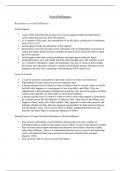
Social Influence:
Resistance to social influence:
Social Support:
Asch (1956) found that the presence of of social support enables an individual to
resist conformity pressure from the majority
in a variation of his study, the introduction of an ally led to a reduction in conformity
from 33% to 5.5%
social support breaks the unanimity of the majority
the presence of an ally provides an the individual with an independent assessment of
reality that makes them feel more confident in their decision and better able to stand
up to the majority
social support also help resisting obedience and opposing an authority figure
disobedient peers act a role model and help make standing up to the authority easier
in a variation of Milgram’s study, the participant was one of a team of three testing
the learner and when they refused to continue shocking the learner, obedience levels
dropped with only 10% continuing to the maximum 450V shock level
Locus of Control:
a scale of a person’s perception of personal control over their own behaviour
high internal or high external are the two opposite sides
a strong internal locus of control is when we believe that we control events in our life
and that what happens is a consequence of our own ability and effort. They are
independent in their thoughts and behaviours and they rely lesson the opinion if others
which means that they are better able to resist social influence
a strong external locus of control is when we believe that what happens is determined
by external factors like the influence of others or luck. They believe that things ‘just
happen to them’ and is out of their control. They approach events with a passive and
fatalistic attitude and they take less personal responsibility for their actions (often go
into the agentic state). They are less likely to display independent behaviour and
therefore are more likely to accept the influence of others
Internal Locus of Control and their Resistance to Social Influence:
they are less vulnerable to social influence because they are active seekers of
information that is useful to them and so are less likely to rely on the opinion of others
they are more achievement orientated and therefore more likely to become leaders
rather than followers. There is a relationship between locus of control and leadership
styles with internals being more persuasive and goal-orientated than externals
(Spector 1982)
they are better able to resist coercion from others
Resistance to social influence:
Social Support:
Asch (1956) found that the presence of of social support enables an individual to
resist conformity pressure from the majority
in a variation of his study, the introduction of an ally led to a reduction in conformity
from 33% to 5.5%
social support breaks the unanimity of the majority
the presence of an ally provides an the individual with an independent assessment of
reality that makes them feel more confident in their decision and better able to stand
up to the majority
social support also help resisting obedience and opposing an authority figure
disobedient peers act a role model and help make standing up to the authority easier
in a variation of Milgram’s study, the participant was one of a team of three testing
the learner and when they refused to continue shocking the learner, obedience levels
dropped with only 10% continuing to the maximum 450V shock level
Locus of Control:
a scale of a person’s perception of personal control over their own behaviour
high internal or high external are the two opposite sides
a strong internal locus of control is when we believe that we control events in our life
and that what happens is a consequence of our own ability and effort. They are
independent in their thoughts and behaviours and they rely lesson the opinion if others
which means that they are better able to resist social influence
a strong external locus of control is when we believe that what happens is determined
by external factors like the influence of others or luck. They believe that things ‘just
happen to them’ and is out of their control. They approach events with a passive and
fatalistic attitude and they take less personal responsibility for their actions (often go
into the agentic state). They are less likely to display independent behaviour and
therefore are more likely to accept the influence of others
Internal Locus of Control and their Resistance to Social Influence:
they are less vulnerable to social influence because they are active seekers of
information that is useful to them and so are less likely to rely on the opinion of others
they are more achievement orientated and therefore more likely to become leaders
rather than followers. There is a relationship between locus of control and leadership
styles with internals being more persuasive and goal-orientated than externals
(Spector 1982)
they are better able to resist coercion from others