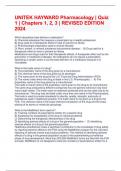
UNITEK HAYWARD Pharmacology | Quiz 1 | Chapters 1, 2, 3 | REVISED EDITION 2024 Which description best defines a medication? A) Chemical substance that requires a prescription by a health professional B) Drug used for a therapeutic effect to treat or prevent an illness C) Pharmacologic preparation used to reverse disease D) Plant, animal, or mineral substance that prevents disea se - B) Drug used for a therapeutic effect to treat or prevent an illness Medications are drugs used for their therapeutic effects. A therapeutic effect can be the prevention or treatment of disease. All medications do not require a prescription. Specify ing a certain action is not the best definition of a medication because it is incomplete. What is the trade name of a drug? A) The proprietary name of the drug given by a manufacturer. B) The chemical name of the drug given by its developer. C) The name g iven to the drug by the U.S. Food and Drug Administration (FDA). D) The name under which the drug is listed in the U.S. Pharmacopeia. - A) The proprietary name of the drug given by a manufacturer. The trade or brand name is the proprietary name given to the drug by its manufacturer. The same drug produced by different companies has one generic name but may have many trade names. The trade name is trademark protected and can be used only by its manufacturer. The drug may be listed under more than one name in the Pharmacopeia. The book is used to provide standards for identity, quality, strength, and purity of substances used in healthcare practice. The trade name is not given to a drug by the FDA. The chemical name is the exact chemical constitution of the drug and the exact placing of its atoms or molecular groupings. What is the MedWatch form used for? A) Tracking numbers of prescriptions written for a specific drug B) Assessing the acceptability of the drug to individual patients C) Determining the thera peutic effectiveness of the drug D) Identifying adverse effects of a drug in the general population - D) Identifying adverse effects of a drug in the general population Healthcare practitioners make a significant contribution to the knowledge of drug saf ety by reporting adverse effects to the FDA using the MedWatch program for the voluntary reporting of adverse events and product problems. This method of identifying adverse effects of a drug in the general population is part of the postmarketing surveilla nce phase of drug development. More than 200,000 MedWatch forms are filed with the FDA annually. MedWatch is not designed to track the numbers of prescriptions written for a specific drug; is not a program involved in determining the therapeutic effectiven ess of a drug; and is not involved in assessing the acceptability of a drug to individual patients. Which statement about drug names is correct? A) Drugs are listed by their chemical names in the U.S. Pharmacopeia. B) A drug may have multiple proprietary names. C) The generic name is a trademarked name. D) The official name must be used on all prescriptions. - B) A drug may have multiple proprietary names. The proprietary name of a drug is a trade or brand name and is followed by the symbol ®. Each manufacturer of a drug can register a proprietary name that can be used only by that company. Thus a drug produced by more than one manufacturer can have multiple proprietary names but only one generic name. Drugs are listed by their official names in the U.S. Pharmacopeia. Generic names are not trademarked. Prescriptions can be written using generic or trade names. How do Schedule II drugs differ from Schedule V drugs? A) Schedule V drugs have greater risk for toxicity. B) Schedule II drugs have less potential for abuse. C) Schedule V drugs lack accepted safety measures for use. D) Schedule II drugs are more likely to cause dependence. - D) Schedule II drugs are more likely to cause dependence. Schedule II drugs have a high potential for abuse that may lead to severe psychological or physical dependence. Schedule II drugs have more, not less, potential for abuse than Schedule V drugs. Schedule II and Schedule V d rugs have accepted guidelines for safe use. Drugs in both schedules are not differentiated based on toxicity. There may be drugs in each schedule that have high or low toxicity. Which legislation was written to require companies to determine the safety of medications before marketing? A) The Federal Food, Drug, and Cosmetic Act of 1938 B) Durham Humphrey Amendment of 1952 C) The Kefauver Harris Drug Amendment of 1962 D) Controlled Substance Act of 1970 - A) The Federal Food, Drug, and Cosmetic Act of 193 8 The Federal Food, Drug, and Cosmetic Act of 1938 (passed on June 25, 1938, and amended in 1952 and 1962) requires the FDA to determine the safety of drugs before marketing and to ensure that certain labeling specifications and standards in advertising are met in the marketing of products. Manufacturers are required to submit new drug applications to the FDA for review of safety studies before products can be released. The Durham Humphrey Amendment of 1952 was passed to tighten control over prescription dr ugs by restricting the refilling of prescriptions. The Kefauver Harris Drug Amendment of 1962 was brought about by the thalidomide tragedy. The amendment provides greater control and surveillance of the distribution and clinical testing of investigational drugs, and requires that a product be proven safe and effective before release for sale. The Controlled Substance Act of 1970 was passed by Congress to improve the administration and regulation of manufacturing, distributing, and dispensing of drugs that h ave been found necessary to be controlled. Which legislation was enacted to stimulate development and availability of drugs to treat rare diseases? A) The Orphan Drug Act B) The Fast Tracking rules C) The Controlled Drugs and Substance Act of 1997 D) The Food and Drug Act of 1979 - A) The Orphan Drug Act The medicines that are developed for rare conditions are known as orphan drugs, because the manufacturers have been unable to recover the costs of the research due to the very limited use of the final pr oduct. Because no companies were willing to "adopt" the disease to complete extensive research to develop products for treatment, the diseases became known as health orphans. In 1983, Congress passed the Orphan Drug Act to stimulate the development and mar ket availability of products that are used for the treatment of rare diseases. The Orphan Drug Act provides research grants, protocol development assistance by the FDA, special tax credits for the cost of clinical trials, and 7 years of exclusive marketing rights after the product has been approved. The Food and Drug Act of 1979 empowered Health Canada to protect the public from foreseeable risks relating to the manufacture and sale of drugs. The Fast Tracking rules allow investigational drugs to receive hi ghest priority for review with the FDA. The Controlled Drugs and Substance Act of 1997 established the requirements for control and sale of narcotics and substances of abuse in Canada. Which stage of new drug development involves giving the medication to large numbers of individuals with the disorder that the medication intends to treat? A) Developmental stage —Phase 2 B) Postmarketing surveillance stage C) Developmental stage —Phase 1 D) Developmental stage —Phase 3 - D) Developmental stage —Phase 3 If phas e 1 trials are successful, the drug is moved to phase 2, which involves a smaller population of patients who have the condition that the drug is designed to treat. Studies at various dosages are conducted to determine the success rate and safety of a drug for its intended use. If successful, the drug is advanced to phase 3 trials, in which larger patient populations are used to ensure the statistical significance of the results. Studies in this phase also provide additional information on proper dosing and safety. Phase 1 studies are done to determine an experimental drug's pharmacologic properties, safe dosage range, potential for toxicity at a certain dosage, and safe routes of administration. The study population consists of either normal volunteers or th e intended treatment population, such as those patients who have failed standard treatments of certain cancers or dysrhythmias. Phase 2 studies usually require 20 to 100 subjects, who are treated for 4 to 6 weeks. Studies in this phase are done to determin e the success rate of a drug for its intended use. After the manufacturer decides to market the medication, there is ongoing review of adverse effects of the new drug, as well as periodic inspections of the manufacturing facilities and products.
Exam (elaborations)
UNITEK HAYWARD Pharmacology | Quiz 1 | Chapters 1, 2, 3 | REVISED EDITION 2024
Rating
Sold
-
Pages
16
Grade
A+
Uploaded on
01-05-2024
Written in
2023/2024
UNITEK HAYWARD Pharmacology | Quiz 1 | Chapters 1, 2, 3 | REVISED EDITION 2024
Institution
UNITEK HAYWARD Pharmacology
Course
UNITEK HAYWARD Pharmacology
Whoops! We can’t load your doc right now. Try again or contact support.
Written for
- Institution
- UNITEK HAYWARD Pharmacology
- Course
- UNITEK HAYWARD Pharmacology
Document information
- Uploaded on
- May 1, 2024
- Number of pages
- 16
- Written in
- 2023/2024
- Type
- Exam (elaborations)
- Contains
- Questions & answers
Subjects
-
unitek hayward pharmacology quiz 1 chapters 1
Content preview
$11.49
Get access to the full document:
100% satisfaction guarantee
Immediately available after payment
Both online and in PDF
No strings attached

Also available in package deal
Package deal
UNITEK EXAM PACKAGE DEAL
11
2024
$ 122.89
More info