
Describe the hierarchy of the civil court
The main purpose of the civil
courts is to solve disputes
between civilians which are
linked to the legal duties and
responsibilities they owe
between one to another.If
one of the civilian is found
guilty than the Civil Court
punish it by giving monetary
damages or by putting to do
anything in the good of the
society.
The Hierarchy of the
Civil Court
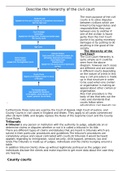
The Civil Court Hierarchy is
quite simple as it could be
seen from the above
diagram, however each cases
are different and are solved
in different courts depending
on the nature of crime.In this
way a civil procedure is made
up in that structure in order
to be used when one civilian
or organisation is making an
appeal about other civilian or
organisation.
Also Civil procedure is the
body of law that sets out the
rules and standards that
courts follow when
adjudicating civil lawsuits (as
Furthermore those rules are used by the Court of Appeal, High Court of Justice, and
County Courts in civil cases in England and Wales. They apply to all cases commenced
after 26 April 1999, and largely replace the Rules of the Supreme Court and the County
Court Rules.
Tribunals
A tribunal is any person or institution with the authority to judge, adjudicate on or
determine claims or disputes whether or not it is called a tribunal in its title.
There are different types of claims and debates that are heard in tribunals which are
solved in their particular procedures and guidelines.The tribunal’s procedures are
completely unique and casual contrasted with courts.At tribunals it would be heard
appeals regarding to immigration, social security, child support, pensions, tax and
lands.The tribunals is made up of judges, individuals and the clients lounging around a
table.
In addition tribunal clients show up without legitimate portrayal so the judges and
individuals disclose the clients and make inquiries to get more data about the case they
are hearing.
County courts
The main purpose of the civil
courts is to solve disputes
between civilians which are
linked to the legal duties and
responsibilities they owe
between one to another.If
one of the civilian is found
guilty than the Civil Court
punish it by giving monetary
damages or by putting to do
anything in the good of the
society.
The Hierarchy of the
Civil Court
The Civil Court Hierarchy is
quite simple as it could be
seen from the above
diagram, however each cases
are different and are solved
in different courts depending
on the nature of crime.In this
way a civil procedure is made
up in that structure in order
to be used when one civilian
or organisation is making an
appeal about other civilian or
organisation.
Also Civil procedure is the
body of law that sets out the
rules and standards that
courts follow when
adjudicating civil lawsuits (as
Furthermore those rules are used by the Court of Appeal, High Court of Justice, and
County Courts in civil cases in England and Wales. They apply to all cases commenced
after 26 April 1999, and largely replace the Rules of the Supreme Court and the County
Court Rules.
Tribunals
A tribunal is any person or institution with the authority to judge, adjudicate on or
determine claims or disputes whether or not it is called a tribunal in its title.
There are different types of claims and debates that are heard in tribunals which are
solved in their particular procedures and guidelines.The tribunal’s procedures are
completely unique and casual contrasted with courts.At tribunals it would be heard
appeals regarding to immigration, social security, child support, pensions, tax and
lands.The tribunals is made up of judges, individuals and the clients lounging around a
table.
In addition tribunal clients show up without legitimate portrayal so the judges and
individuals disclose the clients and make inquiries to get more data about the case they
are hearing.
County courts


