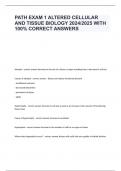
Exam 1 - Altered Cellular and Tissue Biology
Atrophy - correct answer Decrease in cell size; ex: skeletal muscle cells shrink after a cast; reversible Hypertrophy - correct answer Increase in cell size; ex: skeletal muscle cells after weight training; reversible Hyperplasia - correct answer Increase in cell number; ex: liver after chronic drinking; reversible Metaplasia - correct answer Replacement of one mature cell by another; may be reversible; ex: trachea cells change to stratified due to smoking Dysplasia - correct answer Abnormal changes in size, shape, organization of mature cells; not a true adaptive process; rapid uncontrolled mitosis/cell cycle; may or may not progress to cancer Neoplasia - correct answer Cells become less mature and start growing in uncontrolled fashion; may be benign Malignancy - correct answer Cancer; invades locally, may metastasize and grow in other parts of the body Physiologic atrophy - correct answer Thymus at puberty Pathologic atrophy - correct answer Disuse atrophy Atrophied cells require less _____. - correct answer O2 Compensatory hyperplasia - correct answer Enables organ to regenerate Hormonal hyperplasia - correct answer Chiefly in estrogen-dependent organs; ex: uterus and breasts during pregnancy Pathologic hyperplasia - correct answer Abnormal growth of normal cells in response to excessive hormones Atypical hyperplasia is _____. - correct answer dysplasia Hypoxia - correct answer Interrupts oxidative metabolism (interferes with ATP generation); loss of Hb, decreased RBCs (anemia), poisoning of the cytochrome enzymes Ischemia - correct answer Reduced blood supply; sudden obstruction (thrombus) or gradual blockage (better tolerated); without O2, ATP production from Kreb's and ETS ends and the cell has to rely on glycolysis (increased pH); low pH denatures proteins, alters cell membranes, chromatin clumping with cell shrinkage; failure of Na+/K+ pump with movement of Ca2+ and Na+ and water into the cell (swelling); ribosome detach from a swollen ER reduced protein synthesis; ATP depletion, mitochondrial damage, cell is still capable to recovery until vacuolation occurs ATP depletion - correct answer Loss of mitochondrial ATP and decreased ATP synthesis; results in cellular swelling, decreased protein synthesis, decreased membrane transport, and lipogenesis, loss of integrity of PM ROS - correct answer Lack of O2 = ischemia; activated O2 species cause destruction of cell membranes and structure Ca2+ entry - correct answer Ischemia and certain chemicals cause an increase in cytosolic Ca2+ concentrations; increased with damage to PM; causes intracellular damage by activating a number of enzymes Mitochondrial damage - correct answer Damaged by increased Ca2+ and ROS; results in loss of membrane potential, causes depletion of ATP and eventual death or necrosis of cell and activation of apoptosis Membrane damage - correct answer Early loss of selective membrane permeability found in all forms of cell injury; lysosomal membrane damage with release of enzymes causing cellular digestion Protein misfiling, DNA damage - correct answer Triggers unfolded protein release; if overwhelmed, response activates cell suicide program or apoptosis; DNA damage can also activate apoptosis Accumulation of calcium inside the cytosol activates _____ and causes _____. - correct answer enzymes; causes intracellular organelle damage and damage to the PM and eventual necrosis Reperfusion injury - correct answer Generation/formation of ROS radicals that can cause cell necrosis of cell Hydroxyl ions, superoxide radical, and hydrogen peroxide are highly reactive and unstable with _____. Low specificity and will react with most molecules. - correct answer one unpaired electron
Geschreven voor
- Instelling
- Altered Cellular and Tissue Biology
- Vak
- Altered Cellular and Tissue Biology
Documentinformatie
- Geüpload op
- 29 april 2024
- Aantal pagina's
- 6
- Geschreven in
- 2023/2024
- Type
- Tentamen (uitwerkingen)
- Bevat
- Vragen en antwoorden
Onderwerpen
-
exam 1 altered cellular and tissue biology