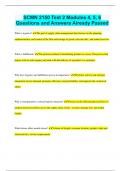
SCMN 2150 Test 2 Modules 4, 5, 6 Questions and Answers Already Passed
SCMN 2150 Test 2 Modules 4, 5, 6 Questions and Answers Already Passed What is logistics? The part of supply chain management that focuses on the planning, implementation, and control of the flow and storage of goods, relevant info., and related services What is fulfillment? The primary method of distributing product to a store. The process that begins with an order inquiry and ends with the delivery of a product to a customer. Why have logistics and fulfillment grown in importance? Promotes activity and strategic integration, boosts demand, promotes efficiency and profitability, and supports the creation of utility. Why is transportation a critical logistics function? Focuses on the efficient physical flows of product between facilities across the supply chain. Goals - on time, damage free, and within budget. What factors affect modal choice? Volume of freight, customer location, product value and characteristics, service requirements. What are primary purposes of holding inventory? Promote service level optimization. What types of inventory ordering models exist? Fixed order quantity, fixed time period, and continuous replenishment. How do you evaluate inventory performance? Average inventory value, inventory turns, selling days on hand, inventory carrying cost, inventory accuracy. What is post-sales customer service? All activity associated with a product/service after the point of sale. Goal is to optimize or make more efficient after market activity, thus saving money and environmental resources while boosting customer loyalty. What do call centers do? Allow customers to access important information and services in the manner that is most convenient. What is service parts logistics? The management of the time critical delivery of spare parts to end users as part of an after sales service. How does service parts logistics differ from traditional logistics? Low volume, infrequent activity, rapid response requirements, and long tail demand. What is reverse logistics? The backward flow of goods through the supply chain. What are the key challenges of reverse logistics? Product quality not uniform damaged or defective, or not packaged consistently or properly, different product flows - repair and return, return and deploy, remanufacture or recycle, hard to forecast return volume. What should companies do with returns, other than throw them in the trash? Resell, recondition, refurbish, remanufacture, cannibalize, recycle, dump. What are the differences between centralized and decentralized networks? Centralized - inventory is placed in fewer, more centrally located facilities • Lower inventory carrying costs due to less safety stock • Better control over inventory • Economies of scale and lower overhead costs • Reduced inbound transport costs • Decentralized - inventory is placed in many, customer facing facilities
Written for
- Institution
- SCMN 2150
- Course
- SCMN 2150
Document information
- Uploaded on
- April 29, 2024
- Number of pages
- 10
- Written in
- 2023/2024
- Type
- Exam (elaborations)
- Contains
- Questions & answers
Subjects
-
scmn 2150 test 2 modules 4 5 6 questions and ans

Also available in package deal