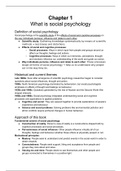
Chapter 1
What is social psychology
Definition of social psychology
Social psychology is the scientific study of the effects of social and cognitive processes on
the way individuals perceive, influence and relate to each other.
● Scientific study: Gathering knowledge systematically by means of scientific
methods → less biases and distortions.
● Effects of social and cognitive processes:
○ Social processes: Ways in which input from people and groups around us
affect our thoughts, feelings and actions.
○ Cognitive processes: Ways in which our memories, perceptions, thought
and emotions influence our understanding of the world and guide our action.
● Way individuals perceive, influence and relate to each other: These processes
shape all forms of social psychology → help us to understand why people
act in the way they do.
Historical and current themes
Late 1800s: Soon after emergence of scientific psychology researcher began to consider
questions about social influences, thought and action.
1900s: North American psychology dominated by behaviorism, but social psychologists
emphasis on effects of thought and feelings on behaviour.
1930s and 1940s: Questions generated by the rise of Nazism and the Second World War
shaped interests.
1950s and 1960s: Social psychology integrated understanding social and cognitive
processes and applications to applied problems.
● Cognitive and social: They are weaved together to provide explanations of people’s
experience and behaviour.
● Science and social problems: Solving problems like environmental pollution and
ethnic conflicts require profound changes in human behaviour.
Approach of this book
Fundamental axioms of social psychology:
● Construction of reality: Person’s view of reality is a constructions shaped both by
cognitive processes and social processes.
● Pervasiveness of social influence: Other people influence virtually all of our
thoughts, feelings and behaviour whether those others ar physically present or not.
Motivational principles:
● Mastery: People seek to understand and predict events in the social world in order to
obtain rewards.
● Connectedness: People seek support, liking and acceptance from people and
groups they care about and value.
● Valuing me and mine: People desire to see themselves and other people and
groups connected to themselves in a positive light.
,Processing principles:
● Conservatism: Individuals’ views of the world are slow to change and they stick to it.
● Accessibility: Information that is most readily available generally has the most
impact on thoughts, feelings and behaviour.
● Superficiality vs. Depth: People ordinarily put little effort into dealing with
information, but when motivated consider information in more depth.
, Chapter 3
Social perception
Forming first impressions
Mental representations: Our beliefs and impressions about members of particular
occupations, nationalities and ethnic groups → these influence our social
behaviour.
Raw materials of first impressions
Physical appearance: Usually the first and only cue to what a person is like
● We attribute more positive qualities to attractive people.
○ More intelligent, higher status, shorter prison sentences (Dion, 1972).
○ Tall men and good looking people earn more.
● Self-sufficient prophecies: When people perceive you a certain way → you
start to behave that way.
○ Interview more positive interview style with positive first impression of
applicant (Dougherty, 1994).
Nonverbal communication: Impressions formed quickly and often quite accurate.
● We like people who express feeling nonverbally more than less expressive
individuals.
● We like it when people orient their bodies toward us, facing us directly, leaning
toward us, nodding while we speak.
● In different cultures express happiness, fear and anger similarly → surprise
sadness and disgust differently.
Impressions from familiarity: Familiarity alone can be one basis for developing a positive
impression of another person.
● Mere exposure: Exposure to a stimulus without any external reward →
creates familiarity with the stimulus → people feel more positively about it.
Impressions from environments: Clues about personality, behaviours and values can be
seen in the real and virtual environment they inhabit and create.
● Experiment dorm rooms: Impressions of observers quite similar to the way the
occupants of the room rated themselves.
● Social-networking: For example you can form accurate impressions from
someone’s facebook profile.
Impressions from behaviour: The most useful resource for developing an impression of
another person.
● People often advised to judge others by their deeds, not their appearance or their
words.
Which cues caption attention?: Characteristics that are different stand out by their rarity or
uniqueness.
● Salience: Ability to attract attention in its context.
, Automatic interpretations of cues
Associations in interpretation: Strong link between two mental representations →
can arise from similarity in meaning, but also unrelated ideas become associated
if repeatedly thought about together.
● People spontaneously think of the associated trait when they comprehend a
behaviour.
Accessibility in interpretation: Meaning of behaviour not always clear → tend to
rely on relevant information currently in mind → accessibility → ease and speed
with which it comes to mind and is used.
● Current activation: Thoughts in mind when interpreting cues activate related mental
representations, making them highly accessible and thys likely to affect our
interpretations.
● Recent activation: Mental representation recently brought to mind remains
accessible for a time.
○ Priming: Activation of mental representation to increase its accessibility and
thus the likelihood that it will be used.
● Frequent activation: Frequent use of mental representations over days, months or
years can make it chronically accessible.
Correspondent inferences: Process of characterizing someone as having a personality
trait that corresponds to his or her observed behaviour.
● Justified when:
○ Individual freely choose to perform the behaviour.
○ Behavior had unique effects that other behaviours do not.
○ Behavior is unexpected rather than expected or typical.
● Correspondence bias: Tendency to infer an actor’s personal characteristics from
behaviours, even when the inference is unjustified because other possible causes of
the behaviour exist.
Covariation theory: When can you attribute a cause to a person?
● Consensus: Other person → covariation of behaviour across different
people → extent to which people behave in similar ways in similar
situations. Shannon chews gum after each meal:
○ High: Friend she’s out with also chews gum.
○ Low: If her friend doesn’t chew gum.
● Consistency: Other context → covariation of behaviour across time →
extent in which a person behaves in a certain manner every time.
○ High: If she needs a gum every time she goes out to eat.
○ Low: If she only chews gum when she is out with friends.
● Distinctiveness: Other objects → behaviour is unique to a particular
situation → low when person behaves similar in all situations, high when
different.
○ High: If she only chews gum when she eats outside.
○ Low: If she constantly chews gum regardless of time or place.
False confessions: People assume guilt can be the only explanation if someone confesses
to a crime
What is social psychology
Definition of social psychology
Social psychology is the scientific study of the effects of social and cognitive processes on
the way individuals perceive, influence and relate to each other.
● Scientific study: Gathering knowledge systematically by means of scientific
methods → less biases and distortions.
● Effects of social and cognitive processes:
○ Social processes: Ways in which input from people and groups around us
affect our thoughts, feelings and actions.
○ Cognitive processes: Ways in which our memories, perceptions, thought
and emotions influence our understanding of the world and guide our action.
● Way individuals perceive, influence and relate to each other: These processes
shape all forms of social psychology → help us to understand why people
act in the way they do.
Historical and current themes
Late 1800s: Soon after emergence of scientific psychology researcher began to consider
questions about social influences, thought and action.
1900s: North American psychology dominated by behaviorism, but social psychologists
emphasis on effects of thought and feelings on behaviour.
1930s and 1940s: Questions generated by the rise of Nazism and the Second World War
shaped interests.
1950s and 1960s: Social psychology integrated understanding social and cognitive
processes and applications to applied problems.
● Cognitive and social: They are weaved together to provide explanations of people’s
experience and behaviour.
● Science and social problems: Solving problems like environmental pollution and
ethnic conflicts require profound changes in human behaviour.
Approach of this book
Fundamental axioms of social psychology:
● Construction of reality: Person’s view of reality is a constructions shaped both by
cognitive processes and social processes.
● Pervasiveness of social influence: Other people influence virtually all of our
thoughts, feelings and behaviour whether those others ar physically present or not.
Motivational principles:
● Mastery: People seek to understand and predict events in the social world in order to
obtain rewards.
● Connectedness: People seek support, liking and acceptance from people and
groups they care about and value.
● Valuing me and mine: People desire to see themselves and other people and
groups connected to themselves in a positive light.
,Processing principles:
● Conservatism: Individuals’ views of the world are slow to change and they stick to it.
● Accessibility: Information that is most readily available generally has the most
impact on thoughts, feelings and behaviour.
● Superficiality vs. Depth: People ordinarily put little effort into dealing with
information, but when motivated consider information in more depth.
, Chapter 3
Social perception
Forming first impressions
Mental representations: Our beliefs and impressions about members of particular
occupations, nationalities and ethnic groups → these influence our social
behaviour.
Raw materials of first impressions
Physical appearance: Usually the first and only cue to what a person is like
● We attribute more positive qualities to attractive people.
○ More intelligent, higher status, shorter prison sentences (Dion, 1972).
○ Tall men and good looking people earn more.
● Self-sufficient prophecies: When people perceive you a certain way → you
start to behave that way.
○ Interview more positive interview style with positive first impression of
applicant (Dougherty, 1994).
Nonverbal communication: Impressions formed quickly and often quite accurate.
● We like people who express feeling nonverbally more than less expressive
individuals.
● We like it when people orient their bodies toward us, facing us directly, leaning
toward us, nodding while we speak.
● In different cultures express happiness, fear and anger similarly → surprise
sadness and disgust differently.
Impressions from familiarity: Familiarity alone can be one basis for developing a positive
impression of another person.
● Mere exposure: Exposure to a stimulus without any external reward →
creates familiarity with the stimulus → people feel more positively about it.
Impressions from environments: Clues about personality, behaviours and values can be
seen in the real and virtual environment they inhabit and create.
● Experiment dorm rooms: Impressions of observers quite similar to the way the
occupants of the room rated themselves.
● Social-networking: For example you can form accurate impressions from
someone’s facebook profile.
Impressions from behaviour: The most useful resource for developing an impression of
another person.
● People often advised to judge others by their deeds, not their appearance or their
words.
Which cues caption attention?: Characteristics that are different stand out by their rarity or
uniqueness.
● Salience: Ability to attract attention in its context.
, Automatic interpretations of cues
Associations in interpretation: Strong link between two mental representations →
can arise from similarity in meaning, but also unrelated ideas become associated
if repeatedly thought about together.
● People spontaneously think of the associated trait when they comprehend a
behaviour.
Accessibility in interpretation: Meaning of behaviour not always clear → tend to
rely on relevant information currently in mind → accessibility → ease and speed
with which it comes to mind and is used.
● Current activation: Thoughts in mind when interpreting cues activate related mental
representations, making them highly accessible and thys likely to affect our
interpretations.
● Recent activation: Mental representation recently brought to mind remains
accessible for a time.
○ Priming: Activation of mental representation to increase its accessibility and
thus the likelihood that it will be used.
● Frequent activation: Frequent use of mental representations over days, months or
years can make it chronically accessible.
Correspondent inferences: Process of characterizing someone as having a personality
trait that corresponds to his or her observed behaviour.
● Justified when:
○ Individual freely choose to perform the behaviour.
○ Behavior had unique effects that other behaviours do not.
○ Behavior is unexpected rather than expected or typical.
● Correspondence bias: Tendency to infer an actor’s personal characteristics from
behaviours, even when the inference is unjustified because other possible causes of
the behaviour exist.
Covariation theory: When can you attribute a cause to a person?
● Consensus: Other person → covariation of behaviour across different
people → extent to which people behave in similar ways in similar
situations. Shannon chews gum after each meal:
○ High: Friend she’s out with also chews gum.
○ Low: If her friend doesn’t chew gum.
● Consistency: Other context → covariation of behaviour across time →
extent in which a person behaves in a certain manner every time.
○ High: If she needs a gum every time she goes out to eat.
○ Low: If she only chews gum when she is out with friends.
● Distinctiveness: Other objects → behaviour is unique to a particular
situation → low when person behaves similar in all situations, high when
different.
○ High: If she only chews gum when she eats outside.
○ Low: If she constantly chews gum regardless of time or place.
False confessions: People assume guilt can be the only explanation if someone confesses
to a crime