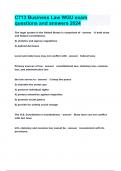
C713 Business Law WGU exam questions and answers 2024
The legal system in the United States is comprised of 1) both state and federal constitutions 2) statutes and agency regulations 3) judicial decisions Local and state laws may not conflict with federal laws Primary sources of law constitutional law, statutory law, common law, and administrative law the law serves to 1) keep the peace 2) maintain the status quo 3) preserve individual rights 4) protect minorities against majorities 5) promote social justice 6) provide for orderly social change The U.S. Constitution is foundational. State laws can not conflict with fed. laws U.S. statutory and common law cannot be inconsistent with its provisions. Congress creates statutory law (with the signature of the president) Introduced as a bill, sent to a committee, pass through house of origination, goes to other (house of rep or senate), if passes goes To joint committee then back to congress for full congressional vote, if passes goes to president (approve or Vito) courts will interpret constitutional law and statutory law Can create a president, but that is not mean it will be upheld in different jurisdiction Where there is neither constitutional law nor statutory law, the courts function in the realm of common law 50 states, each of which also has a constitution, or foundational law Can not conflict with federal law/constitution Both the federal government and the states have created administrative agencies and an agency only has _______ the power that the legislature gives it. Examples of administrative agencies Ex. OSHA, EPA, FTC, FCC They use administrative law an agency will often create regulations, which have the same force and effect as ______. statutes FCC regulates how cigarettes are advertised on tv is an example of: ADMINISTRATIVE LAW Congress creates administrative agencies through enabling acts Act includes deligating authority and giving the agency authority as to what it will accomplish agencies are usually given broad powers to investigate, set standards (promulgating regulations), and enforce those standards Most agencies are ___________, but some are independent. executive branch agencies Administrative agencies are given unusual powers (3) legislate (make rules) investigate adjudicate (enforce) Agency powers are limited by executive and legislative controls and by judicial review Common law Judge made law - A system of law based on precedent and customs law is made when an appellate (appeals) court endorses a rule to be used in deciding court case Having agencies with rule-making power is a practical necessity 1) Congress does not have the expertise or continuity to develop specialized knowledge in various areas (e.g., communications, the environment, aviation) 2) it makes sense for Congress to set forth broad statutory guidance to an agency and delegate authority to the agency to propose rules that further the statutory purposes 3) As long as Congress makes this delegating guidance sufficiently clear, it is not delegating improperly - NOT GIVING AWAY CONSTITUTIONAL POWER antitrust law law intended to promote free competition in the market place by outlawing monopolies Negative externalities a cost that is suffered by a third party as a result of an economic transaction. Examples of leveling economic playing field to provide information to consumers: Consumer protection laws (consumers) Securities laws (investors) The toxics release inventory laws in environmental law (citizens) Statutory law is to legislative bodies as common law is to: courts statutory laws laws passed by a state or the federal legislature. Criminalize actions with set penalties. Congress Senate (100) + House (435) = Congress; the legislative branch; makes the laws House of Representatives # of members 435 Members, based on population of the state, changes 10 yrs @census, sometimes states are represented disproportionately (Ak and Delaware only have one rep) Senate term length 6 years, no max # of terms term limit Changing a law 2/3 congress vote to create and amendment House of Representatives term length 2 years, no max term # of terms limit President is formed by: Stare decisis (let the decision stand) legal reasoning steps 1.) identify the legal question: issue in dispute 2.)identify the rule of law that applies (may be drawn from president) 3.)analyze facts, reach suitable conclusion Administrative law the body of law that regulates the operation and procedures of government agencies. administrative agencies governmental units, either state or federal, that have specialized expertise and authority over some area of the economy rules or regulations created by administrative agencies and have the force of law State law claims are generally heard in state courts, while federal question cases are generally heard in ____. federal court. Federal courts sometimes hear state law claims under ____ diversity jurisdiction The U.S. Supreme Court is the highest court in the country, and all other courts must ___ follow the precedent in Supreme Court opinions. A common method of dispute resolution that avoids many of the challenges associated with litigation is _____. alternative dispute resolution Common (3) methods of dispute resolution are _______. (Remember acronym: No More Attorneys) negotiation, mediation, and arbitration. law and government are ____. interdependent Today, much of the law comes from ______. Congress and the state legislatures define: litigation the process of bringing in a court to settle a dispute, criminal or civil define: litigants a person involved in a lawsuit Who carries the burden of proof in a court case? prosecution (criminal trial) plaintiff (civil trial)
Written for
- Institution
- WGU C713
- Course
- WGU C713
Document information
- Uploaded on
- April 28, 2024
- Number of pages
- 45
- Written in
- 2023/2024
- Type
- Exam (elaborations)
- Contains
- Questions & answers
Subjects
-
c713 business law wgu exam

Also available in package deal