

IAAP CPACC Exam
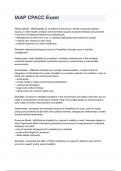
Medical Model - ANSdisability as a problem of the person, directly caused by disease,
trauma, or other health condition which therefore requires sustained medical care provided
in the form of individual treatment by professionals.
~ Management is aimed at a cure, or individual adjustment and behavioral change
~ medical care viewed as main issue
~ political response is to reform healthcare
Strengths: addresses biological sources of disabilities through cures or medical
management
Weaknesses: treats disability as a problem or inherent characteristic of the indvidual,
overlooks broader sociopolitical constraints imposed by unwelcoming or inaccessible
environments
Social Model - ANSviews disability as a socially created problem, a matter of the full
integration of individuals into society. Disability is a complex collection of conditions, many of
which are created by the social environment.
~ social action
~ society needs to make environmental modifications
~ cultural and ideological
~ large-scale cultural change
~ equal access as a human rights issue
Strenghts: Focuses on disabling conditions in the environment and makes clear they are not
solely a characteristic of individual's "broken" body. Encourages design to accommodate a
wide range of human characteristics and abilities
Weaknesses: downplays the embodied aspects of disabilities too much, push for social
justice puts activitists at odds with other political interests, antagonizes relationships, creates
resolute political adversaries.
Economic Model - ANSDefines disability by a person's inability to work. Assesses degree to
which impairment affect's individual productivity and economic consequences for individual,
employer, and state.
~ loss of earnings for/payment for assistance by individual
~ lower profit margins for employer
~ State welfare payments
Strengths: recognizes the affect of bodily limitations on a person's ability to work and for
economic support and/or accommodation
, Weaknesses: creates a legally-defined category of people who are "needy", stigmatizing for
people with disabilities, if individual's do not meet legal threshold may not receive needed
support
Functional Solutions Model - ANSpractical perspective that identifies limitations ("functional
impairments") due to disability, intent to create and promote solutions to overcome
limitations.
~ eliminate/reduce impact of functional limitations
~ deemphasizes sociopolitical aspects
~ prioritizes inventiveness and entrepreneurship
Strengths: results-oriented, seeks to provide solutions to real-world challenges, side steps
convoluted sociopolitical implications of disability
Weaknesses: entrepreneurs often miss the mark, profit driven entrepreneurism may lead to
innovations of more benefit to the entrepreneur than target population, deemphasis of
socioeconomic issues may lead innovators to ignore most important aspects of the original
problem
Social Identity or Cultural Affiliation Model - ANSrefers to sense of deriving personal identity
from membership within a group of like-minded individuals
Strengths: accepts disability completely, pride in being associated with others in a similar
condition
Weaknesses: sense of belonging to one group may be counterbalanced by sense of
exclusion by those who don't quite fit group's expectations
Charity Model - ANSregards people with disabilities as unfortunate and in need of assistance
from outside
~ benevolent contributors to a needy population
Strengths: can inspire people to contribute time and resources when genuinely needed
Weaknesses: can be condescending to people with disabilities, often focuses on short-term
immediate needs at expense or more comprehensive, effective, long-term solutions
Color Blindness Demographics - ANS~ 8% of males
~ 0.4% of females
Blindness Demographics - ANS~ 0.5% of world population, 39 million people
~ 82% of people who are blind aged 50+
~ 90% of people who are blind live below poverty level
Low Vision Demographics - ANSCorrected visual acuity of 20/40 or 20/60
~ 3.5% of world population, 246 million people
~ 90% of people with low vision live below poverty level
Medical Model - ANSdisability as a problem of the person, directly caused by disease,
trauma, or other health condition which therefore requires sustained medical care provided
in the form of individual treatment by professionals.
~ Management is aimed at a cure, or individual adjustment and behavioral change
~ medical care viewed as main issue
~ political response is to reform healthcare
Strengths: addresses biological sources of disabilities through cures or medical
management
Weaknesses: treats disability as a problem or inherent characteristic of the indvidual,
overlooks broader sociopolitical constraints imposed by unwelcoming or inaccessible
environments
Social Model - ANSviews disability as a socially created problem, a matter of the full
integration of individuals into society. Disability is a complex collection of conditions, many of
which are created by the social environment.
~ social action
~ society needs to make environmental modifications
~ cultural and ideological
~ large-scale cultural change
~ equal access as a human rights issue
Strenghts: Focuses on disabling conditions in the environment and makes clear they are not
solely a characteristic of individual's "broken" body. Encourages design to accommodate a
wide range of human characteristics and abilities
Weaknesses: downplays the embodied aspects of disabilities too much, push for social
justice puts activitists at odds with other political interests, antagonizes relationships, creates
resolute political adversaries.
Economic Model - ANSDefines disability by a person's inability to work. Assesses degree to
which impairment affect's individual productivity and economic consequences for individual,
employer, and state.
~ loss of earnings for/payment for assistance by individual
~ lower profit margins for employer
~ State welfare payments
Strengths: recognizes the affect of bodily limitations on a person's ability to work and for
economic support and/or accommodation
, Weaknesses: creates a legally-defined category of people who are "needy", stigmatizing for
people with disabilities, if individual's do not meet legal threshold may not receive needed
support
Functional Solutions Model - ANSpractical perspective that identifies limitations ("functional
impairments") due to disability, intent to create and promote solutions to overcome
limitations.
~ eliminate/reduce impact of functional limitations
~ deemphasizes sociopolitical aspects
~ prioritizes inventiveness and entrepreneurship
Strengths: results-oriented, seeks to provide solutions to real-world challenges, side steps
convoluted sociopolitical implications of disability
Weaknesses: entrepreneurs often miss the mark, profit driven entrepreneurism may lead to
innovations of more benefit to the entrepreneur than target population, deemphasis of
socioeconomic issues may lead innovators to ignore most important aspects of the original
problem
Social Identity or Cultural Affiliation Model - ANSrefers to sense of deriving personal identity
from membership within a group of like-minded individuals
Strengths: accepts disability completely, pride in being associated with others in a similar
condition
Weaknesses: sense of belonging to one group may be counterbalanced by sense of
exclusion by those who don't quite fit group's expectations
Charity Model - ANSregards people with disabilities as unfortunate and in need of assistance
from outside
~ benevolent contributors to a needy population
Strengths: can inspire people to contribute time and resources when genuinely needed
Weaknesses: can be condescending to people with disabilities, often focuses on short-term
immediate needs at expense or more comprehensive, effective, long-term solutions
Color Blindness Demographics - ANS~ 8% of males
~ 0.4% of females
Blindness Demographics - ANS~ 0.5% of world population, 39 million people
~ 82% of people who are blind aged 50+
~ 90% of people who are blind live below poverty level
Low Vision Demographics - ANSCorrected visual acuity of 20/40 or 20/60
~ 3.5% of world population, 246 million people
~ 90% of people with low vision live below poverty level


