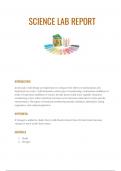
Science report on why vineager dissolves chalk, lab with data attached.
SCIENCE LAB REPORT INTRODUCTION In this lab, I will design an experiment to compare the effects of carbonation and hydrolysis on rocks. I will determine which type of weathering, carbonation (addition of acid) or hydrolysis (addition of water), breaks down chalk more rapidly. Chemical weathering occurs when chemical reactions occur between minerals in rocks and the environment. The types of chemical weathering include oxidation, hydrolysis, living organisms, and acid precipitation. HYPOTHESIS If vinegar is added to chalk, then it will dissolve faster than if it had water because vinegar is more acidic than water. MATERIALS Chalk Vinegar Water Stopwatch Thermometer Clear container Scale Dropper to add liquids Student Guide PROCEDURE Prepare for lab Watch video Gather materials Form hypothesis Design experiment Experiment using two containers, one containing water and the other containing a mixture of vinegar and water. Note the amount of liquid and chalk in each container, the amount of time you run the experiment, and your observations in your lab notebook. Once you are done with the experiment, note the condition of the chalk that was in the water and the chalk that was in the mixture of vinegar and water. Submit written lab report Quantitative Data Description Amount of water/vinegar Amount of chalk Temp Water and chalk 8 fluid ounces Before and after (no change): 1 stick of sidewalk chalk 70 degrees fahrenheit Vinegar and chalk 8 fluid ounces Before: 1 stick of sidewalk chalk After: 1 small pebble of chalk and small cloudy remnants 70 degrees fahrenheit Both stayed for 48 hours Description Observation Water and Chalk Nothing truly happened. Chalk got wet. Vinegar and Chalk Bubbles formed, chalk got smaller (almost nothing left) after 48 hours. 1. In this experiment, you used vinegar to simulate carbonic acid. Why did you dilute the vinegar with water? I diluted the vinegar with water because it shows how acid rain works to erode sediment rocks. It also makes the vinegar less potent which leads to there being a more balanced result. 2. In your hypothesis for this lab, you made a prediction about whether carbonation or hydrolysis would dissolve the chalk faster. Did the results support or disprove your hypothesis? The results supported my hypothesis because I predicted that the vinegar would dissolve my chalk faster than the water and this proved to be true because at the end of the experiment the chalk in the vinegar was almost gone while the chalk in the water was still solid and present. 3. What are the controls for this experiment? What is the dependent variable? The independent variable? The controls were the amount of water or vinegar in each container and the type of chalk used. The independent variable was the type of liquid I used (water or vinegar) and the dependent variable was the amount of chalk left after the experiment. 4. How did the pH of the water and vinegar seem to affect the amount of chalk that was dissolved? The pH of the water did not affect anything at all. If it did affect anything there would be a change in the amount of chalk after the experiment. The vinegar’s pH may have done something to influence the amount of chalk left after the experiment was done because there was a significant difference. 5. In this lab, you collected measurements on the temperature in the room. Would the temperature have an effect on how much chalk is dissolved? Explain. The temperature would and would not affect the way the chalk was dissolved. For example, if the temperature of the room was close to freezing then the vinegar would start to form into a solid like form. And of course the chalk would take longer to dissolve or would not dissolve at all. However, in this case the temperature of the room was room temperature and it didn’t truly affect the rate of dissolving. According to a lab done by Vanderbilt university, “The rate of bubbles coming off in the cooler vinegar was slower so the lower the temperature the slower the reaction; and the higher the temperature the faster the reaction.” Evidently, the temperature of the vinegar does in fact affect the rate of reaction. 6. What rock formations could be created by carbonation? What are the environmental implications of carbonation? Carbonation is A form of solution where carbonic acid, formed by the solution of atmospheric CO2 in water, dissolves minerals. Carbonation is also a key process in the formation of many mineral resources, including limestone, dolomite, and some types of ore deposits. According to , “Carbonation is a chemical weathering process that occurs when carbon dioxide (CO2) in the atmosphere reacts with water (H2O) to form carbonic acid (H2CO3), which can then react with minerals in rocks to form new compounds. Carbonation is particularly effective on rocks that contain calcium carbonate (CaCO3), such as limestone and marble.” It is evident that carbonation plays a vital role in the formation of rocks and the devolution of minerals like the ones found in the chalk used during this lab. Not only is carbonation used to form rocks such as limestone it is also used in our drinks. Carbonation can also be the addition of carbon dioxide gas to a beverage, imparting sparkle and a tangy taste and preventing spoilage. The liquid is chilled and cascaded down in an enclosure containing carbon dioxide (either as dry ice or a liquid) under pressure. Examples of carbonated beverages include soft drinks, sparkling water (seltzer water), and carbonated wine. RESULTS The chalk in the vinegar almost immediately began to dissolve while the chalk in the water just got wet. This is due to the fact that chalk is made of calcium carbonate. Rocks that contain calcium carbonate can erode when they come in contact with acids, and chalk contains calcium carbonate. Vinegar is acetic acid, and chalk is a base. An acid plus a base causes a chemical reaction. So, vinegar combined with chalk creates a chemical reaction as seen by the carbon dioxide bubbles.
Written for
- Institution
- Junior / 11th grade
- Course
- AP environmental science
- School year
- 3
Document information
- Uploaded on
- April 26, 2024
- Number of pages
- 5
- Written in
- 2023/2024
- Type
- PRESENTATION
- Person
- Unknown
Subjects
- science report
- calcium
- erosion
-
science report on why vineager dissolves chalk

Also available in package deal