
SLK 310
Chapter 5
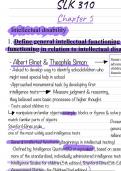
Intellectual disability
1. Define general intellectual functioning
functioning in relation to intellectual disa
- Albert Binet & Theophile Simon
Some o
advanc
- Asked to develop way to identify schoolchildren who childre
functio
might need special help in school
-Approached monumental task by developing first
intelligence tests Measure judgment & reasoning,
they believed were basic processes of higher thought.
- Tests asked children to:
manipulate unfamiliar objects example : blocks or figures & solve p
match familiar parts of objects Presum
Stanford-Binet scale
genera
one of the most widely used intelligence tests
tellienc
General intellectual functioning(beginnings in intellectual testing)
-Defined by: Intelligence Quotient[IQ or equivalent), based on asses
more of the standardized, individually administered intelligence tests
Intelligence Scales for children(5th edition), Stanford-Binet(5th Ed
, -Convention, IQ scores(with mean of 100 & standard
deviation of 15) Derived from standardized table
on a person’s age & test score
- Intelligence defined:
1. normal distribution: approx. 95% of population has scores within 2 st
deviations of the mean e.g. between 70 and 130
2. Understand & identify subaverage intellectu
2. Subaverage intelligence: IQ of about 70 or below(approx. 2 stan
deviations below the mean)
-Definition of “Intellectual disability”—> not only subaverage level of ada
functioning but ALSO subaverage level of adaptive functioning
-Adaptive functioning: how effectively individuals cope with ordinary
& how capable they are of living independently and abiding by comm
standards.
NOTE- some children + adolescents may learn to adapt quite well to
environment despite their lower intelligence as measured by IQ tests
not be considered to have an intellectual disability
3 major categories of adaptive behavior:
1. Conceptual skills(receptive & expressive language, reading & writing,
concepts, self-directions)
2. Social skills(interpersonal, responsibility, self-esteem, gullibility, naïvet
rules, obeys laws, avoids victimization)
3. Practical skills(personal activities of daily living-preparing meals, tak
, Introduction
-Until mid-19th century, children & adults today diagno
Labeled as “idiots”—>lumped together with people suffering from me
medical conditions
-Feared & ignored by medical profession, differences in ap
ability so little understood
-field of ID experienced monumental gains over past centur
determining causes & providing services
Overshadow NB discoveries about subnormal intelligence: age-old fears, resen
-Dramatically changed face of field:
1. Advances in understanding development of children with ID
2. Research in genetics, psychopathology & other areas
Definition -“Intellectual Disability” replaced “Mental Retardatio
On consensus among professionals, advocacy groups & lay public
-ID is a neurodevelopmental disorder—>
-group of conditions with onset in the developmental period(before 18
impairments of: social, personal, academic or occupational functionin
ID characteristics- significant limitations in mental abilities(e
planning & judgment)= impairments in adaptive functioning(c
social,practical skills), needed to fulfill aspects of daily life
-Name changed, 3 essential elements(defining condition):
1. Intellectual limitations
Remained same for the
2. Deficits in adaptive skills past 50 years
Chapter 5
Intellectual disability
1. Define general intellectual functioning
functioning in relation to intellectual disa
- Albert Binet & Theophile Simon
Some o
advanc
- Asked to develop way to identify schoolchildren who childre
functio
might need special help in school
-Approached monumental task by developing first
intelligence tests Measure judgment & reasoning,
they believed were basic processes of higher thought.
- Tests asked children to:
manipulate unfamiliar objects example : blocks or figures & solve p
match familiar parts of objects Presum
Stanford-Binet scale
genera
one of the most widely used intelligence tests
tellienc
General intellectual functioning(beginnings in intellectual testing)
-Defined by: Intelligence Quotient[IQ or equivalent), based on asses
more of the standardized, individually administered intelligence tests
Intelligence Scales for children(5th edition), Stanford-Binet(5th Ed
, -Convention, IQ scores(with mean of 100 & standard
deviation of 15) Derived from standardized table
on a person’s age & test score
- Intelligence defined:
1. normal distribution: approx. 95% of population has scores within 2 st
deviations of the mean e.g. between 70 and 130
2. Understand & identify subaverage intellectu
2. Subaverage intelligence: IQ of about 70 or below(approx. 2 stan
deviations below the mean)
-Definition of “Intellectual disability”—> not only subaverage level of ada
functioning but ALSO subaverage level of adaptive functioning
-Adaptive functioning: how effectively individuals cope with ordinary
& how capable they are of living independently and abiding by comm
standards.
NOTE- some children + adolescents may learn to adapt quite well to
environment despite their lower intelligence as measured by IQ tests
not be considered to have an intellectual disability
3 major categories of adaptive behavior:
1. Conceptual skills(receptive & expressive language, reading & writing,
concepts, self-directions)
2. Social skills(interpersonal, responsibility, self-esteem, gullibility, naïvet
rules, obeys laws, avoids victimization)
3. Practical skills(personal activities of daily living-preparing meals, tak
, Introduction
-Until mid-19th century, children & adults today diagno
Labeled as “idiots”—>lumped together with people suffering from me
medical conditions
-Feared & ignored by medical profession, differences in ap
ability so little understood
-field of ID experienced monumental gains over past centur
determining causes & providing services
Overshadow NB discoveries about subnormal intelligence: age-old fears, resen
-Dramatically changed face of field:
1. Advances in understanding development of children with ID
2. Research in genetics, psychopathology & other areas
Definition -“Intellectual Disability” replaced “Mental Retardatio
On consensus among professionals, advocacy groups & lay public
-ID is a neurodevelopmental disorder—>
-group of conditions with onset in the developmental period(before 18
impairments of: social, personal, academic or occupational functionin
ID characteristics- significant limitations in mental abilities(e
planning & judgment)= impairments in adaptive functioning(c
social,practical skills), needed to fulfill aspects of daily life
-Name changed, 3 essential elements(defining condition):
1. Intellectual limitations
Remained same for the
2. Deficits in adaptive skills past 50 years


