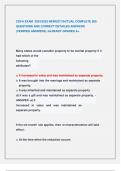
Final Exam for: IS-200.C: Basic Incident
Command System for Initial Response,
ICS-200 Questions and Answers 2024
Which Incident Type is limited to one operational period, does not require a written
Incident Action Plan, involves Command and General Staff only if needed, and requires
several single resources? A. Type 3 B. Type 5 C. Type 2 D. Type 4 - Answer-D. Type 4
When the supervisor-to-subordinate ratio exceeds manageable span of control,
additional Teams, Divisions, Groups, Branches, or Sections can be established. Which
NIMS Management characteristic does this describe? A. Modular Organization B.
Management by Objectives C. Comprehensive Resource Management D. Formal
Communication - Answer-A. Modular Organization
When command is transferred, then all personnel involved in the incident should be
told: A. The limits of the Incident Commander's scope of authority B. The Incident
Commander's cell phone number C. The qualifications of the incoming Incident
Commander D. The effective time and date of the transfer - Answer-D. The effective
time and date of the transfer
Which of these is NOT a tool that you would need at the incident? A. Agency
Procedures Manual B. Exercise Plan C. Emergency Operations Plan (EOP) D. Maps of
the affected area - Answer-B. Exercise Plan
Which type of briefing is delivered to individual resources or crews who are assigned to
operational tasks and/or work at or near the incident site? A. Staff-level briefing B.
Operational Period Briefing C. Field-level briefing D. Section-level briefing - Answer-C.
Field-level briefing
An Incident Commander's scope of authority is derived from existing laws, agency
policies, and/or ______. A. Outgoing Incident Commander B. IMT Position Description
C. Delegation of Authority D. Incident Action Plan - Answer-C. Delegation of Authority
Which statement best describes ICS Form 201? A. It allows a Single Resource Unit
Leader to track major activities during each operational period. B. Lists all resources
and organization assignments for the upcoming operations period C. It is completed by
the Safety Officer in order to address safety concerns and identify mitigation measures.
D. It contains status information for briefing the incoming Incident Commander or other
incoming resources. - Answer-D. It contains status information for briefing the incoming
Incident Commander or other incoming resources.
Command System for Initial Response,
ICS-200 Questions and Answers 2024
Which Incident Type is limited to one operational period, does not require a written
Incident Action Plan, involves Command and General Staff only if needed, and requires
several single resources? A. Type 3 B. Type 5 C. Type 2 D. Type 4 - Answer-D. Type 4
When the supervisor-to-subordinate ratio exceeds manageable span of control,
additional Teams, Divisions, Groups, Branches, or Sections can be established. Which
NIMS Management characteristic does this describe? A. Modular Organization B.
Management by Objectives C. Comprehensive Resource Management D. Formal
Communication - Answer-A. Modular Organization
When command is transferred, then all personnel involved in the incident should be
told: A. The limits of the Incident Commander's scope of authority B. The Incident
Commander's cell phone number C. The qualifications of the incoming Incident
Commander D. The effective time and date of the transfer - Answer-D. The effective
time and date of the transfer
Which of these is NOT a tool that you would need at the incident? A. Agency
Procedures Manual B. Exercise Plan C. Emergency Operations Plan (EOP) D. Maps of
the affected area - Answer-B. Exercise Plan
Which type of briefing is delivered to individual resources or crews who are assigned to
operational tasks and/or work at or near the incident site? A. Staff-level briefing B.
Operational Period Briefing C. Field-level briefing D. Section-level briefing - Answer-C.
Field-level briefing
An Incident Commander's scope of authority is derived from existing laws, agency
policies, and/or ______. A. Outgoing Incident Commander B. IMT Position Description
C. Delegation of Authority D. Incident Action Plan - Answer-C. Delegation of Authority
Which statement best describes ICS Form 201? A. It allows a Single Resource Unit
Leader to track major activities during each operational period. B. Lists all resources
and organization assignments for the upcoming operations period C. It is completed by
the Safety Officer in order to address safety concerns and identify mitigation measures.
D. It contains status information for briefing the incoming Incident Commander or other
incoming resources. - Answer-D. It contains status information for briefing the incoming
Incident Commander or other incoming resources.