

Cell respiration (ib biology)
Class notes
• What is made in aerobic respiration: Carbon dioxide and water.
• Respiration is the controlled release of energy from organic compounds in cells to form atp.
C1.2.1— ATP as the molecule that distributes energy within cells
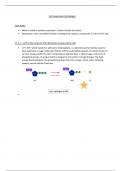
• ATP: ATP, which stands for adenosine triphosphate, is a biomolecule formed by a purine
base (adenine), a sugar molecule (ribose) and three phosphate groups. Its main function is
to store energy within the cell. Comprising an adenine base, a ribose sugar, and a trio of
phosphate groups, its unique build is integral to its function. Energy Storage: The high-
energy bonds between the phosphate groups store the energy, which, when released,
powers various cellular functions.
•
,•
• Outline properties of ATP that make it suitable for the use as an energy currency within
cells:
•
, • 1. High-energy phosphate bonds: ATP contains three phosphate groups that are linked
together by high-energy bonds. When one of these phosphate groups is broken off, it
releases a significant amount of energy. This energy can be used by cells to power various
biological processes, such as muscle contraction, active transport, and synthesis of
molecules. For example, in muscle cells, ATP is hydrolyzed to release energy for muscle
contraction.
• 2. Rapid and efficient energy transfer: ATP acts as an intermediary molecule that can quickly
transfer energy within cells. When ATP is hydrolyzed to ADP (adenosine diphosphate) and
inorganic phosphate, the released energy can be used to fuel cellular processes.
Furthermore, ATP can be regenerated by adding a phosphate group back to ADP through
cellular respiration or photosynthesis. This cycle of ATP hydrolysis and synthesis allows cells
to efficiently store and release energy as needed.
• Versatile and easily regenerated: After ATP is hydrolyzed to ADP, it can be recharged by
adding a phosphate group through the process of phosphorylation. This regeneration
process allows ATP to continuously provide energy for cellular processes. It acts as a
rechargeable battery, ensuring a constant supply of energy for the cell's needs.
• ATP is a good source of energy because it contains high-energy phosphate bonds that can
be easily broken to release energy when needed. The breaking of these bonds releases
energy that can be used to power cellular processes like muscle contraction, nerve
impulses, and protein synthesis. Additionally, ATP can be quickly and efficiently produced
through cellular respiration, making it a readily available source of energy for the cell.
• Summary
•
C1.2.2— Life processes within cells that ATP supplies with energy
• Outline example cellular processes that require use of ATP: Ion transport, Muscle
contraction, nerve impulse propagation, DNA/RNA replication, synthesis of new cells,
synthesis of amino acids, active transport, cellular respiration, photosynthesis and making
cell walls.
Class notes
• What is made in aerobic respiration: Carbon dioxide and water.
• Respiration is the controlled release of energy from organic compounds in cells to form atp.
C1.2.1— ATP as the molecule that distributes energy within cells
• ATP: ATP, which stands for adenosine triphosphate, is a biomolecule formed by a purine
base (adenine), a sugar molecule (ribose) and three phosphate groups. Its main function is
to store energy within the cell. Comprising an adenine base, a ribose sugar, and a trio of
phosphate groups, its unique build is integral to its function. Energy Storage: The high-
energy bonds between the phosphate groups store the energy, which, when released,
powers various cellular functions.
•
,•
• Outline properties of ATP that make it suitable for the use as an energy currency within
cells:
•
, • 1. High-energy phosphate bonds: ATP contains three phosphate groups that are linked
together by high-energy bonds. When one of these phosphate groups is broken off, it
releases a significant amount of energy. This energy can be used by cells to power various
biological processes, such as muscle contraction, active transport, and synthesis of
molecules. For example, in muscle cells, ATP is hydrolyzed to release energy for muscle
contraction.
• 2. Rapid and efficient energy transfer: ATP acts as an intermediary molecule that can quickly
transfer energy within cells. When ATP is hydrolyzed to ADP (adenosine diphosphate) and
inorganic phosphate, the released energy can be used to fuel cellular processes.
Furthermore, ATP can be regenerated by adding a phosphate group back to ADP through
cellular respiration or photosynthesis. This cycle of ATP hydrolysis and synthesis allows cells
to efficiently store and release energy as needed.
• Versatile and easily regenerated: After ATP is hydrolyzed to ADP, it can be recharged by
adding a phosphate group through the process of phosphorylation. This regeneration
process allows ATP to continuously provide energy for cellular processes. It acts as a
rechargeable battery, ensuring a constant supply of energy for the cell's needs.
• ATP is a good source of energy because it contains high-energy phosphate bonds that can
be easily broken to release energy when needed. The breaking of these bonds releases
energy that can be used to power cellular processes like muscle contraction, nerve
impulses, and protein synthesis. Additionally, ATP can be quickly and efficiently produced
through cellular respiration, making it a readily available source of energy for the cell.
• Summary
•
C1.2.2— Life processes within cells that ATP supplies with energy
• Outline example cellular processes that require use of ATP: Ion transport, Muscle
contraction, nerve impulse propagation, DNA/RNA replication, synthesis of new cells,
synthesis of amino acids, active transport, cellular respiration, photosynthesis and making
cell walls.


