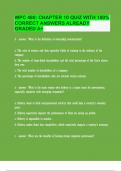
WPC 480 CHAPTER 10 QUIZ WITH 100% CORRECT ANSWERS ALREADY GRADED A+
b What is the definition of ownership concentration? a. The ratio of owners and their specialty fields of training to the industry of the company b. The number of large-block shareholders and the total percentage of the firm's shares they own c. The total number of shareholders of a company d. The percentage of shareholders who are internal versus external a What is the main reason why bribery is a major issue for governments, especially countries with emerging economies? a. Bribery tends to limit entrepreneurial activity that could help a country's economy grow. b. Bribery negatively impacts the performance of firms by eating up profits. c. Bribery is impossible to monitor. d. Bribery makes firms less competitive, which negatively impacts a country's economy. c What are the benefits of having strong corporate governance? a. Because managers and employees fear for their jobs, it allows fear to improve productivity. b. It shifts accountability and responsibility for developing an ethical organizational culture and making sure the firm performs effectively from top-level managers to the board of directors. c. It encourages top-level managers to be strategically competitive. d. There are no benefits to corporate governance, which is seen as an unneeded expense. b Melissa is the CEO of her company and has to make a business decision. She is faced with a scenario in which she can please one group of stakeholders, or all of them minimally. What is Melissa's most likely action? a. To please the suppliers, as they are the highest priority b. To please as many stakeholders as possible, because if stakeholders are not minimally satisfied, they will give support to another company c. To please the employees, because a happy workforce will have a ripple effect on the rest of the value chain d. To determine which action will result in higher executive compensation and make that choice c Which is an alternate definition for "poison pill"? a. A contract between the target firm and the potential acquirer specifying that the acquirer will not purchase additional shares of the target firm for a specified period of time in exchange for a fee paid by the target firm b. The repurchase of the target firm's shares of stock that were obtained by the acquiring firm at a premium in exchange for an agreement that the acquirer will no longer target the company for takeover c. A strategy whereby a company decides to increase the number of overall shares, which will both dilute the hostile company's shares and increase the cost of the company overall, making the company less appealing to take over d. A lump-sum payment of cash that is given to one or more top-level managers when the firm is acquired in a takeover bid b Greg is the CEO of a leading company in the consumer packaged goods industry. He is trying to grow his company for personal gain and wealth. However, Greg sees that his company has an opportunity to break into the chemical industry. He has decided to invest free cash flow into acquiring small chemical companies that have the potential for growth if funded properly. Shareholders are not happy because they are concerned about: a. underdiversification. b. overdiversification. c. diversification. d. segmentation. b Why are corporate governance mechanisms important to foreign investors? a. To prove that the organization being invested in is legitimate b. To protect their investments c. To prevent exposure for investors who might otherwise place their money in a legal gray area d. To ensure that the country's government is in control of the business, which protects shareholders' investments d A company is part of a keiretsu in Japan. Its leaders are worried about the company's financial viability and ask for help from other members of the keiretsu. Why would other participants of the keiretsu feel the need to aid the failing company? a. Members of the keiretsu are legally obligated to aid when members are in need. b. The keiretsu are companies that make a profit from lending money. c. Members of the keiretsu will not feel obligated to help, as they will have members of the company fend for themselves. d. Members of the keiretsu are seen as family, which commands attention and allegiance. a Shareholder activists are very unhappy with a certain board of directors' recent pattern of decisions. The activists believe they need to be given more decision-making capabilities, have their voices heard, and have the opportunity to nominate another board member. What should the shareholder activists propose?
Written for
- Institution
- WPC 480
- Course
- WPC 480
Document information
- Uploaded on
- April 24, 2024
- Number of pages
- 5
- Written in
- 2023/2024
- Type
- Exam (elaborations)
- Contains
- Questions & answers
Subjects

Also available in package deal