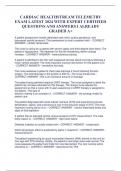
CARDIAC HEALTHSTREAM TELEMETRY EXAM LATEST 2024 WITH EXPERT CERTIFIED QUESTIONS AND ANSWERS I ALREADY GRADED A+
CARDIAC HEALTHSTREAM TELEMETRY EXAM LATEST 2024 WITH EXPERT CERTIFIED QUESTIONS AND ANSWERS I ALREADY GRADED A+ A patient assessment reveals distended neck veins, pulsus paradoxus, and decreased systolic pressure. This assessment is most consistent with: - CORRECT ANSWER - cardiac tamponade. The nurse is caring for a patient with severe sepsis and third-degree heart block. The patient is hypotensive. The treatment for this life-threatening rhythm change includes: - CORRECT ANSWER - transcutaneous pacing. A patient is admitted to the ICU with suspected cervical spinal cord injury following a motor vehicle accident. The most important nursing intervention for this patient is to: - CORRECT ANSWER - immobilize his head. The nurse assesses a patient's chest tube drainage 2 hours following thoracic surgery. The total drainage in the system is 200 mL. The nurse knows that: - CORRECT ANSWER - this is an excessive amount of drainage The patient being admitted requires CRRT therapy. The nurse assigned to admit the patient has not been educated on this therapy. The charge nurse adjusts the assignment so that a nurse with 3 years experience in CRRT therapy is assigned to the patient. This type of decision making is an example of: - CORRECT ANSWER - the synergy model for patient care. The patient diagnosed with acute tubular necrosis (ATN) and experiencing severe dehydration, sepsis, and pneumonia is now in the polyureic stage of ATN. The most important nursing action is to: - CORRECT ANSWER - monitor electrolyte levels and signs of fluid depletion. A patient has an elevated central venous pressure (CVP) measurement. The most likely reason is: - CORRECT ANSWER - right heart failure. Diabetes insipidus is usually treated with - CORRECT ANSWER - vasopressin. Which physiologic effect is produced by alpha-1 receptors? - CORRECT ANSWER - Vasoconstriction The patient experiencing an acute myocardial infarction (AMI) arrived on the unit an hour ago with TPA infusing. Initially, the patient's neurologic exam was normal. The nurse assesses the patient and finds him now disoriented. The next nursing action should be to: - CORRECT ANSWER - discontinue the TPA.
Document information
- Uploaded on
- April 24, 2024
- Number of pages
- 8
- Written in
- 2023/2024
- Type
- Exam (elaborations)
- Contains
- Questions & answers