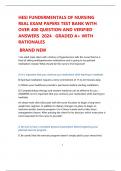
QMA Practice Test questions and answers graded A+
QMA Practice Test #1 (Lessons 1-7) - QMA Practice Test #1 (Lessons 1-7) The QMA is prohibited from performing which of the folllowing tasks: 1)Assessing the resident's condition 2) Calling the physician 3) Administering a medication per nasogastric tube 4)Administering a medication by injection 5) All of the above 6) NOne of the above - 5) All of the above The QMA's scope of practice includes which of the following: 1) Observe and report to the facility's licensed nurse reactions and side effects to medications exhibited by a resident 2) Initiate oxygen per nasal cannula or non-sealing mask only in an emergency 3) Administer treatment to an advanced skin condition such as a stage III decubitus ulcer 4) Count and administer and document controlled substances 5) 1,2, 4 6) 1,2, 3 - 5) 1,2, 4 Assault and battery is defined as: 1) The threat to use force upon another person and the carrying out of the threat 2) A malicious statement or report 3) Omission or neglect of any reasonable precaution, care or action 4) Any written statement that damages a person's character 5) None of the above - 1) The threat to use force upon another person and the carrying out of the threatA QMA would be consider negligent if he/she: 1) Observes the legal rights of every resident 2) Follows facility policy and procedures 3) Fails to inform the licensed nurse of medication error 4) Follows the six rights of medication administration 5) All of the above - 3) Fails to inform the licensed nurse of medication error If a QMA makes a medication error, the following actions should be taken EXCEPT: 1) Report the error to a licensed nurse 2) Observe the resident for undesirable effects 3) Document the medication error 4) Contact the physician and family to inform them of the medication error 5) Truthfully report the error - 4) Contact the physician and family to inform them of the medication error Resident rights include which of the following: 1) The right to voice grievances 2) The right to refuse treatment and be informed of the consequences 3) The right to be free from abuse 4) Both 1 and 2 5) All of the above 6) None of the above - 5) All of the above The four elements of successful communication include which of the following: 1) Formulating the message 2) Sending the message 3) Receiving the message 4) Observing the feedback 5) All of the above6) None of the above - All of the above Verbal communication is: 1) Written words 2)Spoken words 3) Facial expressions 4)Tone of voice 5) Both 1 and 2 6) All of the above - 5) Both 1 and 2
Geschreven voor
- Instelling
- QMA
- Vak
- QMA
Documentinformatie
- Geüpload op
- 23 april 2024
- Aantal pagina's
- 52
- Geschreven in
- 2023/2024
- Type
- Tentamen (uitwerkingen)
- Bevat
- Vragen en antwoorden
Onderwerpen

Ook beschikbaar in voordeelbundel