NSG 527 Final: Mod 10-12
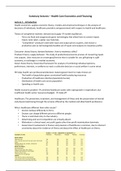
General Systems Theory - ANS"a system theory constitutes a way of explaining a unit such as a
family as it relates to and interacts with other systems....it explain how each variable affects the
whole and how the whole affects each part"
Concepts of the General Systems Theory - ANSSystem: one unit in totality for analysis;
interdependency; the structure is the organization of the parts needed for effective function and
measurable outcomes.
Holism or Nonsummativity: the system is analyzed holistically and not in individual parts
Interconnectedness: the system is interconnected with the environment in which it exists
Social System: is a social organization with persons having interactions with defined boundaries
Open System: all living systems must be interactive with the environment
Closed System: does not need interaction with the environment to survive
Hierarchy of Systems: each unit has a hierarchy that transcends from a higher-level to a
lower-level system; an identified system of study is called a target system of focal system.
Boundaries: are lines of demarcation from systems, subsystems, and suprasystems; these
boundaries can be porous or flexible to allow more or less interaction between the system and
the environment.
Input: is received from the environment and affects survival; it is the source of output in the
system.
Output: occurs when a system monitors and processes its output.
Feedback: ongoing monitoring of input and output in a system.
Self-Regulation, Homeostasis, Steady State, and Equilibrium: self-regulation is a mechanism for
managing the family's ability to balance and control input; when this occurs there is
homeostasis, steady state and equilibrium.
Differentiation: this process occurs for growth and change to occur; families need a balance of
stability (morphostasis) and change to grow as a unit.
Energy: increased energy is needed from the environment for systems with increased activity;
energy is necessary for differentiation to occur.
Application of the General Systems Theory Concepts to the Family - ANS- Family: living social
system; interdependent; family members in a single unit for reaching mutual goals.
- Reciprocal Determinism of the Ripple Effect: the ripple effect occurs when a significant
stressor impacts one family member and the effect "ripples" to the entire family unit; circular
causation.
- Nonsummativity: the family unit is "greater than the sum of its parts"; a comprehensive
assessment of the family includes all components of the interrelatedness.
- Self-Reflexivity and Goal Seeking: families have an innate sense to focus on their
organizational structure and function and then to set goals accordingly; communication is the
key methodology for ensuring success of this process.
, - Hierarchy of Systems: Family as Focal System: the family has a hierarchal structure with its
members; this also extends to the environment which encompasses institutions of the
suprasystem.
- Open, Closed and Random Family Systems: Open family-in an open system with the
environment; change is necessary and desirable; boundaries are permeable in the family
system. Closed-family-social control; rigidity; change is a stressor to the family
Random-family-individual family members determine their boundaries; family dynamics are in
chaos
- Family Boundaries: adaptation within families occurs when boundaries can expand and retract
to regulate input and output; the degree of openness can act negatively and/or positively on the
stability of the family.
- Family Adaptation: family members have the ability to be flexible in altering behavior; the
family adapts by actively processing internal and external input; family homeostasis occurs
when there is balance.
- Family Subsystems: families have multiple subsystems comprising the family structure; Table
6-2, p. 162, provides an overview of family subsytems in the nuclear, two-parent family.
Attachment Theory - ANSAttachment theory is focused on the relationships and bonds between
people, particularly long-term relationships including those between a parent and child and
between romantic partners.
Patterns of Attachment: Characteristics of Secure Attachment - ANSSecure attachment is
marked by distress when separated from caregivers and are joy when the caregiver returns.
Remember, these children feel secure and able to depend on their adult caregivers. When the
adult leaves, the child may be upset but he or she feels assured that the parent or caregiver will
return.
When frightened, securely attached children will seek comfort from caregivers. These children
know their parent or caregiver will provide comfort and reassurance, so they are comfortable
seeking them out in times of need.
Patterns of Attachment: Characteristics of Ambivalent Attachment - ANSAmbivalently attached
children usually become very distressed when a parent leaves. This attachment style is
considered relatively uncommon, affecting an estimated 7-15% of U.S. children. Research
suggests that ambivalent attachment is a result of poor maternal availability. These children
cannot depend on their mother (or caregiver) to be there when the child is in need.
Patterns of Attachment: Characteristics of Avoidant Attachment - ANSChildren with an avoidant
attachment tend to avoid parents or caregivers. When offered a choice, these children will show
no preference between a caregiver and a complete stranger. Research has suggested that this
attachment style might be a result of abusive or neglectful caregivers. Children who are
punished for relying on a caregiver will learn to avoid seeking help in the future.
Patterns of Attachment: Characteristics of Disorganized Attachment - ANSChildren with a
disorganized attachment often display a confusing mix of behavior and may seem disoriented,
General Systems Theory - ANS"a system theory constitutes a way of explaining a unit such as a
family as it relates to and interacts with other systems....it explain how each variable affects the
whole and how the whole affects each part"
Concepts of the General Systems Theory - ANSSystem: one unit in totality for analysis;
interdependency; the structure is the organization of the parts needed for effective function and
measurable outcomes.
Holism or Nonsummativity: the system is analyzed holistically and not in individual parts
Interconnectedness: the system is interconnected with the environment in which it exists
Social System: is a social organization with persons having interactions with defined boundaries
Open System: all living systems must be interactive with the environment
Closed System: does not need interaction with the environment to survive
Hierarchy of Systems: each unit has a hierarchy that transcends from a higher-level to a
lower-level system; an identified system of study is called a target system of focal system.
Boundaries: are lines of demarcation from systems, subsystems, and suprasystems; these
boundaries can be porous or flexible to allow more or less interaction between the system and
the environment.
Input: is received from the environment and affects survival; it is the source of output in the
system.
Output: occurs when a system monitors and processes its output.
Feedback: ongoing monitoring of input and output in a system.
Self-Regulation, Homeostasis, Steady State, and Equilibrium: self-regulation is a mechanism for
managing the family's ability to balance and control input; when this occurs there is
homeostasis, steady state and equilibrium.
Differentiation: this process occurs for growth and change to occur; families need a balance of
stability (morphostasis) and change to grow as a unit.
Energy: increased energy is needed from the environment for systems with increased activity;
energy is necessary for differentiation to occur.
Application of the General Systems Theory Concepts to the Family - ANS- Family: living social
system; interdependent; family members in a single unit for reaching mutual goals.
- Reciprocal Determinism of the Ripple Effect: the ripple effect occurs when a significant
stressor impacts one family member and the effect "ripples" to the entire family unit; circular
causation.
- Nonsummativity: the family unit is "greater than the sum of its parts"; a comprehensive
assessment of the family includes all components of the interrelatedness.
- Self-Reflexivity and Goal Seeking: families have an innate sense to focus on their
organizational structure and function and then to set goals accordingly; communication is the
key methodology for ensuring success of this process.
, - Hierarchy of Systems: Family as Focal System: the family has a hierarchal structure with its
members; this also extends to the environment which encompasses institutions of the
suprasystem.
- Open, Closed and Random Family Systems: Open family-in an open system with the
environment; change is necessary and desirable; boundaries are permeable in the family
system. Closed-family-social control; rigidity; change is a stressor to the family
Random-family-individual family members determine their boundaries; family dynamics are in
chaos
- Family Boundaries: adaptation within families occurs when boundaries can expand and retract
to regulate input and output; the degree of openness can act negatively and/or positively on the
stability of the family.
- Family Adaptation: family members have the ability to be flexible in altering behavior; the
family adapts by actively processing internal and external input; family homeostasis occurs
when there is balance.
- Family Subsystems: families have multiple subsystems comprising the family structure; Table
6-2, p. 162, provides an overview of family subsytems in the nuclear, two-parent family.
Attachment Theory - ANSAttachment theory is focused on the relationships and bonds between
people, particularly long-term relationships including those between a parent and child and
between romantic partners.
Patterns of Attachment: Characteristics of Secure Attachment - ANSSecure attachment is
marked by distress when separated from caregivers and are joy when the caregiver returns.
Remember, these children feel secure and able to depend on their adult caregivers. When the
adult leaves, the child may be upset but he or she feels assured that the parent or caregiver will
return.
When frightened, securely attached children will seek comfort from caregivers. These children
know their parent or caregiver will provide comfort and reassurance, so they are comfortable
seeking them out in times of need.
Patterns of Attachment: Characteristics of Ambivalent Attachment - ANSAmbivalently attached
children usually become very distressed when a parent leaves. This attachment style is
considered relatively uncommon, affecting an estimated 7-15% of U.S. children. Research
suggests that ambivalent attachment is a result of poor maternal availability. These children
cannot depend on their mother (or caregiver) to be there when the child is in need.
Patterns of Attachment: Characteristics of Avoidant Attachment - ANSChildren with an avoidant
attachment tend to avoid parents or caregivers. When offered a choice, these children will show
no preference between a caregiver and a complete stranger. Research has suggested that this
attachment style might be a result of abusive or neglectful caregivers. Children who are
punished for relying on a caregiver will learn to avoid seeking help in the future.
Patterns of Attachment: Characteristics of Disorganized Attachment - ANSChildren with a
disorganized attachment often display a confusing mix of behavior and may seem disoriented,