MHA 705 Health Informatics Exam Proven 100%
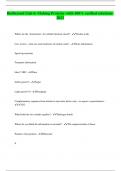
MHA 705 Health Informatics Exam Proven 100% _____ is a combination of principles from disciplinary science, computer science, information science, and cognitive science. - Health Informatics Why study informatics? - healthcare is information intensive, interprofessional collaboration and communication are essential for care coordination to promote safe, evidence-based, efficient, and cost effective care, and technology tools help us to collect integrate and manage clinical information ____ is science of information management in healthcare. - informatics How are data, information, and knowledge used in the discipline, and how does this understanding promote wisdom in practice? - basic understanding of informatics principles What are the core elements of informatics? - data, info, knowledge, wisdom paradigm, foundation of disciplinary knowledge, based on foundation of knowledge model, informatics competencies needed by all HC professionals to practice in information intensive 21st century HC environments what does DIKW - data, info, knowledge, wisdom ____ is raw facts. - data ____ is data that has been interpreted for meaning. - information ____ is awareness and understanding of a set of information and ways that information can be made useful to support a specific task or arrive at a decision. - knowledge ____ is appropriate use of knowledge. - wisdom we experience our environment and learn by ______ knowledge. - acquiring, processing, generating, disseminating the ability to manage knowledge is learned and honed from ___. - birth the ______ is organizing conceptual framework for text, helps to explain ties between disciplinary science, informatics, and knowledge, informatics is viewed as tool for finding knowledge. - foundation of knowledge model KA stands for ___> - knowledge acquisition KD stands for _____> - knowledge dissemination KG stands for _____> - knowledge generation KP stands for _____> - knowledge processing As technology and research continue to advance, new SDLC models are pioneered and introduced to ____. The interpretation and implementation of any model selected reflects knowledge and skill of team applying model. - enhance techniques At times during SDLC, new into affects the ____ from earlier phases and development effort may be re-examined or halted until these modifications can be reconciled with current design and scope of project. - outputs ____ is the ability to share information across organization; this will remain paramount under HITECH Act; ability to share patient data is extremely important, both within organization and across organizational boundaries. - interoperability ____ any programmer can implement, modify, and apply, reconstruct, and restructure rich libraries of source codes available from proven, well-tested products. - open source software (OSS) and free/OSS _____ automates many of the tasks required in systems development effort, encourage adherence to SDLC, thus instilling high degree of rigor and standardization to entire systems development process, these tools help to reduce cost and development time while enriching quality of product. - computer aided software engineering tools (CASE) what are the three phases of DSDM - pre-project, project life cycle, post projec ___ is highly iterative and incremental approach with high level of user input and involvement, iterative process requires repetitive examination that enhances details and improves accuracy - dynamic system development method DSDM ____ makes effort to represent real world objects -- modeling real world entities or things (hospital, patient, account, respiratory therapist) into abstract computer software objects, once system is object oriented all interactions or exchanges take place between or among objects. - object oriented modeling ____ combines logic of systems development life cycle with power of object-oriented modeling and programming. - object oriented systems development (OOSD) ____ provides fast way to add functionality through prototyping and user testing, its easier for users to examine actual prototypes rather than documentation; theres rapid requirements gathering phase using workshops and focus groups to build prototype is beta tested with users, their feedback is used to perfect or add functionality and capabilities to system. - rapid prototyping or rapid application development
Written for
- Institution
- MHA 705
- Course
- MHA 705
Document information
- Uploaded on
- April 20, 2024
- Number of pages
- 6
- Written in
- 2023/2024
- Type
- Exam (elaborations)
- Contains
- Questions & answers
Subjects
- why study informatics
- informatics
-
mha 705 health informatics exam proven 100
-
science and cognitive science health informati
-
what does dikw data info knowledge wisdom
-
we experience our environment

Also available in package deal