AP Chemistry AP Exam Review Questions with Answers
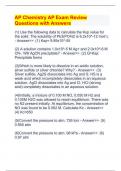
(1) Use the following data to calculate the Ksp value for the solid. The solubility of Pb3(PO4)2 is 6.2x10^-12 mol/ L - Answer>> (1) Ksp= 9.89x10^-55
(2) A solution contains 1.0x10^-5 M Ag+ and 2.0x10^-6 M CN-. Will AgCN precipitate? - Answer>> (2) Q>Ksp: Precipitate forms
(3)Which is more likely to dissolve in an acidic solution, silver sulfide or silver chloride? Why? - Answer>> (3) Silver sulfide, Ag2S dissociates into Ag and S. HS is a weak acid which incompletely dissociates in an aqueous solution. AgCl dissociates into Ag and Cl. HCl (strong acid) completely dissociates in an aqueous solution.
(4)Initially, a mixture of 0.100 M NO, 0.050 M H2 and 0.100M H2O was allowed to reach equilibrium. There was no N2 present initially. At equilibrium, the concentration of NO was found to be 0.062 M. Calculate Kc - Answer>> (4) Kc=650
(5)Convert the pressure to atm. 726 torr - Answer>> (5) 0.955 atm
(6)Convert the pressure to atm. 98 kPa - Answer>> (6) 0.97 atm (7)Convert the pressure to atm. 16.33 psi - Answer>> (7) 1.11 atm
(8) 2 NO(g) + O2(g) ⇋ 2NO2 (g) H<0. Which of the following changes alone would cause a decrease in the value of Keq for the reaction represented above?
a. Decreasing the temperature
b. Increasing the temperature
c. Decreasing the volume of the reaction vessel
d. Increasing the volume of the reaction vessel
e. Adding a catalyst - Answer>> (8) (B) Increasing the temperature
(9) 2SO3(g) ⇋ 2SO2(g) + O2(g). After the equilibrium represented above is established, some pure O2(g) is injected into the reaction vessel at constant temperature. After equilibrium is reestablished, which of the following has a lower value compared to its value at the original equilibrium?
a. Keq for the reaction
b. The total pressure in the reaction vessel
c. The amount of SO3(g) in the reaction vessel
d. The amount of O2(g) in the reaction vessel
e. The amount of SO2(g) in the reaction vessel - Answer>> (9) (E) The amount of SO2(g) in the reaction vessel
(10) Estimate the mass of CaCl2 (molar mass = 111.0) required to prepare 75.00ml of a 2.000 M solution of this slat
a. 150 g
(1) Use the following data to calculate the Ksp value for the solid. The solubility of Pb3(PO4)2 is 6.2x10^-12 mol/ L - Answer>> (1) Ksp= 9.89x10^-55
(2) A solution contains 1.0x10^-5 M Ag+ and 2.0x10^-6 M CN-. Will AgCN precipitate? - Answer>> (2) Q>Ksp: Precipitate forms
(3)Which is more likely to dissolve in an acidic solution, silver sulfide or silver chloride? Why? - Answer>> (3) Silver sulfide, Ag2S dissociates into Ag and S. HS is a weak acid which incompletely dissociates in an aqueous solution. AgCl dissociates into Ag and Cl. HCl (strong acid) completely dissociates in an aqueous solution.
(4)Initially, a mixture of 0.100 M NO, 0.050 M H2 and 0.100M H2O was allowed to reach equilibrium. There was no N2 present initially. At equilibrium, the concentration of NO was found to be 0.062 M. Calculate Kc - Answer>> (4) Kc=650
(5)Convert the pressure to atm. 726 torr - Answer>> (5) 0.955 atm
(6)Convert the pressure to atm. 98 kPa - Answer>> (6) 0.97 atm (7)Convert the pressure to atm. 16.33 psi - Answer>> (7) 1.11 atm
(8) 2 NO(g) + O2(g) ⇋ 2NO2 (g) H<0. Which of the following changes alone would cause a decrease in the value of Keq for the reaction represented above?
a. Decreasing the temperature
b. Increasing the temperature
c. Decreasing the volume of the reaction vessel
d. Increasing the volume of the reaction vessel
e. Adding a catalyst - Answer>> (8) (B) Increasing the temperature
(9) 2SO3(g) ⇋ 2SO2(g) + O2(g). After the equilibrium represented above is established, some pure O2(g) is injected into the reaction vessel at constant temperature. After equilibrium is reestablished, which of the following has a lower value compared to its value at the original equilibrium?
a. Keq for the reaction
b. The total pressure in the reaction vessel
c. The amount of SO3(g) in the reaction vessel
d. The amount of O2(g) in the reaction vessel
e. The amount of SO2(g) in the reaction vessel - Answer>> (9) (E) The amount of SO2(g) in the reaction vessel
(10) Estimate the mass of CaCl2 (molar mass = 111.0) required to prepare 75.00ml of a 2.000 M solution of this slat
a. 150 g