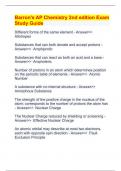
Barron's AP Chemistry 2nd edition Exam
Study Guide
Different forms of the same element - Answer>> Allotropes
Substances that can both donate and accept protons - Answer>> Amphiprotic
Substances that can react as both an acid and a base - Answer>> Amphoteric
Number of protons in an atom which determines position on the periodic table of elements - Answer>> Atomic Number
A substance with no internal structure - Answer>> Amorphous Substance
The strength of the positive charge in the nucleus of the atom; corresponds to the number of protons the atom has - Answer>> Nuclear Charge
The Nuclear Charge reduced by shielding or screening - Answer>> Effective Nuclear Charge
An atomic orbital may describe at most two electrons, each with opposite spin direction - Answer>> Pauli Exclusion Principle Group 1A on the Periodic Table - Answer>> Alkali Metals
Group 2A on the Periodic Table - Answer>> Alkaline Earth Metals
A negatively charged subatomic particle that revolves around the nucleus of an atom - Answer>> Electron
A subatomic particle that has no charge and that is found in the nucleus of an atom - Answer>> Neutron
A subatomic particle that has a positive charge and that is found in the nucleus of an atom - Answer>> Proton
Electrons, Neutrons, and Protons - Answer>> Subatomic Constituents of Atom
First quantum number, designated as the letter "n." It takes on any positive integer value and describes an electron's energy level. An electron with a higher n value is
at a higher energy state. - Answer>> Principal Quantum Number
Second quantum number, designated by the letter "l." This
"angular momentum" refers to the subshells within each principle quantum energy level. It can take on the value of an integer in the 0 to (n-1) range. - Answer>> Azimuthal Quantum Number
Third quantum number, designated as ml. Describes a particular orbital within a subshell where an electron is
Study Guide
Different forms of the same element - Answer>> Allotropes
Substances that can both donate and accept protons - Answer>> Amphiprotic
Substances that can react as both an acid and a base - Answer>> Amphoteric
Number of protons in an atom which determines position on the periodic table of elements - Answer>> Atomic Number
A substance with no internal structure - Answer>> Amorphous Substance
The strength of the positive charge in the nucleus of the atom; corresponds to the number of protons the atom has - Answer>> Nuclear Charge
The Nuclear Charge reduced by shielding or screening - Answer>> Effective Nuclear Charge
An atomic orbital may describe at most two electrons, each with opposite spin direction - Answer>> Pauli Exclusion Principle Group 1A on the Periodic Table - Answer>> Alkali Metals
Group 2A on the Periodic Table - Answer>> Alkaline Earth Metals
A negatively charged subatomic particle that revolves around the nucleus of an atom - Answer>> Electron
A subatomic particle that has no charge and that is found in the nucleus of an atom - Answer>> Neutron
A subatomic particle that has a positive charge and that is found in the nucleus of an atom - Answer>> Proton
Electrons, Neutrons, and Protons - Answer>> Subatomic Constituents of Atom
First quantum number, designated as the letter "n." It takes on any positive integer value and describes an electron's energy level. An electron with a higher n value is
at a higher energy state. - Answer>> Principal Quantum Number
Second quantum number, designated by the letter "l." This
"angular momentum" refers to the subshells within each principle quantum energy level. It can take on the value of an integer in the 0 to (n-1) range. - Answer>> Azimuthal Quantum Number
Third quantum number, designated as ml. Describes a particular orbital within a subshell where an electron is