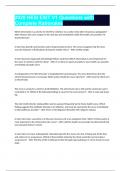
2020 HESI EXIT V1 Questions with Complete Rationales
2020 HESI EXIT V1 Questions with Complete Rationales Which information is a priority for the RN to reinforce to an older client after intravenous pylegraphy? - ANS: Measure the urine output for the next day and immediately notify the health care provider if it should decrease. A client has altered renal function and is being treated at home. The nurse recognizes that the most accurate indicator of fluid balance during the weekly visits is - ANS: weekly weight A client has been diagnosed with Zollinger-Ellison syndrome.Which information is most important for the nurse to reinforce with the client? - ANS: It is critical to report promptly to your health care provider any findings of peptic ulcers A primigravida in the third trimester is hospitalized for preeclampsia. The nurse determines that the client's blood pressure is increasing. Which action should the nurse take first? - ANS: Have the client turn to the left side The nurse is caring for a client in atrial fibrillation. The atrial heart rate is 250 and the ventricular rate is controlled at 75. Which of the following findings is cause for the most concern? - ANS: A cold, pale lower leg The client with infective endocarditis must be assessed frequently by the home health nurse. Which finding suggests that antibiotic therapy is not effective, and must be reported by the nurse immediately to the healthcare provider? - ANS: Fever of 103 degrees Fahrenheit (39.5 degrees Celsius) A client who had a vasectomy is in the post recovery unit at an outpatient clinic. Which of these points is most important to be reinforced by the nurse? - ANS: Until the health care provider has determined that your ejaculate doesn't contain A client who is to have antineoplastic chemotherapy tells the nurses of a fear of being sick all the time and wishes to try acupuncture. Which of these beliefs stated by the client would be incorrect about acupuncture? - ANS: The flow of life is believed to flow through major pathways or nerve clusters in your body. The nurse is discussing with a group of students the disease Kawasaki. What statement made by a student about Kawasaki disease is incorrect? - ANS: Kawasaki disease occurs most often in boys, children younger than age 5 and children of Hispanic descent A client has viral pneumonia affecting 2/3 of the right lung. What would be the best position to teach the client to lie in every other hour during first 12 hours after admission? - ANS: Side-lying on the left with the head elevated 10 degrees A client has an indwelling catheter with continuous bladder irrigation after undergoing a transurethral resection of the prostate (TURP) 12 hours ago. Which finding at this time should be reported to the health care provider? - ANS: minimal drainage into the urinary collection bag A nurse is performing CPR on an adult who went into cardiopulmonary arrest. Another nurse enters the room in response to the call. After checking the client's pulse and respirations, what should be the function of the second nurse? - ANS: Participate with the compressions or breathing . The nurse assesses a 72 year-old client who was admitted for right sided congestive heart failure. Which of the following would the nurse anticipate finding? - ANS: Jugular vein distention A client with heart failure has a prescription for digoxin. The nurse is aware that sufficient potassium should be included in the diet because hypokalemia in combination with this medication? - ANS: Can predispose to dysrhythmias A nurse assesses a young adult in the emergency room following a motor vehicle accident. Which of the following neurological signs is of most concern? - ANS: Pupils fixed and dilated A 14 year-old with a history of sickle cell disease is admitted to the hospital with a diagnosis of vaso-occlusive crisis. Which statements by the client would be most indicative of the etiology of this crisis - ANS: "I went to the health care provider last week for a cold and I have gotten worse." Which these findings would the nurse more closely associate with anemia in a 10 month-old infant? - ANS: Pale mucosa of the eyelids and lips The nurse is caring for a client in hypertensive crisis in an intensive care unit. The priority assessment in the first hour of care is - ANS: Pupil responses Which of these clients who are all in the terminal stage of cancer is least appropriate to suggest the use of patient controlled analgesia (PCA) with a pump? - ANS: A preschooler with intermittent episodes of alertness The nurse is about to assess a 6 month-old child with nonorganic failure-to thrive (NOFTT). Upon entering the room, the nurse would expect the baby to be - ANS: Pale, thin arms and legs, uninterested in surroundings As the nurse is speaking with a group of teens which of these side effects of chemotherapy for cancer would the nurse expect this group to be more interested in during the discussion? - ANS: Hair loss While caring for a client who was admitted with myocardial infarction (MI) 2 days ago, the nurse notes today's temperature is 101.1 degrees Fahrenheit (38.5 degrees Celsius). The appropriate nursing intervention is to - ANS: Administer acetaminophen as ordered as this is normal at this time . A client is admitted for first and second degree burns on the face, neck, anterior chest and hands. The nurse's priority should be - ANS: Assess for dyspnea or stridor Which of these clients who call the community health clinic would the nurse ask to come in that day to be seen by the health care provider? - ANS: I went to the bathroom and my urine looked very red and it didn't hurt when I went. A middle aged woman talks to the nurse in the health care provider's office about uterine fibroids also called leiomyomas or myomas. What statement by the woman indicates more education is needed? - ANS: Fibroids that cause no problems still need to be taken out. An elderly client admitted after a fall begins to seize and loses consciousness. What action by the nurse is appropriate to do next? - ANS: Stay with client and observe for airway obstruction A nurse is providing care to a primigravida whose membranes spontaneously ruptured (ROM) 4 hours ago. Labor is to be induced. At the time of the ROM the vital signs were T-99.8 degrees F, P-84, R-20, BP-130/78, and fetal heart tones (FHT) 148 beats/min. Which assessment findings taken now may be an early indication that the client is developing a complication of labor? - ANS: FHT 168 beats/min A client with pneumococcal pneumonia had been started on antibiotics 16 hours ago. During the nurse's initial evening rounds the nurse notices a foul smell in the room. The client makes all of these statements during their conversation. Which statement would alert the nurse to a complication? - ANS: "I have been coughing up foul-tasting, brown, thick sputum." The nurse is performing an assessment on a client in congestive heart failure. Auscultation of the heart is most likely to reveal - ANS: S3 ventricular gallop Which of these observations made by the nurse during an excretory urogram indicate a complicaton? - ANS: The client's entire body turns a bright red color A client is diagnosed with a spontaneous pneumothorax necessitating the insertion of a chest tube. What is the best explanation for the nurse to provide this client? - ANS: "The tube will remove excess air from your chest." The nurse is reviewing laboratory results on a client with acute renal failure. Which one of the following should be reported immediately? - ANS: Serum potassium 6 mEq/L The nurse is caring for a client undergoing the placement of a central venous catheter line. Which of the following would require the nurse's immediate attention? - ANS: Dyspnea The nurse is performing a physical assessment on a client who just had an endotracheal tube inserted. Which finding would call for immediate action by the nurse? - ANS: Pulse oximetry of 88 A nurse checks a client who is on a volume-cycled ventilator. Which finding indicates that the client may need suctioning? - ANS: Restlessness The most effective nursing intervention to prevent atelectasis from developing in a post operative client is to - ANS: Assist client to turn, deep breathe, and cough When caring for a client with a post right thoracotomy who has undergone an upper lobectomy, the nurse focuses on pain management to promote - ANS: Deep breathing and coughing
École, étude et sujet
- Établissement
- HESI EXIT RN 2023 V1
- Cours
- HESI EXIT RN 2023 V1
Infos sur le Document
- Publié le
- 17 avril 2024
- Nombre de pages
- 18
- Écrit en
- 2023/2024
- Type
- Examen
- Contenu
- Questions et réponses
Sujets
-
2020 hesi exit v1 questions with complete rational

Document également disponible en groupe