______tylase002________
Student Number
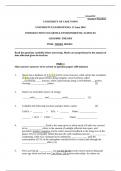
UNIVERSITY OF CAPE TOWN
UNIVERSITY EXAMINATIONS: 12 June 2018
INTRODUCTION TO EARTH & ENVIRONMENTAL SCIENCES
GEO1009F: THEORY
TIME: THREE HOURS
Read the questions carefully before answering. Marks are proportional to the amount of
time allocated given in brackets.
PART 1
Short answers (answers to be written on question paper) (100 minutes)
1. Quartz has a hardness of 3/ 5/ 7/ 9 (circle correct answer), while calcite has a hardness
of 3/ 5/ 7/ 9, and quartz breaks along irregular, curved surfaces called
__conchoidal_____ fracture, while calcite breaks along 3 well-defined ___perfect
cleavage _____________ planes. [2]
2. Name two renewable sources of energy:
______solar_______ and ___________wind______________. [1]
3. Complete the following reactions and give them a name: [3]
CaSiO3 + ________ = SiO2 + _______ Name: ______________
_______ + H2O = CH2O + ________ Name: _________________
4. ___________________ Earth is the name given to when much of Earth was covered
in ice. ___________ refers to the amount of sunlight reflected into space, and
provided a positive /negative (circle correct answer) feedback to the icing over of the
planet. The ice eventually melted because the cold conditions slowed _____________
weathering, while CO2 continued to be emitted by _____________ until the
concentration of CO2 in the atmosphere reached levels to warm Earth through the
____________________ effect. [3]
5. The Last Glacial ___________ was 10/ 20/ 40/ 60 (circle correct answer) thousand
years ago when sea level was 5 m/ 60 m/ 120 m lower than today. Ice sheets are
, dominated by chemical/ physical weathering and their melting results in deposits
called ____________ that are poorly/ well sorted having angular/ rounded rock clasts.
If all of the ice on Earth today were to melt, global sea level would rise 25 m/ 65 m/
125 m. [4]
6. The Malmesbury Group is the oldest rock in the Cape Town area (True or False) and
is a low/ intermediate/ high grade of metamorphic rock having experienced maximum
temperatures of 250 to 300oC. [1]
7. The interior structure of Earth is determined from ___________ waves of which there
are two types that penetrate the deep Earth called ___________ and ______________
waves. These waves indicate that the Earth’s outer core is solid/ liquid. The outer core
is thought to generate Earth’s ______________ field which shields us from the
____________ wind. [3]
8. The oceans contain approximately _______ percent of the water on Earth’s surface.
Of the remaining water, three-quarters is stored as _____________ and most of the
rest is stored as ________________________. One in ______ people on Earth do not
have access to fresh water. [2]
9. ____________ or the remains of living organisms were first used to assign
_______________ ages to rocks. The _______________ ages of rocks in million of
years before the present could only be determined once _________________
elements had been discovered. [2]
10. Define the Anthropocene: [1]
_____________________________________________________________
_____________________________________________________________
11. List the three types of plate tectonic boundaries and give an example of each:
____________________________ ____________________________
____________________________ ____________________________
____________________________ _____________________________
[3]
Student Number
UNIVERSITY OF CAPE TOWN
UNIVERSITY EXAMINATIONS: 12 June 2018
INTRODUCTION TO EARTH & ENVIRONMENTAL SCIENCES
GEO1009F: THEORY
TIME: THREE HOURS
Read the questions carefully before answering. Marks are proportional to the amount of
time allocated given in brackets.
PART 1
Short answers (answers to be written on question paper) (100 minutes)
1. Quartz has a hardness of 3/ 5/ 7/ 9 (circle correct answer), while calcite has a hardness
of 3/ 5/ 7/ 9, and quartz breaks along irregular, curved surfaces called
__conchoidal_____ fracture, while calcite breaks along 3 well-defined ___perfect
cleavage _____________ planes. [2]
2. Name two renewable sources of energy:
______solar_______ and ___________wind______________. [1]
3. Complete the following reactions and give them a name: [3]
CaSiO3 + ________ = SiO2 + _______ Name: ______________
_______ + H2O = CH2O + ________ Name: _________________
4. ___________________ Earth is the name given to when much of Earth was covered
in ice. ___________ refers to the amount of sunlight reflected into space, and
provided a positive /negative (circle correct answer) feedback to the icing over of the
planet. The ice eventually melted because the cold conditions slowed _____________
weathering, while CO2 continued to be emitted by _____________ until the
concentration of CO2 in the atmosphere reached levels to warm Earth through the
____________________ effect. [3]
5. The Last Glacial ___________ was 10/ 20/ 40/ 60 (circle correct answer) thousand
years ago when sea level was 5 m/ 60 m/ 120 m lower than today. Ice sheets are
, dominated by chemical/ physical weathering and their melting results in deposits
called ____________ that are poorly/ well sorted having angular/ rounded rock clasts.
If all of the ice on Earth today were to melt, global sea level would rise 25 m/ 65 m/
125 m. [4]
6. The Malmesbury Group is the oldest rock in the Cape Town area (True or False) and
is a low/ intermediate/ high grade of metamorphic rock having experienced maximum
temperatures of 250 to 300oC. [1]
7. The interior structure of Earth is determined from ___________ waves of which there
are two types that penetrate the deep Earth called ___________ and ______________
waves. These waves indicate that the Earth’s outer core is solid/ liquid. The outer core
is thought to generate Earth’s ______________ field which shields us from the
____________ wind. [3]
8. The oceans contain approximately _______ percent of the water on Earth’s surface.
Of the remaining water, three-quarters is stored as _____________ and most of the
rest is stored as ________________________. One in ______ people on Earth do not
have access to fresh water. [2]
9. ____________ or the remains of living organisms were first used to assign
_______________ ages to rocks. The _______________ ages of rocks in million of
years before the present could only be determined once _________________
elements had been discovered. [2]
10. Define the Anthropocene: [1]
_____________________________________________________________
_____________________________________________________________
11. List the three types of plate tectonic boundaries and give an example of each:
____________________________ ____________________________
____________________________ ____________________________
____________________________ _____________________________
[3]