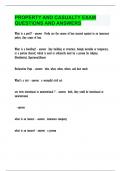
PROPERTY AND CASUALTY (CHAPTER 1) EXAM PREP QUESTIONS AND ANSWERS 2024.
Assume the financial risk one's self. Self Insure A condition where the chance, likelihood, probability or potential loss exists. Risk A form changing the provisions of a policy. Endorsement An accepting of an insurance contract takes place when the insurance company agrees to issue insurance. Acceptance Specifies that the insured may not transfer rights of ownership or interest in an insurance policy to another party without the insurer's written consent. Assignment A written contract is the final expression of agreement and may not be altered by prior or simultaneous oral or written negotiations without the written consent of both parties. Parol Evidence Rule *Must charge a premium for the risk based on the same factors used in evaluating the risk. * Premium rates are considered inadequate when they don't cover projected losses and expenses. *Rates must not be excessive or unfairly discriminatory. Premium Assumptions Insurance regulator allows competition between insurers to produce rates. Open Competition An owner may transfer or assign ownership of a life or health insurance policy to another person. Non-Personal Contract A loss reserve established based on average settlements of particular claim types. Average Value Method The application submitted by the applicant. Offer A person appointed by an insurance company to represent the company and the present policies on it behalf. Producer (Agent) A person that negotiates insurance contracts on behalf of the insured, thereby representing the client's interest, not the insurer. Broker The person making application for insurance. Applicant Oversee the operation of the business. Executives Illegal activity voids contract Legal Purpose Minors, mentally incompetent, people under an influence of drugs or alcohol do not have legal capacity. Competent Parties A Physical condition that increases the probability of loss. (Flammable material stored near a furnace.) Physical Hazard Something that increases the chance or likelihood of a loss occurring. ( Physical or Moral or Morale) Hazard One party prepares a contract (insurer) and submits to the other party on a take-it-or-leave-it basis (insured). Contract of Adhesion Both parties to a contract must perform certain duties and follow rules of conduct to make the contract enforceable. Conditional Contract A reinsurance agreement allowing the ceding company and the reinsurance company an opportunity to exchange advice about the underwriting of each case. Facultative Agreements Reinsurance agreement that covers all risks contained in the subject line(s) of business automatically. Treaty Agreements A contractual agreement removing the liability of one party from a second party. Hold Harmless Agreement One party must make and communicate an offer to the other party and the second party must accept that offer. Agreement File with insurance regulator, in use immediately. File and Use A loss reserve established for each claim, when reported. Case Reserve Method An insurer deals directly with the insured through an employee. Direct Writing System The process of evaluation a risk for the purpose of issuing insurance coverage. Underwriting *Nature of risk *What hazards are present *What outside factors might affect the risk *What past losses have occurred Underwriting (Considered) The insuring of risks that are more prone to losses that the average (standard) or above average (preferred) risk. Adverse Selection An insurer that hasn't sought approval, hasn't been able to obtain approval to transact business from the insurance regulator in this state. Non-Admitted Refers to whether or not an insurer is approved or authorized to write business in this state. Admitted VS Non-Admitted Instances where there is a chance of loss or gain (gambling). Speculative Risk Situations where only the chance of loss and no chance for gain exists. (fire,windstorm,explosion) Pure Risk Insurers agree to apportion among themselves those risks. Risk Sharing/ Risk Sharing Plan *The determination of what types of protection are required to meet an insured's needs. *Survey of an insured's operations, assets, exposures, that could give rise to losses. Risk Managment *Assumes the financial risk one's self. *Generally an option only for large companies. Self-Insurer Any event, whether past or present, that may cause loss or damage to a person having an insurable interest or create a liability against him/her. Insurable Events The principle of restoring the insured to the same financial condition as before the loss, with no intent of loss or gain. Principle of Indemnity To restore individuals to the same financial or economic condition that existed prior to a loss. Indemnity A specified dollar amount of each covered property loss that an insured must pay. Deductible *The net premiums plus interest reflects possible future contract obligations. *An accounting measurement of an insurer's future obligation to its policyholders. Loss Reserves
Written for
- Institution
- Property & Casualty
- Course
- Property & Casualty
Document information
- Uploaded on
- April 16, 2024
- Number of pages
- 22
- Written in
- 2023/2024
- Type
- Exam (elaborations)
- Contains
- Questions & answers
Subjects
-
property and casualty chapter 1 exam prep

Also available in package deal