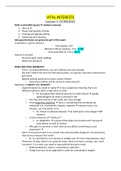
Holistic Health Assessment Midterm 1 Questions & Answers Solved 100% Correct!!
Holistic Health Assessment Midterm 1 Questions & Answers Solved 100% Correct!! Before starting assessment -Have all equipment ready -Clean/sterilize your equipment -Routine precautions Tangential lighting a source of illumination directed from an angle to the side of what is being examined; used to make a raised lesion cast a shadow, for example Oblique/indirect lighting -45 degrees *jugular pulsation Inspection -Compare right and left sides (symmetrical) -Use good lighting >Otoscope >Ophthalmoscope >Specula: vaginal, nasal >Penlight Palpation -Slow and systemic -Light versus deep palpation -Intermittent pressure -Bimanual palpation Percussion -Tapping: short, sharp strokes -Assess underlying structures Characteristic sounds: >Resonant >Hyperresonant >Tympany >Dull >Flat Auscultation -Sounds produced by heart, lungs, BVs, and abdomen -Normal sounds vs abnormal and extra sounds Health history -Focuses on patient concerns -Establish a trusting relationship -Gather info -Assessment in nursing process -medications -allergies Primary data source patient Secondary data source Patient's family and chart >is the patient a reliable historian or inaccurate historian >Document who provides info Objective data -What you see during an exam -What you measure -A "sign" Subjective data -What the client tells you -What the client says -A "symptom" Components of nonverbal communication -Physical appearance -Facial expression -Posture and positioning -Gestures -Eye contact -Use of touch -Personal touch Sex vs gender sex is biological; gender is the predetermined roles for men and women in the community History -Chief concern- reason for seeking care -Try to put it in the patients own words -i.e. "the patient says my stomach hurts Past history (health history) -Childhood illnesses with potentially lasting effects: polio, varicella Immunizations -Medical conditions (e.g. cardiac, respiratory, kidney, liver, etc.) & treatments received -Surgical interventions & outcomes -Injuries -For female pts note last menstrual period (LMP) and whether she could be pregnant -Include dates of initial diagnoses or surgeries Family history -any significant illnesses that run in the patient's family -relevant Qs to patients concern -any immediate family? OPQRSTUA -Onset: when did this start -Provocation and palliation: wha causes the symptoms and what makes them better or worse -Quality and/or quantity -Region/radiation -Severity: on a scale of 1-10 or how does it affect ADLs -Time: of day -Understanding: of patient -Associated symptoms DADSPIES D diet A alcohol D drugs S smoking P physical exam I immunizations E exercise S stress DADSPIES questions -Tobacco use for how long and how much? Alcohol -How much Alcohol do you drink in a day or week? -Recreational drug Any use? What? How often Components of subjective assessment -History -Health history:past and family -OPQRSTUA -medications and allergies -DADSPIES -check for abuse -health teaching -functional assessment -cultural and social considerations -review of systems -mental health -sexual history and orientation -closing interview Closing interview -Summarize what you found including: >Positive health aspects >Any identified problems >Plans for action -Thank client for time and cooperation Functional assessment -Effects of health or illness on quality of life -Identify strengths and areas that need improvement -Assessing ability to perform ADLs Cultural and social considerations -Important health history information for new immigrants: >When arrived in Canada and from where >Refugee or immigrant status >Effect of historical events in country of origin for older patients >Spiritual resources and religion >Past health (immunizations in country of origin) >Health perception >Nutrition (taboo foods/combinations) Review of systems description of individual body systems in order to discover any symptoms not directly related to the main problem Mental health -"Describe any changes that you have had in your mood or feelings" & "have you ever been treated for any condition with your mood or behavior?" -Always approach with a matter-of-fact approach -Avoid showing signs of judgment or embarrassment Sexual history & orientation -Are you sexually active? -How many partners? -What types of intimate contact do you have -Do you use protection? What kind? Oral temp. -30 minutes after eating, drinking, smoking or chewing gum -Gloves not necessary but make sure to dispose or probe cover in garbage -place under the patients tongue and instruct to keep lips closed tightly wit no talking for the duration of the temp. assessment -sublingual pocket -most accurate -carotid artery Tympanic temp. -The position of the adult (child >1) pinna for tympanic temp.: pull pinna up, back slightly outward to straighten the curvature -accurate -Internal carotid artery Axillary temp. -safe and accurate -Infants and young children Rectal temp. -when the other routes are not practical -lubricated rectal probe electronic thermometer -Insert 2-3cm towered umbilicus Temporal temp. -non-invasive -Infrared emissions of temporal artery -Takes 2-3 sec If pulse is irregular... auscultate apical for 1 minute Normal adult resting rate 60-100bpm bradycardia less than 60 bpm tachycardia more than 100 bpm Asystole absence of a pulse Assessing respirations -Count for 30 seconds and multiply by 2 >One full inspiration and expiration= one breath (start counting at 1) >Take resp. rate after pulse so pt is not aware you are assessing respirations -Take for a full minute if suspected to be abnormal -Observe the rate, rhythm, depth, and quality of the respirations Ideal respirations >Expected= within normal range, regular, relaxed, no use of accessory muscle or retractions, and silent, (Eupnea) Pulse oximetry noninvasive method of measuring oxygen in the blood by using a device that attaches to the fingertip -97-99% (>95%) -85-89% may be acceptable for its with chronic conditions -assess cap. refill in extremity to be used (colour returns in <3 s) -No nail polish -Assess pulse amp. in the extremity to be used (2+) -If cap. refill and pulse amp. are normal place pulse oximeter -If not normal can place on bridge of nose or earlobe Appropriate BP cuff size The width of the rubber bladder should equal 40% of the circumference of the person's arm. The length of the bladder should equal 80% of this circumference. -9x18: child -12x22: 26-33 -15-33: 33-41 -18x36: <41 CHEP (when measuring BP) -Before taking your medication -After emptying bladder and bowel if you need to -After a 5 minute rest -No tobacco, no caffeine in the hour before -No exercise 30 mins before Standard BP technique -Cuff placement >Locate the brachial artery >Above the antecubital fossa and medial to biceps tendon -Place the cuff so that the low edge is 2.5 cm above the elbow crease- snug not tight
Written for
- Institution
- Holistic Health Assessment
- Course
- Holistic Health Assessment
Document information
- Uploaded on
- April 16, 2024
- Number of pages
- 17
- Written in
- 2023/2024
- Type
- Exam (elaborations)
- Contains
- Questions & answers
Subjects
-
holistic health assessment midterm 1 questions a

Also available in package deal