

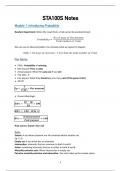
STA100S Notes
Module 1: Introducing Probability
Random Experiment: When the result from a trial cannot be predetermined.
𝑁𝑜. 𝑜𝑓 𝑤𝑎𝑦𝑠 𝑜𝑓 𝑡ℎ𝑒 𝑜𝑢𝑡𝑐𝑜𝑚𝑒
𝑃𝑟𝑜𝑏𝑎𝑏𝑖𝑙𝑖𝑡𝑦 =
𝑇𝑜𝑡𝑎𝑙 𝑛𝑢𝑚𝑏𝑒𝑟 𝑜𝑓 𝑡𝑟𝑖𝑎𝑙𝑠
We can use an observed pa7ern to conclude what we expect to happen
𝑂𝑑𝑑𝑠 = 𝑁𝑜 𝑤𝑎𝑦𝑠 𝑜𝑓 𝑜𝑢𝑡𝑐𝑜𝑚𝑒 ∶ 1 𝑙𝑒𝑠𝑠 𝑡ℎ𝑎𝑡 𝑡ℎ𝑒 𝑡𝑜𝑡𝑎𝑙 𝑛𝑢𝑚𝑏𝑒𝑟 𝑜𝑓 𝑡𝑟𝑖𝑎𝑙𝑠
Fair Game:
• P(W) : Probability of winning
• Bet amount: Price to play
• Actual payout: What they pay you if you win
• The E(X) = 0
• Fair payout: What they should pay you if you win (if the game is fair)
• AP<FP
𝟏
𝒇𝒑 = × 𝑩𝒆𝒕 𝒂𝒎𝒐𝒖𝒏𝒕
𝑷(𝑾)
• House Advantage:
𝒇𝒑 − 𝒂𝒑
𝑯𝑨% = × 𝟏𝟎𝟎
𝒇𝒑
𝑯𝑨% = 𝟏𝟎𝟎 − 𝑾𝒊𝒏 %
𝑨𝒄𝒕𝒖𝒂𝒍 𝒑𝒂𝒚𝒐𝒖𝒕
𝑾% = × 𝟏𝟎𝟎
𝑭𝒂𝒊𝒓 𝒑𝒂𝒚𝒐𝒖𝒕
Risk averse: Doesn’t like risk
Sets:
Subset: A set whose element are all contained within another set
Eg. CÌA
Empty set: A set which has no elements
Intersec?on: elements that are common to both A and B
Union: combining elements that are in either or both A and B
Mutually exclusive sets: When intersecKon is empty set
Pairwise mutually exclusive and exhaus?ve: Two sets make up the sample space
1
,Exhaus?ve: nothing in sample space
Complement: All elements that ae not in the set
NOTE!!!: Use a Venn diagram for these types of ques?ons.
Combinations and Permutations:
• PermutaKon: Arrangement of objects when Order maKers
• CombinaKon: Order doesn’t ma7er
• Arrangement: n! = number of arrangements with no repe??on
o If is repeKKon remove the repeKKon by dividing by number repe??ons
o If want things to be together you treat it as a single thing(remember to take
into consideraKon of swapping posiKons)
o When they are not supposed to be together you take:
𝐻𝑜𝑤 𝑚𝑎𝑛𝑦 𝑤𝑎𝑦𝑠 𝑐𝑎𝑛 𝑎𝑟𝑟𝑎𝑛𝑔𝑒(𝑛𝑜 𝑐𝑜𝑛𝑑𝑖𝑡𝑖𝑜𝑛𝑠) − 𝑊ℎ𝑒𝑛 𝑡ℎ𝑒𝑦 𝑎𝑟𝑒 𝑡𝑜𝑔𝑒𝑡ℎ𝑒𝑟
o If something needs to be in a specific posiKon say 1 x (n-1)!
• Permuta?on: nPr = number ways ordering r objects from n object with no repe??on
o Order ma7ers
o No Arrangements as there is only 1 correct answer
o Select in a specific order
• Combina?on: SelecKon + Arrangement
• Selec?on: nCr = number ways selecKng/choosing set r objects from n with no
repleKon
• nr= number of ways of arranging n objects taken r at a Kme with repe??on
Conditional Probability:
Use Tree Diagrams!! Don’t need Bayes Theorem
𝑃(𝐴 ∪ 𝐵) = 𝑃(𝐴) + 𝑃(𝐵) − 𝑃(𝐴 ∩ 𝐵)
!(#∩%) !(#∩%)
Condi?onal Probability: 𝑃(𝐴|𝐵) = !(%)
OR 𝑃(𝐵|𝐴) = !(#)
If have same condiKonal informaKon: 𝑃(𝐴|𝐵) = 1 − 𝑃(𝐴̅|𝐵)
Know that:
𝑃(𝐷) = 𝑃(𝐷|𝑆)𝑃(𝑆) + 𝑃(𝐷|𝑆̅)𝑃(𝑆̅)
2
,Independent Events:
Use Arrangements with Independent events!!
• 𝑃(𝐴 ∩ 𝐵) = 𝑃(𝐴) × 𝑃(𝐵)
• 𝑃(𝐴|𝐵) = 𝑃(𝐴)
Module 2: Graphical Data
NOTE!!: Mostly theory ques?ons with mul?ple choice
Graphs:
Pie Chart: Showing composiKon
Histogram: Showing quanKtaKve
Qualita?ve data: Categorical data(put into categories and can we counted)
Quan?ta?ve data: Count or a measure of data(interval or raKo)
Ordinal: ranked or ordered data
('()*+'(,-)
Interval Width: √-
Trend Line: linear regression of y=ax+b
Numerical summaries:
5 number summary:
• Min/ QuarKle 0
• Lower QuarKle 1
• Median/ QuarKle 2
• Upper QuarKle 3
• Max/ QuarKle 4
Some sta?s?cs that can be drawn:
• Median: Number in the middle (ascending or descending order) – 50% MARK
• Mean: Average of the data
• Mean=Median: The data is symmetrical
• Mean>Median: The data is skewed to the right/posiKvely skewed
• Mean<Median: The data is skewed to the lea/negaKvely skewed
3
,• Variance: How variable your data is
o high = data not close to mean, more outliers
o low = data close to mean, few or no outliers
o Range also indicated variance
• Lower Quar?le: The 25% mark for the data
• Upper Quar?le: The 75% mark for the data
• Regression: Tells us about the relaKonship between data
o R/Mul?ple R = -1<R<1
§ R = 1 : perfect posiKve correlaKon
§ 0.5<R<1 : strong posiKve
§ 0<R<0.5 : weak posiKve correlaKon
§ -0.5<R<0 : weak negaKve correlaKon
§ -1<R<-0.5 : strong negaKve correlaKon
§ R = -1 : perfect negaKve correlaKon
§ Determine if its +/- by looking at slope (y=ax+b)
2
o R = Represents the proporKon of the dependent variable that can be
explained by the independent variable (relaKonship between 2 variables)
• Regression Line: y = a + bx
o a = y intercept
o b = slope – if posiKve slants up ; if negaKve slopes down
§ Posi?ve or nega?ve rela?onship
• Standard devia?on: How far out data deviates from mean
• Strays: Median ± 3(Median – Lower/Upper QuarKle)
• Outliers: Median ± 6(Median – Lower/Upper QuarKle)
o Greater the difference between the mean and median the more outliers we
have
• Interquar?le Range: Upper - Lower
• Lower fence: Q1−1.5 × IQR
• Upper fence: Q1+1.5 × IQR
4
, Module 3: Discrete and Continuous Random Variables
Probability Mass Functions (Discrete):
If given a PMF use a TABLE!!
It will be given as either Formula or a Table
The general format for the table
X X1 X2 X3 X4
P(X=x) P1 P2 P3 P4
• P1+P2+P3+P4 = 1
• The Expected Value E(X) is the sum of all the probabiliKes Kmes x à
X1p1 +x2p2 +x3p3 … (This is also known as the mean or average)
• The Variance is the sum of all the probabiliKes Kmes 𝑥 / minus the E(X) squared à
𝒙𝟐 1p1 + 𝒙𝟐 2p2 … - (E(X))2 (If they ask for standard devia?on just square root √ )
Linear Combination of Random Discrete Variables:
• E(ax +by) = aE(X) + bE(Y)
• E(ax -by) = aE(X) - bE(Y)
• E(b) = b
• Var(ax±by) = 𝒂𝟐 𝑽𝒂𝒓(𝑿) + 𝒃𝟐 𝑽𝒂𝒓(𝒀)
o Workout in variance and then convert to standard deviaKon.
o Either decide to square or not
o Sums: (NOT Square)
§ Independent variables tell you not to square
§ If you have to figure out formula you may not square variance
§ eg. 20R = 20 rusks
o Mul?ples: (DO Square)
§ When you need to mulKply(constant mulKplied by variable) you do
square
§ If you are given the formula it is mulKple so you square
§ eg. Kg = 0.45(W))
• Var(b) = 0
5
Module 1: Introducing Probability
Random Experiment: When the result from a trial cannot be predetermined.
𝑁𝑜. 𝑜𝑓 𝑤𝑎𝑦𝑠 𝑜𝑓 𝑡ℎ𝑒 𝑜𝑢𝑡𝑐𝑜𝑚𝑒
𝑃𝑟𝑜𝑏𝑎𝑏𝑖𝑙𝑖𝑡𝑦 =
𝑇𝑜𝑡𝑎𝑙 𝑛𝑢𝑚𝑏𝑒𝑟 𝑜𝑓 𝑡𝑟𝑖𝑎𝑙𝑠
We can use an observed pa7ern to conclude what we expect to happen
𝑂𝑑𝑑𝑠 = 𝑁𝑜 𝑤𝑎𝑦𝑠 𝑜𝑓 𝑜𝑢𝑡𝑐𝑜𝑚𝑒 ∶ 1 𝑙𝑒𝑠𝑠 𝑡ℎ𝑎𝑡 𝑡ℎ𝑒 𝑡𝑜𝑡𝑎𝑙 𝑛𝑢𝑚𝑏𝑒𝑟 𝑜𝑓 𝑡𝑟𝑖𝑎𝑙𝑠
Fair Game:
• P(W) : Probability of winning
• Bet amount: Price to play
• Actual payout: What they pay you if you win
• The E(X) = 0
• Fair payout: What they should pay you if you win (if the game is fair)
• AP<FP
𝟏
𝒇𝒑 = × 𝑩𝒆𝒕 𝒂𝒎𝒐𝒖𝒏𝒕
𝑷(𝑾)
• House Advantage:
𝒇𝒑 − 𝒂𝒑
𝑯𝑨% = × 𝟏𝟎𝟎
𝒇𝒑
𝑯𝑨% = 𝟏𝟎𝟎 − 𝑾𝒊𝒏 %
𝑨𝒄𝒕𝒖𝒂𝒍 𝒑𝒂𝒚𝒐𝒖𝒕
𝑾% = × 𝟏𝟎𝟎
𝑭𝒂𝒊𝒓 𝒑𝒂𝒚𝒐𝒖𝒕
Risk averse: Doesn’t like risk
Sets:
Subset: A set whose element are all contained within another set
Eg. CÌA
Empty set: A set which has no elements
Intersec?on: elements that are common to both A and B
Union: combining elements that are in either or both A and B
Mutually exclusive sets: When intersecKon is empty set
Pairwise mutually exclusive and exhaus?ve: Two sets make up the sample space
1
,Exhaus?ve: nothing in sample space
Complement: All elements that ae not in the set
NOTE!!!: Use a Venn diagram for these types of ques?ons.
Combinations and Permutations:
• PermutaKon: Arrangement of objects when Order maKers
• CombinaKon: Order doesn’t ma7er
• Arrangement: n! = number of arrangements with no repe??on
o If is repeKKon remove the repeKKon by dividing by number repe??ons
o If want things to be together you treat it as a single thing(remember to take
into consideraKon of swapping posiKons)
o When they are not supposed to be together you take:
𝐻𝑜𝑤 𝑚𝑎𝑛𝑦 𝑤𝑎𝑦𝑠 𝑐𝑎𝑛 𝑎𝑟𝑟𝑎𝑛𝑔𝑒(𝑛𝑜 𝑐𝑜𝑛𝑑𝑖𝑡𝑖𝑜𝑛𝑠) − 𝑊ℎ𝑒𝑛 𝑡ℎ𝑒𝑦 𝑎𝑟𝑒 𝑡𝑜𝑔𝑒𝑡ℎ𝑒𝑟
o If something needs to be in a specific posiKon say 1 x (n-1)!
• Permuta?on: nPr = number ways ordering r objects from n object with no repe??on
o Order ma7ers
o No Arrangements as there is only 1 correct answer
o Select in a specific order
• Combina?on: SelecKon + Arrangement
• Selec?on: nCr = number ways selecKng/choosing set r objects from n with no
repleKon
• nr= number of ways of arranging n objects taken r at a Kme with repe??on
Conditional Probability:
Use Tree Diagrams!! Don’t need Bayes Theorem
𝑃(𝐴 ∪ 𝐵) = 𝑃(𝐴) + 𝑃(𝐵) − 𝑃(𝐴 ∩ 𝐵)
!(#∩%) !(#∩%)
Condi?onal Probability: 𝑃(𝐴|𝐵) = !(%)
OR 𝑃(𝐵|𝐴) = !(#)
If have same condiKonal informaKon: 𝑃(𝐴|𝐵) = 1 − 𝑃(𝐴̅|𝐵)
Know that:
𝑃(𝐷) = 𝑃(𝐷|𝑆)𝑃(𝑆) + 𝑃(𝐷|𝑆̅)𝑃(𝑆̅)
2
,Independent Events:
Use Arrangements with Independent events!!
• 𝑃(𝐴 ∩ 𝐵) = 𝑃(𝐴) × 𝑃(𝐵)
• 𝑃(𝐴|𝐵) = 𝑃(𝐴)
Module 2: Graphical Data
NOTE!!: Mostly theory ques?ons with mul?ple choice
Graphs:
Pie Chart: Showing composiKon
Histogram: Showing quanKtaKve
Qualita?ve data: Categorical data(put into categories and can we counted)
Quan?ta?ve data: Count or a measure of data(interval or raKo)
Ordinal: ranked or ordered data
('()*+'(,-)
Interval Width: √-
Trend Line: linear regression of y=ax+b
Numerical summaries:
5 number summary:
• Min/ QuarKle 0
• Lower QuarKle 1
• Median/ QuarKle 2
• Upper QuarKle 3
• Max/ QuarKle 4
Some sta?s?cs that can be drawn:
• Median: Number in the middle (ascending or descending order) – 50% MARK
• Mean: Average of the data
• Mean=Median: The data is symmetrical
• Mean>Median: The data is skewed to the right/posiKvely skewed
• Mean<Median: The data is skewed to the lea/negaKvely skewed
3
,• Variance: How variable your data is
o high = data not close to mean, more outliers
o low = data close to mean, few or no outliers
o Range also indicated variance
• Lower Quar?le: The 25% mark for the data
• Upper Quar?le: The 75% mark for the data
• Regression: Tells us about the relaKonship between data
o R/Mul?ple R = -1<R<1
§ R = 1 : perfect posiKve correlaKon
§ 0.5<R<1 : strong posiKve
§ 0<R<0.5 : weak posiKve correlaKon
§ -0.5<R<0 : weak negaKve correlaKon
§ -1<R<-0.5 : strong negaKve correlaKon
§ R = -1 : perfect negaKve correlaKon
§ Determine if its +/- by looking at slope (y=ax+b)
2
o R = Represents the proporKon of the dependent variable that can be
explained by the independent variable (relaKonship between 2 variables)
• Regression Line: y = a + bx
o a = y intercept
o b = slope – if posiKve slants up ; if negaKve slopes down
§ Posi?ve or nega?ve rela?onship
• Standard devia?on: How far out data deviates from mean
• Strays: Median ± 3(Median – Lower/Upper QuarKle)
• Outliers: Median ± 6(Median – Lower/Upper QuarKle)
o Greater the difference between the mean and median the more outliers we
have
• Interquar?le Range: Upper - Lower
• Lower fence: Q1−1.5 × IQR
• Upper fence: Q1+1.5 × IQR
4
, Module 3: Discrete and Continuous Random Variables
Probability Mass Functions (Discrete):
If given a PMF use a TABLE!!
It will be given as either Formula or a Table
The general format for the table
X X1 X2 X3 X4
P(X=x) P1 P2 P3 P4
• P1+P2+P3+P4 = 1
• The Expected Value E(X) is the sum of all the probabiliKes Kmes x à
X1p1 +x2p2 +x3p3 … (This is also known as the mean or average)
• The Variance is the sum of all the probabiliKes Kmes 𝑥 / minus the E(X) squared à
𝒙𝟐 1p1 + 𝒙𝟐 2p2 … - (E(X))2 (If they ask for standard devia?on just square root √ )
Linear Combination of Random Discrete Variables:
• E(ax +by) = aE(X) + bE(Y)
• E(ax -by) = aE(X) - bE(Y)
• E(b) = b
• Var(ax±by) = 𝒂𝟐 𝑽𝒂𝒓(𝑿) + 𝒃𝟐 𝑽𝒂𝒓(𝒀)
o Workout in variance and then convert to standard deviaKon.
o Either decide to square or not
o Sums: (NOT Square)
§ Independent variables tell you not to square
§ If you have to figure out formula you may not square variance
§ eg. 20R = 20 rusks
o Mul?ples: (DO Square)
§ When you need to mulKply(constant mulKplied by variable) you do
square
§ If you are given the formula it is mulKple so you square
§ eg. Kg = 0.45(W))
• Var(b) = 0
5


