Critical Thinking D265 WGU (Terms and Examples) questions and answers
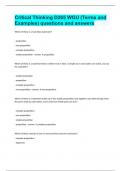
Which of these is a true/false statement? - proposition - non-proposition - complex proposition - simple proposition A proposition Which of these is a statement that is neither true or false, is simple (as in only makes one claim), and can be a question? - simple proposition - proposition - complex proposition - non-proposition A non-proposition Brainpower Read More Previous Play Next Rewind 10 seconds Move forward 10 seconds Unmute 0:00 / 0:15 Full screen Which of these is a statement made up of two simple propositions put together, uses internal logic (how the parts relate to each-other), and is only true if both parts are true? - complex proposition - non-proposition - simple proposition - proposition A complex proposition Which of these consists of one or more premises and one conclusion? - complex proposition - argument - non-argument - Fallacy An argument What is being referred to below? How propositions relate to each-other, usually indicated by these words (either/or, and, if/then) Internal logic What is being referred to below? A statement that supports a conclusion, introduces a proposition that provides evidence, a reasoning for an argument, or is indicated by these words (because, for, given that, as, since, as indicated by) A premise What term is indicated by these words? (Either/or, and, if/then) Internal Logic Indicators/independent statements What term do these words indicate ? (Because, for, given that, as, since, as indicated by) A premise What is being referred to below? A statement/claim supported by an arguments reasons, and is what is believed in the argument. Indicated by the words (Therefore, so, it follows that, thus, we may conclude that, as a result) A conclusion What term do these words indicate ? (Therefore, so, it follows that, thus, we may conclude that, as a result) A conclusion Which of these consists of a proposition without an argument being made, and includes explanations, stories, and statements that stand on their own? - argument - non-argument - complex proposition - inference A non-argument Which of these establishes a conclusion in a way that doubt or exceptions are not possible, and the premises/reasons provide evidence the conclusion must be true? - argument - inductive argument - non-argument - deductive argument A deductive argument Which of these contain premises/reasons which provide evidence that it's conclusion is (probably/likely) to be true? - argument - deductive argument - inductive argument - non-argument A inductive argument Which of these terms demonstrate when a conclusion follows from the premises/reasons, and is based off the structure of the argument and not about whether the statement is realistically true? - valid - sound - strong - uncogent A Valid argument Which of these relies on an argument being valid first, and then also having true premises? - valid - sound - strong - cogent A sound argument Which of these terms demonstrate when premises are true, and a conclusion is likely to be true, though not guaranteed, and provided sufficient evidence to lead us to conclude with confidence? - valid - sound - strong - weak A strong Argument Which of these relies on an argument being strong first, and then also having true premises? - sound - cogent - uncogent - strong A cogent argument What is the following an example of? All fruits are sweet. Tomatoes are fruit. Therefore tomatoes are sweet. A deductive argument What is the following an example of? It looks like a duck. It also quacks like a duck. Therefore, it probably is a duck. A inductive argument What is an argument that contains bad reasoning ? - weak argument - uncogent argument - fallacy - bias A fallacy What is an argument that contains an invalid structure, and occurs in deductive reasoning? - fallacy - formal fallacy - informal fallacy - invalid argument A formal fallacy What is an argument that contains bad content, and occurs in inductive reasoning? - fallacy - weak argument - informal fallacy - formal fallacy A informal fallacy
Written for
- Institution
- D265 WGU
- Course
- D265 WGU
Document information
- Uploaded on
- April 13, 2024
- Number of pages
- 21
- Written in
- 2023/2024
- Type
- Exam (elaborations)
- Contains
- Questions & answers
Subjects
-
critical thinking d265 wgu terms and examples

Also available in package deal