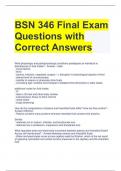
BSN 346 Final Exam Questions with Correct Answers
BSN 346 Final Exam Questions with Correct Answers What physiologic and pathophysiologic conditions predispose an individual to disturbances in fluid intake? - Answer-- habit - social factors - thirst - trauma, infection, neoplasia, surgery -- disruption in physiological signals of thirst - altered level of consciousness - inability to acquire or physically drink fluids - increasing age; cerebral osmoreceptor-mediated thirst diminishes in older adults additional routes for fluid intake: - IV - tube in GI tract and other body cavities - subcutaneous tissue or bone marrow - rectal intake - lungs (drowning) How do the compositions of plasma and interstitial fluids differ? How are they similar? - Answer-Different: - Plasma contains many proteins whereas interstitial fluid contains few proteins Similar: - relatively rich in sodium, chloride, and bicarbonate ions - relatively low in potassium, magnesium and phosphate ions What regulates water and electrolyte movement between plasma and interstitial fluids? Across cell membranes? - Answer-Between plasma and interstitial fluids: - Water and electrolytes move across capillary walls by filtration, which is the net result of opposing hydrostatic and colloid osmotic pressures in the capillary and the interstitial fluid Across cell membranes: - Water moves in and out of cells by osmosis, which is driven by unequal particle concentrations on the two sides of the semipermeable cell membrane - Electrolytes move across cell membranes through membrane channels or ion pumps What are the usual and pathologic routes of fluid exit from the body? - Answer-Usual: - urinary tract - bowels - lungs - skin Pathologic: - emesis (vomiting) - tubes in GI tract or other body cavities - hemorrhage - drainage from fistulas, wounds, or open areas of the skin - paracentesis (the perforation of a cavity of the body or of a cyst or similar outgrowth, especially with a hollow ne
Document information
- Uploaded on
- April 12, 2024
- Number of pages
- 25
- Written in
- 2023/2024
- Type
- Exam (elaborations)
- Contains
- Questions & answers