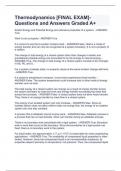
Thermodynamics [FINAL EXAM]-Questions and Answers Graded A+
Thermodynamics [FINAL EXAM]-Questions and Answers Graded A+ Kinetic Energy and Potential Energy are extensive properties of a system. - ANSWER-True Work is not a property - ANSWER-True It is correct to say that a system contains heat. - ANSWER-False. Heat is a mode of energy transfer and can only be recognized at a system boundary. It is not a property of a system. The change in total energy of a closed system other than changes in kinetic and gravitational potential energy are accounted for by the change in internal energy. - ANSWER-True. The change in total energy of a closed system consists of the changes in KE, PE, and U. For a system at steady state, no property values at the same location change with time. - ANSWER-True. If a system's temperature increases, it must have experienced heat transfer. - ANSWER-False. The system temperature could increase due to other mode of energy transfer such as work. The total energy of a closed system can change as a result of energy transfer across the system boundary by heat and work and energy transfer accompanying mass flow across the boundary. - ANSWER-False. A closed system does not allow mass transfer. Thus, there is no energy transfer by mass flow in a closed system. The energy of an isolated system can only increase. - ANSWER-False. Since an isolated system does not allow neither mass nor energy flow, the energy of an isolated system can only stay constant. A process that is adiabatic cannot involve work. - ANSWER-False. Adiabatic process is a process that has no heat transfer. Work can transfer during an adiabatic process. There is no boundary work associated with a rigid system. - ANSWER-True. Boundary work is work that occurs at the boundary. Since the boundaries of a rigid system are fixed, there is no boundary work in the system. For liquid water, the approximation v (T, p) = Vf (T) is reasonable for many engineering applications. - ANSWER-True. The availability of compressed liquid properties is often limited. However, since the compressed liquid is an incompressible substance, its properties depend primarily on temperature, not pressure. Thus, the compressed liquid properties can be approximated to the properties of a saturated liquid at the given temperature.
Written for
- Institution
- Thermodynamics
- Course
- Thermodynamics
Document information
- Uploaded on
- April 10, 2024
- Number of pages
- 10
- Written in
- 2023/2024
- Type
- Exam (elaborations)
- Contains
- Questions & answers
Subjects
- zeroth law
- entropy
- isolated system
- closed system
- adiabatic boundary
- isothermal process
-
thermodynamics final exam questions and answers
-
kinetic energy and potential energy
-
first law of thermodynamics

Also available in package deal