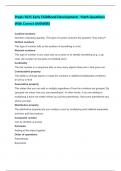
Praxis 5025 Early Childhood Development - Math Questions
With Correct ANSWERS
Cardinal numbers
Numbers indicating quantity. This type of number answers the question "how many?"
Ordinal numbers
This type of number tells us the position of something in a list.
Nominal numbers
This type of number is one used only as a name or to identify something (e.g. a zip
code, the number on the back of a football shirt.)
Cardinality
The last number in a sequence tells us how many objects there are in that given set.
Commutative property
The ability to change places or swap the numbers in addition/multiplication problems.
5+4=9 or 4+5=9
Associative property
This states that you can add or multiply regardless of how the numbers are grouped. By
'grouped' we mean 'how you use parenthesis'. In other words, if you are adding or
multiplying it does not matter where you put the parenthesis. Add some parenthesis any
where you like!.
Distributive property
The distributive property lets you multiply a sum by multiplying each addend separately
and then add the products.
Composite number
Can be divided up evenly
Perimeter
Adding all the sides together
Order of operations
Parentheses
Exponents
, Multiplication
Division
Addition
Subtraction
Area
Base x Height
For a triangle use half of base.
mixed number
This has an integer part and fractional part
exponent form
A shorthand way of writing a repeated multiplication
exponent
How many times the base is multiplied by itself
greatest common factor
the largest number that is a factor of all the numbers in a problem
least common multiple
the smallest number of a group of numbers that all the given numbers will divide into
evenly
prime numbers
whole numbers greater than 1 that only have two factors: 1 and the number itself
composite numbers
whole numbers that have more than two different factors
terminating decimal
a decimal that has a fixed number of digits
repeating decimal
a decimal that has a fixed number of digits
acute triangle
a triangle angles all less than 90 degrees
Obtuse triangle
A triangle with angles all greater than 90 degrees.
isosceles triangle
With Correct ANSWERS
Cardinal numbers
Numbers indicating quantity. This type of number answers the question "how many?"
Ordinal numbers
This type of number tells us the position of something in a list.
Nominal numbers
This type of number is one used only as a name or to identify something (e.g. a zip
code, the number on the back of a football shirt.)
Cardinality
The last number in a sequence tells us how many objects there are in that given set.
Commutative property
The ability to change places or swap the numbers in addition/multiplication problems.
5+4=9 or 4+5=9
Associative property
This states that you can add or multiply regardless of how the numbers are grouped. By
'grouped' we mean 'how you use parenthesis'. In other words, if you are adding or
multiplying it does not matter where you put the parenthesis. Add some parenthesis any
where you like!.
Distributive property
The distributive property lets you multiply a sum by multiplying each addend separately
and then add the products.
Composite number
Can be divided up evenly
Perimeter
Adding all the sides together
Order of operations
Parentheses
Exponents
, Multiplication
Division
Addition
Subtraction
Area
Base x Height
For a triangle use half of base.
mixed number
This has an integer part and fractional part
exponent form
A shorthand way of writing a repeated multiplication
exponent
How many times the base is multiplied by itself
greatest common factor
the largest number that is a factor of all the numbers in a problem
least common multiple
the smallest number of a group of numbers that all the given numbers will divide into
evenly
prime numbers
whole numbers greater than 1 that only have two factors: 1 and the number itself
composite numbers
whole numbers that have more than two different factors
terminating decimal
a decimal that has a fixed number of digits
repeating decimal
a decimal that has a fixed number of digits
acute triangle
a triangle angles all less than 90 degrees
Obtuse triangle
A triangle with angles all greater than 90 degrees.
isosceles triangle