BUILDING UTILITIES EXAM QUESTIONS WITH 100% CORRECT ANSWERS 2024
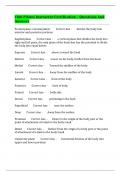
BUILDING UTILITIES EXAM QUESTIONS WITH 100% CORRECT ANSWERS 2024 dug, bored driven or drilled (ground water) - answerwell shaft is excavated and installed with casing ; shallow construction. - answerdug well a hole is bored with hand or machine driven auger. - answerbored well a pipe is driven equipped with a well point by means of a maul or pile driver - answerdriven wells a hole is made by a drilling machine installing casing or screen - answerdrilled wells level of service: point source; protected well developed spring with outlet but w/o distribution system; adaptable for rural areas; serves an average of 15 households - answerlevel i level of service: communal faucet system or stand post; a system composed of a source, a reservoir, a piped distribution network and communal faucets. one faucet serves 4- 6 households; for rural and urban fringed areas. - answerlevel ii level of service :( water works system of individual house connection); system with a source , a reservoir , piped distribution network and house hold taps for densely populated area. - answerlevel iii referred to as "watershed protection" - answersource water protection not the most effective water treatment method. - answerdilution water treatment method. where in coagulants and filter are mixed in the water to make fine particles stick together to form bigger particles that can better settle out or be filtered out more effectively. - answercoagulation and flocculation water treatment method used for facilities treatment water containing lots of solids, settling or sedimentation is a common treatment step. this process slows down the flow of water so the heavier items can settle to the bottom. - answersettling water treatment method where in water will flow through a material that remove particles , organisms and contaminants. - answerfiltration water treatment method used prior to filtration. chemical process using chlorine, chloramines, ozone etc. - answerdisinfection added to water to adjust its hardness and softness, ph and alkalinity. - answerother chemical treatments. the water that s passing or standing in or passing through the ground. - answergroundwater impairment of the quality of the potable water. - answercontamination satisfactory for drinking , culinary and domestic purposes. - answerpotable water what is the level of hazard for water contamination - answerhigh hazard what is the level of hazard for water pollution - answerlow hazard portion of rainfall or other precipitation which runs off over the surface of ground. - answersurface water a geological formation containing ground water - answeracquifer a well in which water rises under pressure from a permeable stratum over laid by impermeable rock. - answerartesian well a reservoir or tank for storing or holding water. - answercistern a conduit or artificial channel from a remote source. constructed by romans to carry a water channel across a valley or river. - answeraqueduct a tower into which water is pump to a height sufficient to maintain a desired pressure for distribution to costumers. - answerwater tower a pipe or conduit through which a public or community water system conveys water to all services. - answerwatermain a valve controlling the flow of water or gas from a main service pipe . - answercorporation stop or corporation cock control valve shutting off the water supply to a building case of an emergency, installed in water service pipe and operated by means of long key inserted through a curb box. - answercurb cock or curb stop a pipe connecting to a water or gas main, usually installed by or under the jurisdiction of a public utility ( water service) 3/4" - answerservice pipes any valve for shutting off the flow of water from a gas pipe. - answershut off valve a device used to measuring and recording the quantity of water that passes through a pipe. - answerwater meter a pipe which conveys potable water from building supply pipe to the plumbing fixtures and other water outlets. - answerwater distributing pipe a device for controlling the flow of a liquid from a pipe opening or closing an orifice. - answerfaucet principal artery of the system to which branches may be connected. - answermain the pipe from street water main or source of water supply to building served. - answerservice pipe other than the main, riser or stack - answerbranch storey height, not less than 8feet/ 2.43m, within which the horizontal branches from one floor or storey of a building are connected to the stack. - answerbranch interval a branch drain extending laterally from a soil or waste stack. with or without section of branches. - answerhorizontal branch the supply pipe between the fixture and the water distribution pipe. - answerfixture branch water supply pipe connecting the fixture with the fixture branch. - answerfixture supply a water supply pipe that extends verticallyone storey or more - answerriser faucet or cock - answerbibb the end pf a pipe which fits into a bell ( synonymous to - answerspigot minimum cross sectional area at the point of water supply discharge measured or expressed in terms of diameter of a circle . - answereffective opening the level in a fixture at which the water begins to over flow the top or rim of a fixture. - answerflood level c/l marking on a back flow prevention device or vacuum breaker (point conforming to approved standards and established by testing laboratory) determines the minimum flood level rim of fixture. - answercritical level top edge of receptacle - answerflood level rim when liquid rises to flood level rim - answerflooded the normal face force exerted by a homogeneous liquid or gas, per unit area on the wall or container. - answerpressure
Written for
- Institution
- BUILDING UTILITIES
- Course
- BUILDING UTILITIES
Document information
- Uploaded on
- April 9, 2024
- Number of pages
- 33
- Written in
- 2023/2024
- Type
- Exam (elaborations)
- Contains
- Questions & answers
Subjects
-
building utilities exam questions with 100 correc

Also available in package deal