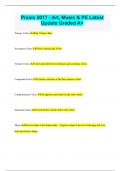
Praxis 5017 - Art, Music & PE Latest Update Graded A+ Primary Colors ✔✔Red, Yellow, Blue Secondary Colors ✔✔Green, Orange and Violet Tertia ry Colors ✔✔Colors that fall between primary and secondary colors Compound Colors ✔✔Contain a mixture of the three primary colors Complimentary Colors ✔✔lie opposite each other on the color wheel. Saturated Colors ✔✔lie around the outside of the color w heel Shape ✔✔Positive shape is the shape made ... Negative shape is the rest of the page left over from the positive shape Form ✔✔The total structure ... all elements independent of their meaning Texture ✔✔rough, smooth, soft, hard and glossy. Can be ph ysical (felt with the hand) or visual (illusion of texture). Art Early Grades ✔✔drawing, paining, designing, constructing crafts, sculpting, weaving, finger painting and a bit of styrofoam carving. Art Grades 3 -5 ✔✔work further with drawing, painting, designing, constructing crafts and sculpting and should start new techniques like printmaking, sponge painting, graphics, film animation and environmental design. Art Upper -Elementary Grades ✔✔Add medi a and techniques and jewelry making and intaglio. Art Materials for elementary grades ✔✔scissors, wet and dry brushes, fabrics, wrapping paper, film, computers, clay, glue, styrofoam, construction paper, crayons, beads and more Goals of Art ✔✔*Developing Aesthetic Perception
Tentamen (uitwerkingen)
Praxis 5017 - Art, Music & PE Latest Update Graded A+
Beoordeling
Verkocht
-
Pagina's
11
Cijfer
A+
Geüpload op
08-04-2024
Geschreven in
2023/2024
Praxis 5017 - Art, Music & PE Latest Update Graded A+ Primary Colors Red, Yellow, Blue Secondary Colors Green, Orange and Violet Tertiary Colors Colors that fall between primary and secondary colors Compound Colors Contain a mixture of the three primary colors Complimentary Colors lie opposite each other on the color wheel. Saturated Colors lie around the outside of the color wheel Shape Positive shape is the shape made ... Negative shape is the rest of the page left over from the positive shape Form The total structure ... all elements independent of their meaning Texture rough, smooth, soft, hard and glossy. Can be physical (felt with the hand) or visual (illusion of texture). Art Early Grades drawing, paining, designing, constructing crafts, sculpting, weaving, finger painting and a bit of styrofoam carving. Art Grades 3-5 work further with drawing, painting, designing, constructing crafts and sculpting and should start new techniques like printmaking, sponge painting, graphics, film animation and environmental design. Art Upper-Elementary Grades Add media and techniques and jewelry making and intaglio. Art Materials for elementary grades scissors, wet and dry brushes, fabrics, wrapping paper, film, computers, clay, glue, styrofoam, construction paper, crayons, beads and more Goals of Art *Developing Aesthetic Perception *Providing opportunities to examine many art forms of both natural and human in form *Providing opportunities to reflect on and discuss observations and reactions *Providing opportunities to develop and extend their own art abilities *Providing opportunities to identify symbols and characteristics of art, objects of arts, and natural art forms. * Increasing awareness of tactile art * Fostering the ability to select and enjoy arts (natural and human made) * Promoting the ability to analyze and enjoy forms based on informed judgements. Critiquing a work of art using vocabulary appropriate for description, analysis interpretation and evaluation students should be able to describe a work of art using terms like line, color, value, shape, balance, texture, repetition and rhythm should be able to discuss some major periods in the history of the visual arts should be able to confront a work and judge its aesthetic merits, regardless of their ability to recognize it from memory. Questions to ask/answer while critiquing works of art "What is the purpose of the work? Religious? Entertainment? Philosophical? Emotional? Didactic? Pure form? Social or political commentary? To what culture does it belong, and to what geographical region and period? How does it reflect that context? Is its origin and/or function popular or commercial? Does it derive organically from the needs or celebratory functions of a community, or is it a self0conscious artistic creation of one individual? What style is it in? baroque? classical? romantic? influenced by ethnic or popular music? Style artist's manner of expression art movement group of artists during a period (usually months, years or decades) have a common style Evaluate Works of Art Does the work achieve its purpose? Has the artist spoken with a unique voice, rgardless of style, or could this artwork just as easily be the work of someone else? Is the style appropriate to the expressed purpose of the work? Is the work memorable and distinctive?
Meer zien
Lees minder
Instelling
Praxis 5017 - Art, Music & PE
Vak
Praxis 5017 - Art, Music & PE
Oeps! We kunnen je document nu niet laden. Probeer het nog eens of neem contact op met support.
Geschreven voor
- Instelling
- Praxis 5017 - Art, Music & PE
- Vak
- Praxis 5017 - Art, Music & PE
Documentinformatie
- Geüpload op
- 8 april 2024
- Aantal pagina's
- 11
- Geschreven in
- 2023/2024
- Type
- Tentamen (uitwerkingen)
- Bevat
- Vragen en antwoorden
Onderwerpen
-
praxis 5017 art music pe latest update grade
Voorbeeld van de inhoud
$9.99
Krijg toegang tot het volledige document:
100% tevredenheidsgarantie
Direct beschikbaar na je betaling
Lees online óf als PDF
Geen vaste maandelijkse kosten

Ook beschikbaar in voordeelbundel
Voordeelbundel
Praxis 5017 Bundled Exams Questions and Answers Latest Versions (2024/2025) Already Passed
7
2024
$ 71.93
Meer info